
具体描述
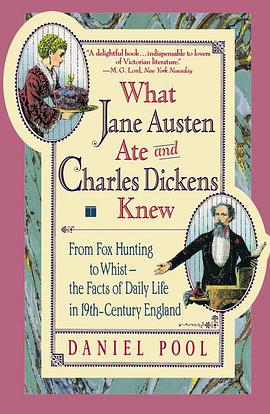
Dozens of short essays provide a panoramic view of British life during the nineteenth century, including information on social niceties, definitions of British phrases, and details about sex, government, law, money, and social institutions.
From Publishers Weekly
Devotees of Austen, Dickens, the Brontes and the like will enjoy this overview of everyday English life in the era depicted by that nation's greatest novelists. As an aid for readers of vintage fiction, Pool, a lawyer turned freelance writer, has compiled more than 60 short chapters that cover the public, private and "grim" aspects of life in 19th-century England, appending a long glossary and a bibliography. Beyond his lucid presentation of the historical facts, Pool offers a series of intriguing narratives: tracing the evolution of the hunt, for example, and explaining the persistence of grave robbers. Frequent references to well-known novels help elucidate institutions, customs and practices that have for the most part lapsed into obscurity. At times, these constant examples become monotonous; but fans of the English novel, even if they have a low tolerance for secondhand Trollope, will want to have this useful volume at hand.
From Library Journal
This guide to daily life in 19th-centuryEngland is a welcome companion for readers of Austin, the Brontes, Dickens, and Trollope. The first section is a collection of engrossing short chapters on various aspects of British life, including clothing, etiquette, marriage, money, occupations, society, and transportation. For example, customs now lost but very much practiced at the time were primogeniture, which ensured that the great family houses would not be split up, and the avoidance of eating cheese by the middle class, who considered it a food for the poor. The second part of the book is a glossary of commonly used words or phrases that may be unfamiliar to the modern reader; for instance, tar was a colloquial name for a sailor. Although there are many books on the social history of 19th-century Britain (including several companions to Victorian fiction), this volume is useful because of its concise chapters and lengthy glossary. Recommended for general literature collections.
From Kirkus Reviews
An eccentric collection of brief essays (plus a glossary) that explains not the facts but the fictions of English life, as they were represented by writers such as Hardy, Trollope, Dickens, and Jane Austen. To provide an understanding of the life portrayed in 19th- century English novels, Pool focuses primarily on economic and social issues; the era's money, calendar (holidays, terms, reigns), and measurements; and geography. The ``public world'' of the era, he explains, consisted of titles, forms of address, various ranks in status and the etiquette associated with them, dinner parties, card games, presentations at court, social ``seasons,'' and balls- -from whom to invite to what to wear, to why wax dripping from overhead chandeliers on to guests was perilous. Pool--often sounding like the annotator of a Jane Austen text--explains the country-house visit; the contemporary definition of wealth; ways to protect one's estate--or to lose it; Parliament; the Church; the navy; universities; law, lawyers, and criminals. A section on ``transition'' discusses the roles of horses, coaches, railroads, and the mail, and is followed by essays on country life (hunting, farms, fairs) and on domesticity (marriage, sex, divorce, furniture, lighting, bathing, food--including puddings, oysters, and gruel--and drink, fashion, and servants). Pool winds up with the ``grim world'' of orphans, work, poverty, disease, and death, while a glossary explains names such as Wellington and Westminster, and terms such as ``wet nurse'' and ``whalebone.'' Not history per se but a period piece--a reproduction of the idealizations and stereotypes that appeared in fiction, many of which were well explained in context. Superficial but charming--in effect, a handbook on how to live as if one were a character in a 19th-century English novel.
作者简介
目录信息
Part One
The Basics
Currency
The Calendar
Hogsheads and Drams: English Measurement
England
London
The Public World
Precedence: Of Bishops, Barristers, and Baronets
The Titled
How to Address Your Betters
Esq., Gent., K.C.B., etc.
Status: Gentlemen and Lesser Folk
Society
The Major Rituals
Money
Power and the Establishment
Transition
The Horse
Please, James, the Coach
The Railroad
The Mail
The Country
Life on the Farm
The Midlands, Wessex, and Yorkshire
Who's Who in the Country
Shire and Shire Alike: Local Government in Britain
"The Theory and System of Fox Hunting"
Vermin, Poachers, and Keepers
Fairs and Markets
The Private World
"Reader, I Married Him"
Sex
An Englishman's Home
Houses with Names
Furniture
Lighting
How the English Kept Clean
"Please, Sir, I Want Some More."
Pudding!
Tea
Drink and the Evils Thereof
Women's Clothing
Men's Clothing
Servants
The Governess
A Taxonomy of Maids
Victorian Recycling
The Grim World
The Orphan
Occupations
Apprentices
The Workhouse
Disease
Doctors
Death and Other Grave Matters
Part Two
Glossary
Bibliography
Index
· · · · · · (收起)
读后感
用户评价
我必须承认,一开始我对这类题材是有些犹豫的,总觉得历史题材的书籍可能会过于枯燥乏味,充斥着晦涩的术语和冗长的背景介绍。然而,这本书完全颠覆了我的固有印象。它行文流畅,语言风格活泼而不失严谨,就像是与一位学识渊博又风趣幽默的朋友在闲聊,娓娓道来那些尘封已久的往事。它巧妙地将宏大的历史叙事与微观的个人生活编织在一起,使得那些历史人物不再是教科书上冰冷的符号,而是一个个有血有肉、有情感、有烦恼的“人”。书中对当时社会思潮和文化现象的探讨,也显得尤为深刻,它没有高高在上的说教感,而是通过生动的案例和引人入胜的叙述,引导读者自己去思考和判断。读完之后,我感觉自己的知识边界被极大地拓宽了,对那个时代的理解也更加立体和人性化。这绝对是一本值得反复品味,并在不同人生阶段都能读出新意的佳作。
评分说实话,我刚开始翻开这本书时,被其厚度吓了一跳,担心阅读体验会像啃硬骨头一样费劲。但事实证明,我的担忧完全是多余的。这哪里是啃书,分明是享受一场丰盛的下午茶点心盛宴!作者的文笔功力深厚,尤其擅长运用幽默和反讽的笔调,为严肃的历史题材注入了轻松活泼的灵魂。很多地方,我都被逗得忍不住笑出声来,那种笑声中带着对世事洞明的释然和对作者机智的赞叹。它成功地做到了寓教于乐的最高境界——在不牺牲学术深度的前提下,将阅读变成了一种纯粹的享受。这种轻松愉悦的阅读感,对于那些渴望了解历史但又害怕“大部头”的读者来说,无疑是一个福音。它像一盏温暖的灯,照亮了过去的生活,让历史不再是冰冷的文献,而是鲜活的记忆。
评分这部作品给我带来的最大震撼,在于它对“时间流逝”这一主题的深刻探讨。虽然书本聚焦于一个特定的时代,但其中所蕴含的关于变化、永恒与短暂的哲学思考,却是跨越时空的。作者仿佛是一位技艺高超的钟表匠,不仅展示了那个时代机械的精确运作,更让我们看到了滴答声背后所承载的生命重量。我读到某些场景时,会油然而生一种“物是人非”的苍凉感,但随之而来的是对生命韧性的敬畏。它引导我们反思,在科技飞速发展的今天,我们是否已经失去了某些那个时代的人们所珍视的、慢节奏下的美好事物。这本书的后劲很足,合上封面之后,思绪久久不能平复,它强迫你慢下来,去审视自己与周遭世界的联系。这是一次精神上的洗礼,而非仅仅是一次信息获取的过程。
评分这部书简直是一场穿越时空的盛宴!作者以极其细腻的笔触,描绘了十九世纪英国社会生活的方方面面,那种氛围感扑面而来,仿佛你正坐在雾气蒙蒙的伦敦街头,耳边是马车的辘辘声和叫卖声。我尤其喜欢他对日常细节的捕捉,那些关于食物、服饰甚至家居陈设的描写,都充满了历史的厚重感和生活的烟火气。你读着读着,就会不自觉地代入角色,想象着当时的人们是如何度过他们的下午茶时光,或者在舞会上是如何交际应酬的。书中对不同阶层人物的刻画入木三分,贵族的虚伪与小市民的精明,都被展现得淋漓尽致,让人在赞叹那个时代精致的同时,也对其刻板的等级制度感到一丝压抑。这本书的阅读体验是沉浸式的,它不仅仅是讲述故事,更像是一部活生生的社会风俗百科全书,让你在享受阅读乐趣的同时,对那个遥远的年代有了更真切的感知。那种对生活的热爱和对人性幽微之处的洞察,使得即便是对历史不甚了解的读者,也能被深深吸引。
评分这本书的结构设计非常精妙,它像一个巧妙的迷宫,每一章的转折都出乎意料,却又在情理之中。作者显然花费了大量心血进行考据,但所有的资料都完美地融入了叙事之中,没有丝毫的堆砌感。我特别欣赏它在叙事节奏上的掌控力,时而紧凑激烈,仿佛置身于一场关键的社交对峙;时而又舒缓悠长,聚焦于一次内心独白或一段宁静的乡间漫步。这种张弛有度的节奏感,让我的阅读过程始终保持着高度的专注。更妙的是,作者在处理人物关系时,那种微妙的张力处理得炉火纯青,那些未言明的思绪、试探性的眼神交流,都通过精炼的文字被精准地捕捉,让读者在心照不宣中体会到人际交往的复杂与乐趣。我甚至觉得,这本书在某种程度上提供了一种解读现代人际关系的“密码”——因为人性的核心变化似乎并不大。
评分 评分 评分 评分 评分