
具体描述
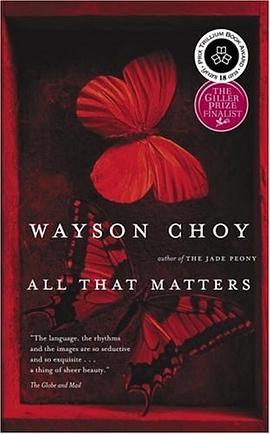
Kiam-Kim is three years old when he arrives by ship at Gold Mountain with his father and his grandmother, Poh-Poh, the Old One. It is 1926, and because of famine and civil war in China, they have left their village in Toishan province to become the new family of Third Uncle, a wealthy businessman whose own wife and son are dead. The place known as Gold Mountain is Vancouver, Canada, and Third Uncle needs help in his large Chinatown warehouse. Canada’s 1923 Chinese Exclusion Act forces them, and many others, to use false documents, or ghost papers, to get past the ‘immigration demons’ and become Third Uncle’s Gold Mountain family.
This is the beginning of All That Matters, the eagerly anticipated sequel to Wayson Choy’s bestselling first novel, The Jade Peony. The author takes us once again to the Vancouver of the 1930s and 1940s to follow the lives of the Chen family, this time through the experiences of First Son, Kiam-Kim, whose childhood and adolescence in a strict but caring Chinatown family is at once strange and familiar to us.
Like many families around them, they must survive in unsavoury surroundings. Since the closing down of the railroad work camps, Chinatown is filled with unemployed labourers who live in poor rooming-houses. Sea winds fill the rooms with acrid smoke from the mills and refineries of False Creek, and freight trains shake their windows at night with noises the Old One says are dragons playing. Yet this is a land where the Chen family will not starve; where they will be able to keep a girl baby, and not sell her into servitude as was the Old One, whose back is scarred from whippings.
In their new life, however, there is a constant struggle to balance the new Gold Mountain ideas with the old traditions and knowledge of China. Old One doesn’t like Kiam-Kim to speak English, and Kiam-Kim knows that to be without manners, without a sense of correct social ritual, is to bring dishonour to one’s family. Children who lose their ‘Chinese brains’ are called ‘bamboo stumps’ by the elders because of the hollow emptiness within, so Kiam-Kim must study hard at Chinese school as well as English school. He must help Poh-Poh to cook for her mahjong ladies, and her hard knuckles rap his head when he misbehaves.
Although Poh-Poh urges him to stick with his own kind and not let non-Chinese ‘barbarians’ into the house, Kiam-Kim forges a lasting friendship with Jack O’Connor, the Irish boy next door. He also has a girlfriend, Jenny, daughter of one of the mahjong ladies who owns a corner grocery shop. Meanwhile, China is suffering during the Japanese invasion of Manchuria, and soon the whole world is at war. Boys at school are enlisting, and many Chinese have gone back to fight for the old country. Kiam-Kim wonders, “What world would we fight for?” Canada is his home, yet he knows that the new country does not want Chinese soldiers.
The Jade Peony, was “a genuine contribution to history as well as fiction” according to author Margaret Drabble. It spent 26 weeks on the Globe and Mail bestseller list, shared the 1995 Trillium Award with Margaret Atwood, and won the Vancouver Book Award. Blending rich historical detail with powerful personal stories, All That Matters follows Kiam-Kim as he learns the responsibilities and rewards of family and community, as he approaches adulthood in a city much divided, and as he faces decisions about what truly matters in life. More than anything else, the novel is an exploration of his character. “I think all stories should arise organically from the characters’ definitions of the world,” says Wayson Choy, who believes that it is in the identification of reader with character that literature exists. “If you give details that ring true...that’s the meaning conveyed by good writing.”
From the Hardcover edition.
作者简介
目录信息
读后感
用户评价
坦白讲,这本书的某些部分读起来令人感到非常“不适”,但正是这种不适感,才让我意识到它的价值所在。它毫不留情地撕开了现代社会中关于“成功”和“幸福”的那些镀金外衣,直指核心的空洞。作者似乎对人性的弱点有着一种近乎病态的敏锐,尤其是在探讨“连接”与“孤独”的关系时。我们生活在一个被信息碎片包围的时代,每个人都在试图通过社交网络证明自己的存在感,而这本书则冷静地指出,这种努力往往只会加剧深层的隔离。它描绘的那些人物,都在努力地在人群中“表演”,却鲜少有人真正地“在场”。我为书中主角在面对选择时的那种进退维谷感到揪心,那不是善恶的选择,而是两种不同程度的妥协。这本书的结构也很有意思,它没有明确的主线,更像是多条支流最终汇入一个巨大的、令人不安的湖泊。它要求读者进行极高的主动参与,你必须自己去填补那些留白的逻辑跳跃,去感受那些未被言明的情绪张力。这是一次对阅读者心智的挑战,而不是一种安逸的消遣。
评分这本书的文学质感达到了一个令人惊叹的高度,其语言的密度和精确性,让我不得不反复回味每一个句子。它处理“记忆”的方式,颠覆了我以往的认知。作者认为,记忆并非是过去的录像带,而更像是一种不断被重塑的、具有高度主观能动性的“创造物”。书中通过一个跨越数代人的家族故事,展示了历史是如何被不同叙事者选择性地遗忘和强调的。我记得有一个章节,讲述了关于一个老物件的描述,仅仅是关于这个物件的材质和它在光线下的反射角度,就花了将近十页的篇幅,但读完后,你却能理解那个物件对于特定人物的情感重量——那种细致入微的描写,将物质世界提升到了形而上的层面。这本书的观点是复杂的,它拒绝二元对立,它展示了爱与伤害往往是同一枚硬币的两面,而我们终其一生都在学习如何区分和平衡它们。我喜欢它对“道德模糊地带”的探索,它没有提供道德审判,而是提供了一个让我们得以站在高处,观察人性挣扎的平台。
评分这本书简直是精神世界的指南针,它没有直接给我任何现成的答案,反而像是一个经验丰富的向导,领着我在人生的迷雾中探索。我特别欣赏作者处理复杂议题的方式,那种深入骨髓的洞察力,仿佛能穿透事物表象直达本质。比如,在探讨“意义”的构建时,它没有落入僵硬的哲学说教,而是通过一系列富有张力的生活片段,展现了不同个体如何在破碎中寻找完整。阅读的过程中,我时常停下来,合上书本,陷入沉思,思考着自己那些未曾被正视的执念与渴望。它提醒我,很多我们以为重要的东西,在宏大的时间尺度下,不过是转瞬即逝的尘埃,而真正值得我们倾注心力的,往往是那些微小却持久的情感联结与内在的诚实。这本书的语言是沉静而有力的,像深海中的暗流,不动声色地改变着你的航向。它不是一本读完就可以束之高阁的书,更像一位老友,在你迷茫时会不时地跳出来,用它特有的方式轻推你一把,让你重新审视脚下的路。它的力量在于,它激发了我们自己去提问、去感受、去构建属于自己的价值体系,而不是被动地接受任何既定的教条。这本书的厚重感并非来自篇幅,而是来自它所承载的思想重量。
评分如果用一个词来形容阅读这本书的体验,我会选择“震撼的平静”。它不像那些情节跌宕起伏的小说那样提供即时的满足感,它的影响是潜移默化的,在阅读结束后的好几天里,我还在不断地消化它所抛出的那些深刻议题。这本书在讨论“真实性”时,采用了非常先锋的手法。它不断地在小说叙事和哲学思辨之间切换,有时甚至会打破“第四面墙”,让书中的角色直接对读者发问。这使得阅读体验变得极其个人化和反思性。我发现自己对书中一些看似随意的对话片段产生了强烈的共鸣,因为它们精准地捕捉到了日常交流中那些“话未尽,意已明”的瞬间。这本书的节奏感是大师级的,它知道何时该加速,何时该放缓,从而将读者的情绪牢牢地控制在作者设定的轨道上。它最终指向的,不是一个宏大的、普适性的结论,而是个体面对自身局限时所能达到的最深沉的理解和接纳。这本作品,无愧于其沉甸甸的分量,它改变了我看待“努力”和“接受”之间关系的方式。
评分初读这本作品时,我差点被它那近乎散文诗般的行文风格劝退。它的叙事节奏极其缓慢,大量篇幅用于描绘环境和人物的内心波动,仿佛作者故意设置了重重障碍,考验读者的耐心。然而,一旦你适应了这种“慢热”的节奏,你会发现其中蕴藏着惊人的能量。它处理“失落”这一主题的手法尤为高明。作者没有渲染戏剧性的冲突,而是用近乎冷酷的精准,剖析了“失去”在个体生命中留下的微妙空隙。那种感觉就像是你的房间少了一件家具,一开始你没注意,但日复一日,你总会在不经意间朝着那个空位走去,那里的一切都变得不自然。这本书的伟大之处在于,它承认了生命中的许多创伤是无法被完全“治愈”的,它们只会慢慢内化,成为我们感知世界的新棱镜。我尤其喜欢作者对“时间流逝感”的捕捉,那种既渴望永恒又深知一切都会腐朽的矛盾心态,被描绘得淋漓尽致。读完后,我感觉自己仿佛经历了一场漫长的、洗涤心灵的冥想,那些曾经困扰我的小烦恼,在书中所构建的巨大背景下,显得微不足道,但这并非虚无,而是一种释然的重量。
评分很平淡但是也很感人……不过到最后50页时剧情突然就很奇怪了= =||
评分和《CHINA DOG》好像一个水平!
评分很平淡但是也很感人……不过到最后50页时剧情突然就很奇怪了= =||
评分和《CHINA DOG》好像一个水平!
评分和《CHINA DOG》好像一个水平!