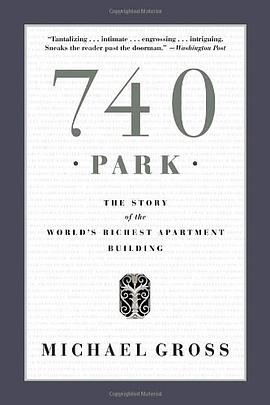

具体描述
For seventy-five years, it’s been Manhattan’s richest apartment building, and one of the most lusted-after addresses in the world. One apartment had 37 rooms, 14 bathrooms, 43 closets, 11 working fireplaces, a private elevator, and his-and-hers saunas; another at one time had a live-in service staff of 16. To this day, it is steeped in the purest luxury, the kind most of us could only imagine, until now.
The last great building to go up along New York’s Gold Coast, construction on 740 Park finished in 1930. Since then, 740 has been home to an ever-evolving cadre of our wealthiest and most powerful families, some of America’s (and the world’s) oldest money—the kind attached to names like Vanderbilt, Rockefeller, Bouvier, Chrysler, Niarchos, Houghton, and Harkness—and some whose names evoke the excesses of today’s monied elite: Kravis, Koch, Bronfman, Perelman, Steinberg, and Schwarzman. All along, the building has housed titans of industry, political power brokers, international royalty, fabulous scam-artists, and even the lowest scoundrels.
The book begins with the tumultuous story of the building’s construction. Conceived in the bubbling financial, artistic, and social cauldron of 1920’s Manhattan, 740 Park rose to its dizzying heights as the stock market plunged in 1929—the building was in dire financial straits before the first apartments were sold. The builders include the architectural genius Rosario Candela, the scheming businessman James T. Lee (Jacqueline Kennedy Onassis’s grandfather), and a raft of financiers, many of whom were little more than white-collar crooks and grand-scale hustlers.
Once finished, 740 became a magnet for the richest, oldest families in the country: the Brewsters, descendents of the leader of the Plymouth Colony; the socially-registered Bordens, Hoppins, Scovilles, Thornes, and Schermerhorns; and top executives of the Chase Bank, American Express, and U.S. Rubber. Outside the walls of 740 Park, these were the people shaping America culturally and economically. Within those walls, they were indulging in all of the Seven Deadly Sins.
As the social climate evolved throughout the last century, so did 740 Park: after World War II, the building’s rulers eased their more restrictive policies and began allowing Jews (though not to this day African Americans) to reside within their hallowed walls. Nowadays, it is full to bursting with new money, people whose fortunes, though freshly-made, are large enough to buy their way in.
At its core this book is a social history of the American rich, and how the locus of power and influence has shifted haltingly from old bloodlines to new money. But it’s also much more than that: filled with meaty, startling, often tragic stories of the people who lived behind 740’s walls, the book gives us an unprecedented access to worlds of wealth, privilege, and extraordinary folly that are usually hidden behind a scrim of money and influence. This is, truly, how the other half—or at least the other one hundredth of one percent—lives.
作者简介
目录信息
读后感
用户评价
如果说这本书有什么显著特点,那就是它像一出精密的机械钟表,每一个齿轮——无论是人物关系、时间线索还是环境设定——都咬合得天衣无缝。我非常欣赏作者的叙事手法,那种看似松散却又步步为营的推进方式。它不像那种开篇就抛出重磅炸弹的悬疑小说,而是更像一幅逐渐展开的油画,初看是精致的风景,细看才发现每一片叶子的脉络和光影的细微变化都蕴含着深意。我特别沉迷于那些关于城市历史和建筑变迁的旁白,它们为故事增添了一种厚重的历史感,让这些现代的、看似永恒的财富,也染上了一层时间侵蚀的沧桑。读完后,我对那个特定地域的建筑风格产生了浓厚的兴趣,仿佛自己也曾漫步在那些铺着精美石板的街道上,感受着历史的回响。
评分这本小说简直是一场奢华的视觉盛宴,作者对细节的描摹简直到了令人发指的地步。我仿佛能闻到那些古董家具上散发出的陈旧木料和昂贵皮革混合的气味,能感受到那些厚重天鹅绒窗帘的质感。故事的主角们,那些生活在顶层公寓里的精英阶层,他们的每一个决定、每一次社交,都像是在精心编排的芭蕾舞剧。我尤其喜欢作者如何不动声色地揭示那些光鲜亮丽外表下的暗流涌动。比如,某位太太为了一个花园派对的邀请函而进行的幕后交易,那种微妙的权力斗争,比任何公开的争吵都来得更震撼。读到他们为了争夺一块传家宝手表而进行的智力博弈时,我甚至紧张到手心冒汗。这本书的节奏掌控得极好,表面上风平浪静,实则暗潮汹涌,每一个场景都充满了未言明的张力,让人忍不住想一探究竟,看看这场精心维护的完美生活,到底会以何种优雅的方式走向崩塌。
评分这本书的对话部分简直是教科书级别的范例,充满了潜台词和微妙的暗示。很少有小说能将“言之未尽”的艺术运用得如此炉火纯青。角色们很少直接表达他们的真实意图,他们更倾向于使用一套精心设计的社交密码进行交流。例如,通过对餐桌上摆放的特定餐具、某一句不经意的法语引用,或者对某件艺术品的品味高低来判断对方的社会地位和真实意图。我花费了大量时间去回味那些看似平淡的交际场景,试图破解其中隐藏的权力博弈。这种阅读体验非常具有互动性,读者仿佛也被拉入了这场高智商的社交游戏,必须保持高度的警惕和专注,才能跟上他们思维的闪转腾挪。这种对语言艺术的极致运用,让整本书的质感瞬间提升了好几个档次。
评分从纯粹的文学角度来看,作者对于“界限”的探讨令人耳目一新。这里说的界限,不单单是社会阶层的区隔,更是关于个人隐私、道德底线和情感忠诚的模糊地带。书中描绘了多重“灰色地带”,比如一段处于婚姻边缘的暧昧关系,或者一桩似乎合法却又游走在法律边缘的商业操作。作者从不给出明确的道德评判,而是将所有的复杂性都摊开在你面前,让你自己去权衡和感受。这种处理方式非常成熟,它承认了人类行为的复杂性,拒绝用简单的“好人”或“坏人”来标签化任何角色。读到最后,我并没有得到一个明确的答案或圆满的结局,更多的是一种对人性深渊的敬畏,以及对那些试图维持体面表象的人们内心挣扎的深刻理解。这绝对是一本需要细细品味,并且值得反复咀嚼的作品。
评分我通常对这种聚焦于上流社会的作品不太感冒,总觉得充满了不切实际的浮夸。然而,这本书却成功地抓住了我,因为它不仅仅是关于财富的堆砌,更像是一部深刻的人性剖析录。作者并没有将角色塑造成扁平的、符号化的富人形象,相反,他们每个人都背负着沉重的历史包袱和难以启齿的秘密。我印象最深的是关于家族遗产继承的那一段情节,那种代际之间无声的较量,以及对“名誉”二字的病态执着,让我不禁思考,当物质的匮乏不再是问题时,人类的欲望究竟会转向何方?是永无止境的控制欲,还是对存在感的极度渴求?书中对心理活动的刻画细腻入微,尤其是在涉及道德抉择的瞬间,那种内心的挣扎和自我辩护的逻辑链条,写得真实得让人心惊。它迫使我跳出自己的生活经验,去审视那些隐藏在光环之下的复杂灵魂。
评分 评分 评分 评分 评分