
具体描述
Book Description
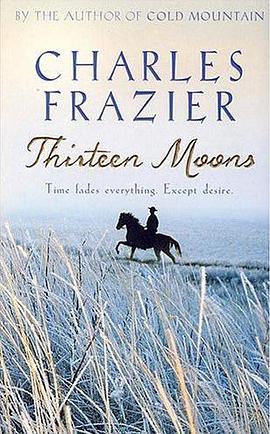
Charles Frazier's Thirteen Moons is the story of one man's remarkable life, spanning a century of relentless change. At the age of twelve, an orphan named Will Cooper is given a horse, a key, and a map and is sent on a journey through the wilderness to the edge of the Cherokee Nation, the uncharted white space on the map. Will is a bound boy, obliged to run a remote Indian trading post. As he fulfills his lonesome duty, Will finds a father in Bear, a Cherokee chief, and is adopted by him and his people, developing relationships that ultimately forge Will's character. All the while, his love of Claire, the enigmatic and captivating charge of volatile and powerful Featherstone, will forever rule Will's heart.
In a distinct voice filled with both humor and yearning, Will tells of a lifelong search for home, the hunger for fortune and adventure, the rebuilding of a trampled culture, and above all an enduring pursuit of passion. As he comes to realize, "When all else in lost and gone forever, there is yearning. One of the few welcome lessons age teaches is that only desire trumps time."
Thirteen Moons takes us from the uncharted wilderness of an unspoiled continent, across the South, up and down the Mississippi, and to the urban clamor of a raw Washington City. Throughout, Will is swept along as the wild beauty of the nineteenth century given way to the telephones, automobiles, and encroaching railways of the twentieth.
From Publishers Weekly
When Frazier's debut Cold Mountain blossomed into a National Book Award–winning bestseller with four million copies in print, expectations for the follow-up rose almost immediately. A decade later, the good news is that Frazier's storytelling prowess doesn't falter in this sophomore effort, a bountiful literary panorama again set primarily in North Carolina's Great Smoky Mountains. The story takes place mostly before the Civil War this time, and it is epic in scope. With pristine prose that's often wry, Frazier brings a rough-and-tumble pioneer past magnificently to life, indicts America with painful bluntness for the betrayal of its native people and recounts a romance rife with sadness. In a departure from Cold Mountain's Inman, Will Cooper narrates his own story in retrospect, beginning with his days as an orphaned, literate "bound boy" who is dispatched to run a musty trading post at the edge of the Cherokee Nation. Nearly nine mesmerizing decades later, Will is an eccentric elder of great accomplishments and gargantuan failures, perched cantankerously on his front porch taking potshots at passenger trains rumbling across his property (he owns "quite a few" shares of the railroad). Over the years, Will—modeled very loosely, Frazier acknowledges, on real-life frontiersman William Holland Thomas—becomes a prosperous merchant, a self-taught lawyer and a state senator; he's adopted by a Cherokee elder and later leads the clan as a white Indian chief; he bears terrible witness to the 1838–1839 Trail of Tears; a quarter-century later, he goes to battle for the Confederacy as a self-anointed colonel, leading a mostly Indian force with a "legion of lawyers and bookkeepers and shop clerks" as officers; as time passes, his life intersects with such figures as Davy Crockett, Sen. John C. Calhoun and President Andrew Jackson. After the Civil War, Will fritters away a fortune through wanderlust, neglect and unquenched longing for his one true love, Claire, a girl he won in a card game when they were both 12, wooed for two erotic summers in his teen years and found again several decades later. In the novel's wistful coda, recalling Claire's voice inflicts "flesh wounds of memory, painful but inconclusive"—a voice that an uncertain old Will hears in the static hiss when he answers his newfangled phone in the book's opening pages. The history that Frazier hauntingly unwinds through Will is as melodic as it is melancholy, but the sublime love story is the narrative's true heart. (Oct. 3)
From The Washington Post's Book World ,washingtonpost.com
Charles Frazier is an intelligent, occasionally witty author who writes incredibly long-winded, sentimental, soporific novels. His first, Cold Mountain, published nine years ago, was the most unlikely bestseller since Oldest Living Confederate Widow Tells All (1989), by his fellow North Carolinian Allan Gurganus, and the most improbable National Book Award winner since John O'Hara's Ten North Frederick half a century ago. Now Frazier weighs in with Thirteen Moons, which manages to be even longer and even duller than Cold Mountain. No doubt it too will be a huge bestseller.
That Frazier's success parallels Gurganus's is purely coincidental, but it's just about impossible not to remark upon the oddness of the coincidence. As a rule, the American book-buying public has only a limited appetite for Southern-fried fiction, yet Frazier and Gurganus somehow have tapped into it. They deal (Frazier somewhat more skillfully than Gurganus) in what a North Carolina newspaper editor of my long-ago acquaintance used to call shucks-'n'-nubbins, which is loosely defined as tiny ears of corn. Frazier's corn is anything but tiny -- more than 400 pages of it in the case of Thirteen Moons -- but it's corn all the same.
Reading Frazier is like sitting by the cracker barrel for hour after hour and listening to an amiable but impossibly gassy guy who talks real slow, says "I reckon" a whole lot and never shuts up. His novels have little structure and not much in the way of plot; in Cold Mountain he gave us the wounded Confederate soldier, Inman, limping his way back to his gal, Ada, in the North Carolina mountains, and in Thirteen Moons it's the ancient Will Cooper reminiscing about his nine decades and his Cherokee buddies and the gal, Claire, whom he managed to love and lose. He is a far less interesting man than Frazier obviously believes him to be, which is a little surprising because he's based on a very interesting historical figure.
"Will Cooper is not William Holland Thomas," Frazier says in an author's note, and then coyly adds, "though they do share some DNA." Actually, they share a whole lot. William Holland Thomas was born in North Carolina in 1805, was almost immediately orphaned, worked as a boy in a general store in the mountains, taught himself the law, worked to secure the right of the Cherokees to remain in their territory as Andrew Jackson sought to drive all Indians westward, served in the state senate and organized a company of Cherokee soldiers on behalf of the Confederacy. All of which is exactly what Will Cooper does in Thirteen Moons; where fact and fiction part is that Thomas married and had children while Cooper remains single, and Thomas's mental condition gradually deteriorated after the Civil War while Cooper remains alert, if rather tired, to the novel's end.
In other words, in Thirteen Moons Frazier essentially has fictionalized history. Nothing wrong with that: happens all the time. But the novel provides less imagination and invention than readers are likely to expect; it reads more like a dutifully researched (check out that author's note) graduate school paper than a work of fiction. It also is chock-a-block with homespun aphorisms that aren't exactly full of original wisdom: "One of the few welcome lessons age teaches is that only desire trumps time," and "Grief is a haunting," and "Writers can tell any lie that leaps into their heads," and "Our worst pain is confined within our own skin," and "We are not made strong enough to stand up against endless grief," and so forth. To be sure Frazier's folksy wisdom is a good deal easier to swallow than Gurganus's, but it's folksy all the same and not especially wise.
The novel is narrated in the first person. Early on, Will tells us that "I was always word-smitten" and that he kept journals for years, though the novel obviously is a reconstruction of the journals rather than the journals themselves. It begins with the "bound boy" that Will became at the age of 12, when his uncle and aunt sent him off to be "a shopkeep" for seven years, apprenticed to an elderly gentleman who owned "a trade post out at the edge of the [Cherokee] Nation." He makes his way through the mountain forests on his own, encountering adventures similar to those that beset Inman in Cold Mountain -- Frazier does like to send his men out on interminable treks that often seem to be headed nowhere -- until he finally arrives at the store, which "was hardly bigger than the parlor room of my aunt's house" and provided with "woefully little . . . stock from the outer world."
Will is a go-getter, though, and soon enough the store is busy, at least by mountain standards. Will runs it for four years, then is able to buy it after the owner's death. By this point, he has become something of a fixture in the Indian community, especially after he befriends an old Indian named Bear, "possessor of the deepest and sharpest mind to which I have ever been exposed." At once the reader is in the presence of the Noble Savage, though a bit later Frazier tries to wriggle out of that one:
"It is tempting to look back at Bear's people from the perspective of this modern world and see them as changeless and pure, authentic people in ways impossible for anybody to be anymore. We need Noble Savages for our own purposes. Our happy imaginings about them and the pure world they occupied do us good when incoherent change overwhelms us. But even in those early days when I was first getting to know Bear and his people, I could see that change and brutal loss had been all they had experienced for two centuries. . . . It was not any kind of original people left. No wild Indians at all, and little raw wilderness. They were damaged people, and they lived in a broken world like everybody else."
True enough, but it's also true that Frazier sentimentalizes the Cherokee even as he tries to keep his distance from the Noble Savage cliché. When Bear offers "to stand as your father" -- i.e., to step in for the father whom Will lost before he was born -- it's a true Noble Savage Moment: "If you were born or adopted into a clan, you were Cherokee. Everybody else was an outsider. So when Bear made his offer it was not only between him and me, it was also a deal with his whole people and thus a matter of identity. For them and for me and for him." Or, as Annie Oakley puts it in "Annie Get Your Gun," "I'm an Indian Too."
Corny? Absolutely. It had best be acknowledged, though, that Frazier's sentimental streak is almost certainly what has gotten him to where he is. It comes naturally to him, and readers seem to recognize this. However one may feel about the books that make their way to the upper reaches of the fiction bestseller lists, one thing is true of just about all of them: They are written with the utmost sincerity. Their authors mean what they write. They aren't trying to jerk readers around, and they aren't condescending to them. Readers can sense when they're being patronized, and they rarely fall for it. Whatever else there is to be said about Frazier's fiction -- and in my view there's not much -- its sincerity is unimpeachable.
Which makes it doubly odd that he tries to have it both ways. In Cold Mountain, after Inman and Ada have their ecstatic and endlessly delayed reunion, Frazier pulls up short by killing Inman off in the closing paragraphs. Something similar (though scarcely as violent) happens between Will and Claire toward the end of Thirteen Moons. Even as Frazier is tugging away at our heartstrings, he's trying to show how tough and realistic he can be, but it feels strained and unpersuasive; my own hunch is that he thinks literary respectability can be earned only if sentimentality is served up with a hard-hearted twist, but it's the sentimentality that's believable, not the twist.
Will readers flock to Thirteen Moons as they did to Cold Mountain? Who knows? Frazier's new publisher has a ton of money invested in him and will be pulling out all the stops. One thing is certain: Thirteen Moons is going to be putting a whole bunch of people to sleep.
From Booklist
In one of the most anticipated novels of the current publishing season, Frazier, author of the widely applauded Cold Mountain (1997), remains true to the historical fiction vein. The author's second outing finds grounding in a timeless theme: a grand old man remembering his glory days. As a teenager during the James Monroe administration, Will Cooper is sent off, in an indentured situation, into the wilderness of the Indian Nation to run a trading post. From a mixed-race Indian, he wins a girl with whom he will be besotted for the rest of his life, and his passion will extend into personal involvement in Indian affairs, to the highest level of politics. Thus Frazier also remains faithful to the theme of his previous novel: the odyssey, especially one man's path through trials and tribulations to be by the side of the woman he loves. And he remains faithful to a method that marked Cold Mountain in readers' memories: a proliferation of detail about customs and costumes, about food and recreation--pretty much what everything looked and smelled like. Unfortunately, for the first fourth of the book, there is too much detail for the plot to easily bear. But, finally, the characters are able to step out from behind this blanket of particulars and incidentals and make the story work. Expect considerable demand, of course.
Brad Hooper
From Bookmarks Magazine
Critics voiced great expectations for Thirteen Moons, coming nearly ten years after Charles Frazier's National Book Award-winning Cold Mountain (1997). Unfortunately, this second novel fails to achieve the same uniform critical acclaim. Certainly, similarities between the two books abound, including a deep appreciation for the Southern Appalachian landscape, a protagonist embarking on a life-defining odyssey, an elegiac tone, and swatches of excellent prose. Here, Frazier frames Will's story against America's transition from a frontier society into an industrial nation. Despite some praise, reviewers generally agree that Thirteen Moons is an "airier production" (New York Times), with perhaps more clichés, less convincing characterizations and relationships, and a less wieldy plot. What critics do agree on, however, is the excellent period detail and research that makes Frazier a first-rate chronicler of American history.
Book Dimension
length: (cm)17.4 width:(cm)11
作者简介
目录信息
读后感
用户评价
我对这本书的感情非常复杂,它成功地营造了一种近乎令人窒息的悬疑氛围,但其核心却非常诗意。小说的主角是一个经历过巨大变故的艺术家,他的视角让整个故事蒙上了一层破碎的美感。与其说它是一部传统的悬疑小说,不如说它是一部关于“寻找”的寓言——寻找失落的自我,寻找被遗忘的真相。作者的语言极具画面感,仿佛每一段文字都能立刻在脑海中构建出清晰的场景,尤其是对自然元素的运用,风声、雨声、植物的生长,都成了推动情感发展的催化剂。我很少看到有哪本书能将如此高雅的文学笔触与如此接地气、近乎残酷的现实描写结合得如此自然。唯一的遗憾是,结局的处理有些过于开放,虽然留下了思考的空间,但对于追求明确答案的读者来说,可能会感到一丝不满足。
评分这本书简直是一场对“时间”本身的解构实验。叙事视角不断地在不同年龄段的角色之间切换,有时候甚至是通过非人类的视角来观察事件的发展,这种手法非常大胆,也极具风险性。初读时,我被这种跳跃感弄得有点晕头转向,感觉自己像在看一部剪辑非常破碎的艺术电影。但当所有时间线最终汇聚交织的那一刻,那种精妙的设计感让人拍案叫绝。它探讨的不是谁做了什么,而是“时间如何塑造了这件事”以及“这件事在不同时间里意味着什么”。大量的心理分析和象征主义手法使得阅读过程充满了挑战,但同时也带来了极大的智力上的满足感。这本书不适合睡前阅读,它需要你全神贯注,因为它奖励的是那些愿意深入挖掘隐藏意义的读者,它证明了文学可以承担多么复杂的结构和思想实验。
评分我最近读完了一本小说,讲的是一个偏远小镇上发生的一系列事件。这本书的叙事节奏非常缓慢,起初可能会让一些读者感到有些沉闷,但随着情节的推进,你会发现作者巧妙地将生活中的琐碎与深层次的心理描写编织在一起。小镇上的每个人物都刻画得栩栩如生,他们的秘密和挣扎如同迷雾一样笼罩着整个故事。最让我印象深刻的是作者对环境的描绘,那种潮湿、封闭的感觉几乎要穿透纸面。故事的主线围绕着一个失踪的孩子展开,但真正精彩的地方在于它如何揭示了社区内部的人际关系网,以及在压力下人性的扭曲。它不是那种情节跌宕起伏的快节奏小说,更像是一幅精细的水墨画,需要你静下心来慢慢品味其中的每一个笔触。读完后,我花了好几天时间才从那种压抑的氛围中走出来,但那种回味无穷的复杂情感,却是很多爆米花小说无法给予的。
评分这本书的结构极其精巧,简直像一个复杂的瑞士钟表,每一个齿轮——每一个章节——都准确地咬合在一起。我特别欣赏作者在时间线处理上的手法,不断地在过去和现在之间跳跃,但每一次跳转都恰到好处地揭示了新的线索,或者重新定义了读者对之前事件的理解。它探讨了记忆的不可靠性,以及创伤如何跨越世代影响个体。书中大量的内心独白和哲学思辨,一开始让我觉得有些晦涩难懂,但当你把那些看似无关的片段联系起来时,会产生一种豁然开朗的震撼感。其中关于“选择”与“命运”的辩论贯穿始终,让人忍不住停下来思考自己的人生轨迹。文字的密度很高,有些句子需要反复阅读才能领会其深意。对于喜欢挑战思维、享受深度阅读体验的读者来说,这无疑是一场盛宴,它要求你付出思考的努力,但回报绝对是值得的。
评分我花了大概一周的时间才“啃完”这本大部头,坦白说,中间有几次差点放弃,因为它对读者的耐心是一个巨大的考验。故事背景设定在一个虚构的、等级森严的社会体系中,围绕着权力斗争和对禁忌知识的探索展开。它的世界构建是如此宏大而细致入微,从政治结构到宗教仪式,无一不透露出作者深厚的功力和严谨的考据(尽管是架空背景)。这本书的缺点在于,人物塑造上,配角的丰满程度远超主角,主角的动机有时显得有些模糊不清,需要读者自行脑补很多空白。但它最成功的地方在于,它提出了很多尖锐的社会议题,比如对权威的盲从、信息垄断带来的后果,这些在今天的世界看来依然振聋发聩。这是一本需要你边读边做笔记的书,充满了可以被引用的警句和洞察人心的段落。
评分 评分 评分 评分 评分