具体描述
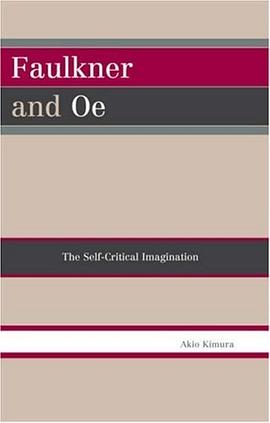
For Oe Kenzaburo, a Japanese novelist who won the 1994 Noble prize in literature, William Faulkner is not so much a father of Yoknapatawpha as he is a critic of the masculine possessiveness attributed to the creation of the imaginary county. Faulkner and Oe: The Self-Critical Imagination focuses on the Faulknerian influence on Oe's satirical or self-critical imagination-especially on his feminist or hermaphroditic criticism of the male "I" contained within the shosetsu (novel). Akio Kimura expertly investigates Oe's feminist turn in his novels in the 1980s as a criticism of this "I" as an authoritarian first-person narrator. Oe considers this concept to be a disruptive reflection of Japanese society's established order. Oe's response to such a disruption is the introduction of a series of metaphors utilized in order to represent Faulkner's individualism and the subsequent deconstruction of Japanese autocracy. Drawing on Kofman, Irigaray, and Derrida, this book explores how Faulkner's individualism inspires Oe to juxtapose the Japanese authoritarian and the Faulknerian self-critical. Kimura explains that Oe's intensive reading of Faulkner's later novels-The Town, The Mansion, A Fable-has brought him a sense of ambiguity, or his awareness of being split between the Japanese "I" and the Western "I." By comparing these two significant novelists, this study acutely highlights the generic difference between the novel of the West and the Japanese shosetsu.
Faulkner and Oe: A Comparative Exploration of Literary Legacies This scholarly work embarks on a meticulous comparative journey into the literary universes of two titans of 20th-century fiction: William Faulkner and Kenzaburo Oe. Far from being a superficial juxtaposition, the book delves into the profound thematic, stylistic, and philosophical resonances that connect these two seemingly disparate yet remarkably aligned authors. It seeks to illuminate how both Faulkner, the quintessential voice of the American South, and Oe, the conscience of post-war Japan, grappled with similar existential dilemmas, historical traumas, and the enduring complexities of the human condition, albeit through distinct cultural lenses and narrative traditions. The initial chapters lay the groundwork by establishing the foundational elements of each author’s oeuvre. For Faulkner, this involves an in-depth examination of his Southern Gothic sensibility, his pioneering use of stream of consciousness, his exploration of themes such as race, class, memory, and the burden of history, and his iconic Yoknapatawpha County. The book will trace the evolution of his narrative techniques, from the experimental fragmentation of The Sound and the Fury to the more accessible storytelling in Go Down, Moses, highlighting his enduring legacy as a master of modernist prose and a profound commentator on American identity. Concurrently, the work dedicates significant attention to Oe's literary landscape. It will explore his recurring preoccupations with disability, madness, exile, and the spiritual void left by the devastation of war. The book will analyze his unique blend of autobiography and fiction, his unflinching engagement with social and political issues in Japan, and his persistent questioning of national identity and post-war reconstruction. Key works such as A Personal Matter, The Silent Cry, and An Echo of Heaven will be dissected to reveal the intricate tapestry of his concerns and the raw emotional power of his prose. The core of the book, however, lies in its intricate comparative analysis. It moves beyond mere thematic parallels to explore the deeper structural and philosophical convergences. One significant area of investigation will be their shared concern with the weight of history and its enduring, often destructive, impact on individuals and communities. Faulkner’s exploration of the legacy of slavery and the Civil War finds a compelling counterpart in Oe’s wrestling with the trauma of World War II and the atomic bombings. The book will argue that both authors saw history not as a static past but as a living, breathing force that shapes present realities and dictates future possibilities. Another crucial point of comparison will be their innovative approaches to narrative form and perspective. Faulkner's revolutionary use of multiple narrators, temporal dislocations, and complex sentence structures will be juxtaposed with Oe's often disorienting yet deeply intimate narrative voices and his willingness to blur the lines between author, protagonist, and reader. The book will argue that both authors, through their formal experiments, sought to capture the fragmented and often chaotic nature of human consciousness and the elusiveness of objective truth. Their narrative strategies, while distinct, both serve to immerse the reader in the subjective experience of their characters and to challenge conventional modes of storytelling. Furthermore, the work will delve into their shared engagement with themes of alienation and the search for meaning in a seemingly indifferent universe. Faulkner's characters often grapple with isolation, the loss of tradition, and a profound sense of existential dread. Similarly, Oe's protagonists frequently experience a deep sense of disconnection from society, from their own bodies, and from the natural world. The book will explore how both authors represent this alienation not as a static state but as a dynamic struggle, often finding glimmers of hope and resilience in unexpected places, such as through familial bonds, artistic creation, or a connection to the land. The concept of the "outsider" is another powerful thematic bridge between Faulkner and Oe. Faulkner’s gallery of eccentrics, outcasts, and marginalized figures – from Dilsey to Jewel – reflects a deep empathy for those who exist on the fringes of society. Oe, too, places characters who are physically or mentally "different" at the center of his narratives, challenging societal norms and celebrating the inherent worth of all individuals. The book will explore how both authors utilize these outsider figures to critique societal hypocrisy and to offer alternative perspectives on humanity and existence. The exploration will also venture into the philosophical underpinnings of their work, touching upon their engagement with existentialism, nihilism, and the search for redemption. While neither author can be neatly categorized, their writing often grapples with the burden of freedom, the absence of inherent meaning, and the human capacity for both great suffering and profound love. The book will highlight how both Faulkner and Oe, despite confronting the bleakness of existence, ultimately affirm the resilience of the human spirit and the possibility of finding meaning through connection, art, and the enduring power of individual will. Finally, the book will consider their broader cultural impact and literary legacies. Faulkner's profound influence on American literature and his role in shaping the modern American narrative will be acknowledged. Similarly, Oe's stature as a leading figure in contemporary Japanese literature and his global recognition for his courageous engagement with difficult truths will be examined. The comparative approach of this study aims to demonstrate that by understanding Faulkner and Oe in dialogue, readers can gain a richer appreciation for the universal dimensions of their art and their enduring relevance to the ongoing human quest for understanding and meaning in an ever-changing world. The book promises a comprehensive, insightful, and rigorously argued exploration that will appeal to scholars of comparative literature, American studies, Japanese studies, and indeed, any reader who seeks a deeper engagement with the profound questions posed by two of the 20th century’s most significant literary voices.