
具体描述
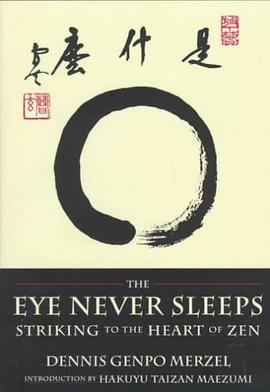
"Genpo fairly gushes with enthusiasm . . . The Eye Never Sleeps makes for lively reading and is an excellent addition to the expanding bookshelf on lay American practice."—Mountain Record
"These unpretentious, exhilarating commentaries on Sosan Zenj's 'Verses on the Faith Mind,' a classic teaching of Zen's Golden Age in China, are a clear and refreshing illustration of how Zen teachings can illuminate our daily lives."—Peter Matthiessen
作者简介
Who is Genpo Roshi?
www.bigmind.org
Zen master Dennis Genpo Merzel Roshi was born in Brooklyn, New York, in 1944. Soon after, his family moved to Long Beach, California, where he grew up. He received a bachelor's degree from California State University at Long Beach in 1966, and a master's degree in educational administration from the University of Southern California in 1968. From an early age, he was active in competitive swimming and water polo, and was named All-American in those sports. Genpo Roshi taught school in Los Angeles and Long Beach from 1966 to 1971.
In 1972, after spending a year in the mountains of California in solitary retreat, Genpo Roshi started formal Zen training at the Zen Center of Los Angeles, under Maezumi Roshi. He was ordained a monk by Maezumi Roshi in 1973 and given the title Hoshi (Dharma-Holder) after completing Koan study in 1979.
In 1980, Genpo Roshi received Shiho (Dharma Transmission) from Maezumi Roshi, followed by Zuisse (Empowerment Ceremony required to become an abbot) in Japan in 1981. In the following year he began to conduct retreats in England, Holland, Poland, France, and Germany. In 1984, he left Los Angeles to devote himself completely to the international community of students he named "Kanzeon Sangha." This Sangha now includes thousands of members in the United States and Europe.
In 1988, Genpo Roshi completed Shinsanshiki (installation as abbot) at Hosshinji Temple in Bar Harbor, Maine. In 1991 he moved to Oregon and in 1993, at the invitation of the Wasatch Zen Group, he relocated Hosshinji (Kanzeon Zen Center) to Salt Lake City, Utah.
Genpo Roshi received the certificate of Dendokyoshi Kenshuso in 1995 at Green Gulch Farm in California. In October of 1996, he received Inka from his elder Dharma brother, Bernie Glassman Roshi, in New York City. Roshi Bernie had received Inka from Maezumi Roshi shortly before the latter's death in May of 1995.
To date, Genpo Roshi has given Dharma Transmission to Catherine Genno Pages, the late John Shodo Flatt, and Anton Tenkei Coppens. Genpo Roshi gave Inka to John Daido Loori in 1997.
In 1999, after studying voice dialogue with Hal and Sidra Stone from 1983 - 1984, Genpo Roshi discovered the Big Mind Process. This method allows anyone who wishes to open their mind to a more universal consciousness to do so in a relatively short amount of time. Individuals or groups are able to do so quite easily without any previous formal Zen training. It is a non-threatening technique which uses the ego instead of trying to destroy it. Genpo Roshi has established a non-profit, non-sectarian organization that brings the Big Mind Process out to the world.
Genpo Roshi's written work includes:
The Eye Never Sleeps:
Striking to the Heart of Zen
Beyond Sanity and Madness:
The Way of Zen Master Dogen
24/7 Dharma:
Impermanence, No-Self, Nirvana
目录信息
读后感
用户评价
这部作品的结构设计堪称精妙的迷宫。它不是按照传统的时间线索线性展开的,而是采用了多重嵌套的回溯和预叙相结合的手法。故事的叙事轴心似乎总是在不断地偏移和重构,你以为你抓住了故事的核心,下一章却可能将你带入一个看似无关紧要的次要人物的童年片段。这种跳跃性叙事非但没有造成混乱,反而像是在拼凑一幅巨大的、碎片化的壁画,直到最后几章,那些看似散落的线索才如同被磁石吸引般聚合起来。我尤其欣赏作者处理“信息延迟”的方式,关键的真相往往被包裹在冗长而看似无用的细节描述之中,让你必须耐心筛选。这种对叙事时间的灵活操控,极大地增强了悬念感和宿命感——仿佛历史的重演是必然的,无论人物如何努力想要逃离,最终还是会被时间的回环所捕获。对于喜欢深度分析情节脉络的读者来说,这本书无疑是提供了丰富的“考古”材料。
评分这部作品的叙事视角无疑是其最引人注目的特点。作者巧妙地运用了一种游离于事件中心之外的观察者口吻,使得整个故事笼罩在一层既疏离又深刻的氛围之中。我仿佛站在一个高处,俯瞰着底下人物的挣扎与欢愉,情感的传递不是直白的宣泄,而是通过细致入微的环境描写和人物不经意的动作捕捉完成的。例如,主人公在某个关键时刻的犹豫,并非通过内心独白来呈现,而是通过他对手中那只陈旧怀表的摩挲频率,以及窗外光线的微妙变化来暗示。这种“不言而喻”的叙事技巧,极大地考验了读者的解读能力,但一旦进入作者设定的节奏,那种醍醐灌顶的快感是无与伦比的。这种处理方式让我想起一些古典文学中对“留白”的运用,它迫使读者主动参与到意义的构建过程中,使得每一次阅读体验都带有强烈的个人印记。尤其是在描绘城市景观时,那些潮湿的石板路、蒸汽弥漫的街角,都不仅仅是背景,它们仿佛有了生命,呼吸着故事中人物的焦虑和希望。读完后,那些场景的影像感极其强烈,仿佛自己也曾在那阴郁的巷子里徘徊过。
评分从主题深度来看,作者探讨的议题是宏大而永恒的,但处理方式却异常细腻和内敛。它并没有直接去批判或歌颂,而是将人性的复杂性摊开来,让我们自己去面对。贯穿始终的,似乎是对“记忆的可靠性”以及“自我认知与外界评价的偏差”这两者的持续追问。书中反复出现的手稿、日记、被篡改的记录,都在提醒我们,我们所相信的历史,即便是最私密的个人历史,也充满了被遗忘和被重塑的可能。这种哲学层面的探讨,是通过一系列高度象征化的意象来完成的,比如反复出现的关于镜子和倒影的描述,或者对特定地理空间中光影变幻的痴迷捕捉。它不像是一部直白的社会评论,更像是一场关于存在的沉思,它要求读者放下对“标准答案”的渴望,拥抱模糊和不确定性,这在当今这个崇尚清晰定义的时代,显得尤为可贵。
评分这部小说的情感基调是极其克制的,几乎可以说是冷峻的。尽管故事中充满了悲剧性的元素——背叛、失落和未竟的理想——但作者似乎刻意避免了煽情的笔触。人物的痛苦不是通过嚎啕大哭来表达,而是通过一系列近乎仪式化的日常行为来体现:比如长时间地凝视一盆枯萎的植物,或者在寒冷的冬夜里反复擦拭一把早已生锈的钥匙。这种“内化的情绪”比外放的表达更具穿透力,它让你感觉到的不是作者在推销悲伤,而是你无意中窥见了一种真实的、难以言喻的生命状态。我个人非常欣赏这种冷静的旁观者姿态,它使得读者有空间去投射自己的理解和共鸣,而不被作者的情绪完全裹挟。阅读它,就像是在一个寂静的博物馆里独自欣赏一尊凝固的雕塑,你无需言语,但能感受到其内部蕴含的巨大能量和长久的回响。它不是一部让人读后热血沸腾的作品,而是一部让人在安静的夜晚,陷入漫长回味的佳作。
评分如果用一个词来形容这部小说的语言风格,那大概是“繁复的精准性”。每一个句子都经过了精心的打磨,词汇的选择极为考究,仿佛每一个词语都被放置在最恰当的位置上,不容许有丝毫的偏移。我注意到作者对于那些带有特定时代感的词汇的使用频率非常高,这不仅构建了故事发生的年代感,更营造出一种略带沉重和宿命论的基调。阅读过程就像是走在一片精心铺设的碎石路上,每一步都需要集中注意力去感受脚下的质地和声音,稍有走神,便可能错过一个至关重要的暗喻。这种文风的魅力在于其内在的音乐性,长句的排比和短句的断裂交替出现,形成了强烈的节奏感,尤其在表现人物内心冲突爆发的瞬间,语言的密度陡然增加,将情绪的张力推至极致。不过,坦白说,对于习惯了快节奏、口语化表达的现代读者而言,初读时可能会感到一定的门槛,但坚持下去,你会被其语言的密度和深度所折服,它提供了一种近乎巴洛克式的阅读享受,层层叠叠,华丽而不失结构。
评分 评分 评分 评分 评分