
具体描述
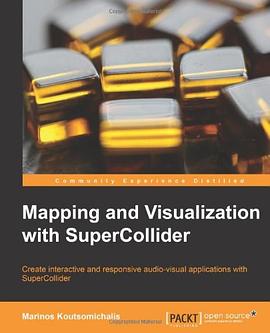
SuperCollider is an environment and programming language used by musicians, scientists, and artists who work with audio-files SuperCollider has built-in graphical features which are used in conjunction with the sound synthesis server to create audio-visual mapping and sound visualization. If you wish to create data visualizations by acquiring data from audio and visual sources, then this book is for you.
Digital sound artists need to analyze, manipulate, map, and visualize data when working on a scientific or an artistic project. As an artist, this book, by means of its numerous code examples will provide you with the necessary knowledge of SuperCollider's practical applications, so that you can extract meaningful information from audio-files and master its visualization techniques. This book will help you to prototype and implement sophisticated visualizers, sonifiers, and complex mappings of your data.
This book takes a closer look at SuperCollider features such as plotting and metering functionality to dispel the mysterious aura surrounding the more advanced mappings and animation strategies. This book also takes you through a number of examples that help you to create intelligent mapping and visualization systems. Throughout the course of the book, you will synthesize and optimize waveforms and spectra for scoping as well as extract information from an audio signal. The later sections of the book focus on advanced topics such as emulating physical forces, designing kinematic structures, and using neural networks to enable you to develop a visualization that has a natural motion with structures that respect anatomy and which come with an intelligent encoding mechanism. This book will teach you everything you need to work with intelligent audio-visual systems to extract and visualize audio-visual data.
作者简介
Marinos Koutsomichalis (Athens, 1981) is an artist and scholar working with sound and a wide range of other media. His artistic work interrogates the specifics of site, perception, technology, and material. His academic interests include computer programming, generative art, new aesthetics, and environmental sound and noise. He has widely performed, exhibited, and lectured internationally and has held residencies in miscellaneous research centers and institutions. He has an MA by research in composition with digital media by the University of York and, as of writing, he is a candidate PhD in Music, Sound, and Media Art at the De Montfort University. He is in the board of the Contemporary Music Research Center (KSYME-CMRC) and also the director of its class of Electronic Music and Sound Synthesis. As of writing, he is a research fellow in the University of Turin.
目录信息
Chapter 2: Waveform Synthesis
Chapter 3: Synthesizing Spectra
Chapter 4: Vector Graphics
Chapter 5: Animation
Chapter 6: Data Acquisition and Mapping
Chapter 7: Advanced Visualizers
Chapter 8: Intelligent Encodings and Automata
Chapter 9: Design Patterns and Methodologies
· · · · · · (收起)
读后感
用户评价
这本书的另一个突出优点是其对“社区资源”和“未来展望”的重视。它没有将知识点封存在书本的最后一页,而是持续地引导读者去探索SuperCollider更广阔的生态系统。例如,作者在关键的技术点后,常常会推荐一些相关的外部库、在线论坛的讨论串,甚至是优秀的开源项目案例,这使得这本书成为了一个强大的“启动平台”,而非终点站。这种前瞻性的导向,极大地激发了我的探索欲,让我清楚地知道下一步应该去关注哪些发展方向,以及在哪里可以找到更即时的帮助和迭代的解决方案。整本书读下来,我得到的不仅仅是关于特定技术的掌握,更是一种持续学习和自我进化的方法论。它成功地培养了一种积极的、面向未来的开发者心态,让人感到自己站在了一个不断成长的技术前沿。
评分这本书的章节布局逻辑性极强,简直像是一部精心编排的交响乐。从基础概念的铺陈开始,逐步过渡到复杂的算法实现,每一步的衔接都显得水到渠成,没有那种突兀的跳跃感。我发现,作者非常擅长将复杂的数学原理用直观的编程实践来消化和阐释,这对于理工科背景较弱但对技术应用感兴趣的读者无疑是一大福音。举例来说,对于傅里叶变换在频谱分析中的应用描述,不仅仅是给出了公式,而是紧密结合了如何在SuperCollider环境中构建相应的可视化模块,这种学以致用的方式效率极高。而且,每一个新引入的技术点,都会配有清晰的上下文说明,让你明白为什么要引入这个技术,它解决了什么问题,而不是生硬地抛出一个工具。这种层层递进的教学设计,极大地降低了学习曲线的陡峭程度,让人有一种“原来如此”的豁然开朗之感。
评分与其他侧重于纯代码实现的教程相比,这本书在“设计美学”和“用户体验”方面的着墨相当之深,这让我感到非常惊喜。作者似乎深谙一个道理:强大的技术必须服务于清晰的传达。书中对于如何选择合适的颜色方案、如何处理运动的平滑性、以及如何避免视觉信息过载等设计原则,都有独到的见解。这些内容并非是附加的“花边知识”,而是与核心编程技巧融为一体的。例如,在讲解如何处理高维数据映射时,作者不只展示了如何用数组表示,更深入探讨了如何通过视觉层级来暗示数据的重要性,这体现了作者对“有效沟通”的执着。对于那些不仅想让自己的系统跑起来,还想让它看起来专业、易懂的开发者而言,这些章节提供了无价的指导方针,它将技术能力和审美素养紧密地结合了起来。
评分这本书的装帧设计真是引人注目,封面采用了深邃的蓝色调,搭配上富有科技感的抽象线条图案,立刻让人联想到声波和数据的可视化,设计感十足。拿到手里沉甸甸的质感,也让人对内容充满了期待。我特别欣赏作者在排版上的用心,字体选择清晰易读,段落间距处理得恰到好处,即便是初次接触这类专业书籍,阅读起来也不会感到压迫。书页的纸张质量也非常上乘,色彩还原度高,对于需要参考大量图表和代码示例的读者来说,这是一个巨大的加分项。而且,全书的结构划分似乎经过了精心规划,从目录的编排就能看出作者试图构建一个循序渐进的学习路径,让人感觉这不是一本堆砌知识点的工具书,而更像是一份精心打磨的学习蓝图。这本书的物理呈现本身就传递出一种专业和严谨的气质,让人忍不住想立刻翻开它,探索其内在的奥秘。这种对细节的关注,无疑提升了整体的阅读体验,也侧面反映了作者对这个主题的认真态度。
评分初读这本书的引言部分,我立刻被作者那种近乎哲学思辨的叙事方式所吸引。他不仅仅是在罗列技术名词和操作步骤,而是深入探讨了“声音如何被视觉化”以及“数据如何转化为可感知的艺术形式”这些核心命题。这种高度的理论自觉性,使得全书的基调非常高远,它引导读者超越了单纯的技术实现层面,去思考设计背后的意图和效果。我感觉作者似乎在试图搭建一座桥梁,连接起冰冷的代码世界与充满情感的艺术表达。特别是对于“实时处理”和“交互性”的讨论,充满了洞见,让我对SuperCollider这一工具的潜力有了全新的认识。这种宏观的视野,对于那些希望将声学研究或音乐创作提升到更高层次的实践者来说,是极其宝贵的。它不是教你怎么写一段代码,而是教你如何“思考”如何构建一个声景或数据流的可视化框架。
评分 评分 评分 评分 评分