
具体描述
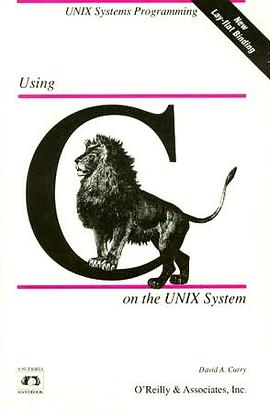
Using C on the UNIX System provides a thorough introduction to the UNIX system call libraries. It is aimed at programmers who already know C, but who want to take full advantage of the UNIX programming environment. If you want to learn how to work with the operating system and to write programs that can interact with directories, terminals, and networks at the lowest level, you will find this book essential. It is impossible to write UNIX utilities of any sophistication without understanding the material in this book.Even if you don't want to program at this level, familiarity with the UNIX system interface is the mark of an experienced and fluent user. If you want to know how the C shell performs job control or how network addressing works, you will find the answer here. Your knowledge of the UNIX system is fundamentally incomplete until you can make C work for you.Using C provides discussions of the most important system calls as well as detailed descriptions of the important system data structures.Topics covered include:
Low-level I/O (open, close, read, write).
Files, directories, and the low-level structure of the file system.
I/O control, including terminal management (ioctl).
Reading the system administrative databases (getpwent, etc.).
Time, timers, and timing.
Signal handling.
How one program starts another program (system, execv, fork).
Job control.
Interprocess communication (sockets, message queues, semaphores, shared memory).
Networking (addressing, port numbers).
This book is based on Berkeley 4.3 UNIX, but also covers System V.
作者简介
David A. Curry is a technically sophisticated, business-savvy information security professional with over 25 years of cross-industry experience in diverse security, privacy, and systems roles including security and privacy governance, risk management and analysis, legal and regulatory compliance, security incident response, professional services, software design, systems programming, and systems administration. He has held multiple senior-level positions with responsibility for envisioning, implementing, and maintaining the major components of information security programs, including policies and standards, risk management methodologies, training and awareness programs, legal and regulatory compliance, third party vendor security management, and security incident management.
Prior to his specialization in information security governance, David spent over ten years as a UNIX and TCP/IP systems programmer and systems administrator in the university/research sector. Some of the software he developed during that time is still in use today. He also spent five years in the professional security services field, where he worked with many cutting-edge security technologies and applications that are taken for granted today. He was a founding member of the world’s first commercial computer security incident response service, and the principal designer of the world’s first commercial real-time intrusion detection monitoring service. He is also the author of three successful technical books: two on the topic of UNIX systems programming, and one on UNIX system security.
David’s varied background gives him a unique ability to examine problems from both the “business” and “technical” perspectives and devise an appropriate solution that meets the requirements of all stakeholders—business and information technology. He believes that one of the most important characteristics of any information security program is that it must support the business goals of the company and enable work to get done in a time- and cost-effective manner. David’s background has also allowed him to develop oral and written presentation skills suitable for any audience—technical, non-technical, or executive—an ability which is demonstrated by his selection as one of the top-five presenters at the Information Security Forum’s worldwide conference four years in a row.
David holds a Bachelor’s degree in Computer Science from Purdue University and is a Certified Information Systems Security Professional (CISSP).
目录信息
读后感
用户评价
这本书,说实话,拿到手上的时候,我本来是抱着一种既期待又有点忐忑的心情。毕竟现在市面上讲C语言和UNIX结合的书籍汗牛充栋,能真正做到深入浅出、兼顾理论深度和实践操作的,真的不多。我当时最关心的就是,它会不会是那种老掉牙的、只停留在概念介绍的教科书,或者反过来,又过于晦涩难懂,动不动就抛出一堆晦涩的系统调用和内核术语。翻开目录,我发现它并没有急于展示那些花哨的图形界面或者最新的网络编程技巧,而是非常扎实地从C语言在系统编程环境下的基石讲起。它花了相当大的篇幅来剖析指针、内存布局在UNIX环境下的具体表现,这对于理解为什么某些代码在不同系统上会有微妙差异至关重要。我印象特别深刻的是它对文件I/O和进程间通信(IPC)的讲解,作者没有直接堆砌`fork()`和`pipe()`的函数原型,而是用一系列精心设计的、逐步递进的小例子,形象地展示了数据如何在父子进程间流动,以及信号处理机制的底层逻辑。那种讲解方式,仿佛作者坐在你旁边,拿着一个调试器,一步步带你穿梭于内核和用户空间之间。读完这部分,我感觉自己对“系统编程”这个词汇的理解,一下子提升到了一个新的维度,不再是纸上谈兵的空泛概念,而是能够真正感知到操作系统在幕后是如何运作的。这本书的结构安排,非常符合一个有一定C语言基础,但渴望深入UNIX底层逻辑的程序员的学习曲线。
评分让我着迷的是它对标准库函数在UNIX内核之上实现细节的“揭秘”过程。市面上很多教材把标准库函数当作黑箱来使用,告诉你`malloc`可以分配内存,`readdir`可以读取目录内容,但很少有人会去深究这些函数背后的系统调用是如何被调用的,又是如何与内核的数据结构交互的。这本书在这方面做得极其出色。它不仅仅是告诉你`read()`和`write()`是系统调用,而是详细对比了带缓冲区的标准I/O(如`fread`)和直接的系统调用在性能和适用场景上的差异,并展示了这些缓冲是如何在用户空间实现的。特别是在处理网络套接字(Socket)编程时,它没有停留于基本的TCP连接建立,而是深入探讨了`select`/`poll`/`epoll`这些I/O多路复用机制的演变历史和内在工作原理。理解了`epoll`那种基于事件驱动的架构,再去看那些高性能服务器的代码,那些原本像魔法一样的代码逻辑,瞬间就变得清晰透明了。这本书让人从“使用”C语言转变为“理解”C语言是如何驱动整个UNIX系统的,这种层次上的飞跃,是其他零散的教程无法比拟的。
评分这本书的叙事风格,简直就像一位经验极其丰富的老工程师在跟你分享他的“血泪史”,而不是冷冰冰的技术手册。它最吸引我的地方在于,它总是能预见到初学者或者经验不足的开发者会在哪里‘踩坑’,然后用非常幽默且切中要害的方式进行“避坑”指导。比如,在讲解信号量和死锁问题时,作者并没有简单地给出解决方案,而是先描述了一个典型的并发场景中,程序是如何陷入僵局的,那种描述的画面感极强,让人仿佛能听到CPU的无谓空转声。接着,他才引入标准的同步机制,并且深入探讨了为什么使用`flock()`而不是`lockf()`在某些特定文件系统挂载点上会遇到意想不到的行为。更赞的是,书中对于调试技巧的介绍,也远超出了标准`gdb`命令的罗列。它详细阐述了如何利用`strace`来追踪系统调用的全过程,以及如何通过分析核心转储文件(core dump)来定位那些瞬时发生的内存损坏问题。这种“实战派”的教学方法,极大地缩短了我将理论知识转化为实际解决问题能力的周期。我感觉自己不是在学习一门技术,而是在学习一种解决问题的思维模式,这对于任何希望在复杂系统中长期维护和开发的人来说,都是无价之宝。
评分对于那些已经习惯了高层抽象语言或者现代IDE自动化的开发者来说,这本书可能需要一些“重新适应”的过程,因为它要求你重新关注那些被现代工具链隐藏起来的底层细节,比如字节序(Endianness)问题在网络通信中的处理,或者在编译时进行复杂的链接器脚本配置。但正是这种“回归本源”的训练,才是我认为它价值最高的所在。它迫使你跳出舒适区,去面对那些真正影响程序健壮性和可移植性的核心挑战。书中对于系统头文件和库的依赖关系分析,细致到令人发指,它会告诉你某个特定的宏定义在哪个版本的POSIX标准中引入,以及它在BSD和System V分支上的微妙差异。这种对规范和历史背景的尊重,使得读者在阅读老旧的或者跨平台的代码库时,能够迅速定位问题的根源。读完这本书,我不再仅仅是“会用”UNIX下的C编程,而是开始“思考”为什么这些API是这样设计的,这才是真正将技术内化为自身能力的关键一步。
评分这本书的排版和配图,虽然谈不上是现代印刷艺术的巅峰,但却透露出一种久经考验的实用主义美学。清晰的章节分隔,恰到好处的代码块缩进,以及那些辅助理解复杂数据结构的流程图,都显示出作者对知识传授效率的极致追求。我特别欣赏它在引入新概念时,总是先给出一个简化的、理想化的模型,让读者建立起一个核心框架,然后再逐步引入UNIX特有的边界条件和异常处理。例如,在讨论文件锁时,它首先用一个简单的互斥锁概念建立模型,然后才引入fcntl锁和flock锁的竞争关系和文件描述符级别的差异。这种层层递进的构建方式,让复杂的系统概念变得可以被逐步消化吸收。此外,书中提供的所有代码示例,都是经过精心编译和运行验证的,而不是那种为了演示某个特性而写的、充满语法错误或逻辑漏洞的“半成品”。我几乎是照着书上的例子,完整地构建了自己的一个小型的、基于管道通信的Shell工具,这极大地增强了我的信心和实战能力。
评分 评分 评分 评分 评分