

具体描述
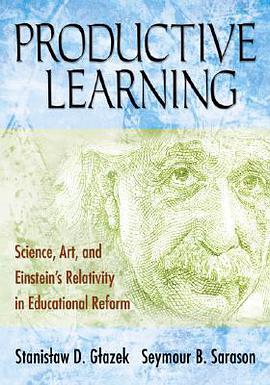
'Fans and disciples of Seymour Sarason all know that education reform needs a change in course. Indeed, the daily practices of schools, education research, and US educational policy all need such a change. Neither Professors Glazek and Sarason, nor anyone else, can give yet a complete description of what these changes would involve. But when the change happens, the leaders of the change will all acknowledge their considerable debt to this book. The reason is that the needed change in school classrooms will be very hard to recognize as such unless these leaders are thoroughly familiar with the concept of 'a context of productive learning.' In this book, Glazek and Sarason collaborated on an extraordinarily daunting attempt to create and analyze a context of productive learning in which, simultaneously, Sarason was the student and Glazek the teacher and vice versa. They attempted what must surely be a 'Mt Everest' example of the concept: explanation of Einstein's famous formula, E=mc².áThe result should be of intense interest to a broad audience concerned with the present problems of science education as well as the nature of a context of productive learning.' -Kenneth G. Wilson, H. C. Youngberg Trustees Distinguished Professor Nobel Laureate for Physics, 1982 Department of Physics, The Ohio State University 'By making accessible and intelligible Einstein's theory of relativity, this remarkable book reveals to its readers the power and possibility of their own learning and, in doing so, brilliantly demonstrates the power and necessity of productive learning for everyone.' -Andy Hargreaves, Thomas More Brennan Chair in Education Lynch School of Education, Boston College 'Professors Glazek and Sarason have written a creative and instructive book that will be read for years to come. Drawing upon their backgrounds in physics and psychology, they support EinsteinÆs recommendations as to the importance of the humanities. The authors' purpose is to help readers acquire a substantive grasp of how Einstein accomplished what he did and the implications of this for educational reform. The reader's view of teaching and learning will be forever changed by the authors' insights.' -Dale L. Brubaker, Professor University of North Carolina 'This is an interesting and provocative book, written by a psychologist with several thousands of hours of observation and analysis of classroom teaching in public schools and a physicist. The book starts with a critique of teaching in our schools and explains why educational reform has been so minimal in its effects. The movie 'Mr. Holland's Opus' is used as a distinguisher between good and bad teaching methodology. These chapters are followed by physics chapters on the foundation of Einstein's E=mc¦. The authors follow Einstein's thinking and use the features of light as a vehicle for their discussion. They fold in stories and shy away from formulas, which they leave for appendices. The book ends with a chapter on the philosophy of teaching. The book is well written and eminently readable; the arguments are easy to follow. I recommend the book to anyone interested in the basis of modern physics and Einstein's role in it.' -Ernest M. Henley, Professor Emeritus of Physics University of Washington Use the concept of productive learning to reframe school reform!áWhy do people, college-bound or even in college, stay away in droves from courses in science, especially physics? Why do people know so little about the significance of Einstein's contributions which require dramatic changes in how we understand ourselves, our world, and the entire universe? Why have educational reforms failed? In this book, two professors, one a particle physicist and the other a psychologist, confront these questions in a unique way based on the assumption that people can grasp on a non-superficial level what Einstein did in 1905 if, and only if, the features of productive learning are taken seriously. The authors make clear that those features are applicable in teaching any subject matter by devoting two chapters to music and other arts. In the case of science, they chose Einstein's work precisely because of the general belief that it cannot be assimilated by 'ordinary mortals' whose brains are not 'wired' to comprehend the ways in which time, mass, energy, and the speed of light are seamlessly interrelated. But this book is not an attempt to popularize Einstein. Its goal is to demonstrate that features of the context of productive learning are applicable to any teacher-student relationship, regardless of whether the student is in first grade, in high school, or in college. Einstein's work was about alignment of frames of reference of observers in physics. A similar process of alignment between the minds of a student and a teacher is the vehicle of productive learning. The book explains the analogy. The authors discuss and emphasize that educational reform will continue to fail as long as the concept of learning is fuzzy and provides no direction to the teacher-student relationship. Reform efforts will continue to fail unless and until they are based on a clear distinction between contexts of productive and unproductive learning.
作者简介
Seymour B. Sarason is Professor Emeritus of Psychology, Yale University. During his distinguished 48-year career, he has been one of the most astute observers and incisive critics of efforts to reform our schools. Among his more than 30 published books are The Predictable Failure of Educational Reform (1990), Schooling in America: Scapegoat or Salvation (1983), and The Culture of School and the Problem of Change (2nd ed., 1982).
目录信息
Acknowledgments
1. Structure of the Book
2. And What Do You Mean by Learning?
3. Mr. Holland’s Opus
4. Transition From Music to E = mc Squared
5. A Letter to the Reader
6. Light Carries Energy
7. How Fast Is Light?
8. What Is Light? What Is Ether?
9. How Can We Describe the Energy of Light?
10. The Principle of Conservation of Energy
11. Max and Ming: Light in the Matchbox
12. Max and Ming Build Their Frames of Reference
13. What Time Is It on a Distant Clock?
14. Max and Ming Review the Concept of Time
15. Einstein’s Theory of Relativity
16. How E = mc Squared Comes About
17. Toward a Conception of Learning
Appendices
Appendix A: Energy of Motion of a Body
Appendix B: Frequencies and Energies of Photons If Time Is Absolute
Appendix C: Max’s Time Coordinates of Four Events
Appendix D: Is the Speed of Light Special?
Appendix E: Einstein’s Relationship Between Frames of Reference
Appendix F: Time and the Pythagorean Theorem
Appendix G: How Gamma Depends on v
Appendix H: Energy of Photons According to Ming
Appendix I: How Absorption of Light Changes Mass
Appendix J: Lenard and Einstein
Notes
Index
· · · · · · (收起)
读后感
用户评价
这是一本让我醍醐灌顶的书,它的思想如同种子,在我心中播撒,并开始生根发芽。作者的语言风格非常精炼,字字珠玑,没有一句废话,却能引人深思。我被书中关于“学习的本质”的探讨深深折服。它不是关于信息量的堆积,而是关于理解、应用和创新。作者强调,真正的学习是能够将所学知识融入自己的生活,并能解决实际问题。我特别喜欢那个关于“反思性学习”的章节,它让我意识到,每一次经历,无论成功与否,都是一次宝贵的学习机会,关键在于我们如何去反思和总结。我正在尝试每天花几分钟时间,回顾今天所学到的新东西,以及可以改进的地方。书中关于“终身学习”的倡导,更是让我看到了未来的方向。在这个快速变化的时代,停止学习就等于退步,而这本书恰恰为我指明了前进的道路。我还在思考那个关于“元认知”的例子,它让我意识到,了解自己的学习过程,才能更有效地学习。
评分读这本书的过程,更像是一场智力探险。作者的逻辑链条清晰得如同精心铺设的地图,一步步引导读者深入探索。我被其中关于“心流体验”的描述深深吸引,那是一种将全部精力投入到一项活动中,最终达到一种忘我、高效甚至愉悦的状态。作者并没有空泛地谈论理论,而是提供了非常实用的方法论,比如如何识别自己进入心流的触发条件,以及如何在日常生活中创造更多这样的时刻。我印象最深刻的是那个关于“刻意练习”的案例,它颠覆了我以往对“天赋”的看法。作者强调,真正的精通并非源于天生的才能,而是源于持续不断的、有针对性的练习。这种练习不是机械的重复,而是有意识地挑战自己的舒适区,不断突破极限。我开始反思自己在工作中的学习方式,是否过于安于现状,没有主动去寻找那些能够真正提升我技能的“难点”。书中还有一段关于“成长型思维”的解读,让我意识到,将挑战视为机遇而非威胁,是多么重要的一个心态转变。这种思维模式不仅有助于学习,更能帮助我们更好地应对生活中的挫折。
评分这本书的封面设计就透露着一种沉静的力量,不是那种张扬的炫耀,而是一种内在的、深思熟虑的智慧。当我翻开它时,我立刻被作者的文字所吸引。他/她叙述的方式非常平易近人,仿佛是在与一位老朋友闲聊,但字里行间又蕴含着深刻的洞察。我特别喜欢其中关于“延迟满足”的探讨,这部分内容让我重新审视了自己很多习惯性的行为模式。通常,我们总以为快乐来自于即时的回报,但作者用非常具象的例子,比如一个艺术家在无数个寂寞的夜晚里创作,最终才收获掌声,来阐述了延迟满足的真正价值。这种价值不仅仅体现在成就上,更体现在个体精神的成长和自律能力的培养上。我甚至开始尝试书中提到的一个小练习,每天写下三件让我感到“值得”去等待的事情,尽管现在看来有些微不足道,但确实让我对时间的流逝有了新的感知。我还在思考那个关于“沉没成本谬误”的例子,它让我意识到,很多时候我们之所以坚持错误的方向,并非因为我们真正相信它,而是因为已经付出了太多。这部分内容让我对人生中很多重要的决策产生了警醒。
评分这本书的叙事方式就像一幅徐徐展开的画卷,每一个笔触都充满哲思。作者的文字时而如潺潺流水,时而如惊涛拍岸,总能触动我内心深处的情感。我被书中关于“时间管理”的独特视角所打动。它不是教你如何填满每一个空闲的时间,而是引导你如何去“管理”你的能量和注意力,从而更有效地利用时间。我一直以为时间管理就是列清单、排日程,但作者指出,真正的关键在于理解自己的精力周期,并在精力最充沛的时候处理最重要的任务。那段关于“番茄工作法”的探讨,让我意识到,短时间的专注,配合休息,反而能带来更高的效率。我尝试将这个方法应用到我的工作和学习中,发现效果出奇的好。我还在回味那个关于“优先级”的讨论,它让我意识到,很多时候我们花费了大量时间在不重要的事情上,而真正重要的事情却被一拖再拖。这种对时间价值的重新定义,对我来说意义重大。
评分这本书给我带来了一种前所未有的清晰感,仿佛一直笼罩在我脑海中的迷雾被驱散了。作者的语言风格非常直接,但又充满感染力,没有华丽的辞藻,却能直击人心。我尤其欣赏书中关于“习惯养成”的科学解释。它并非简单地告诉你“坚持就是胜利”,而是深入剖析了习惯形成的神经科学原理,以及如何利用这些原理来构建积极的习惯。我以前一直以为改变坏习惯是件极其困难的事情,但作者提供的“微习惯”策略,让我看到了曙光。这种从小处着手,逐步积累的方式,显得既可行又充满希望。我正在尝试每天只做一件我渴望养成的新习惯,例如,每天阅读一页书,或者做十个俯卧撑。令人惊讶的是,这种微小的行动,确实在悄悄地改变着我的日常。书中关于“认知偏差”的讨论也让我受益匪浅,让我意识到自己有多少时候是被不理性的思维所左右。例如,那个关于“确认偏差”的例子,让我警惕自己是否只看到了符合自己观点的信息。
评分 评分 评分 评分 评分


