
具体描述
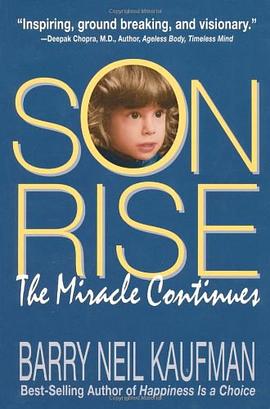
In 1979, the classic best-seller Son-Rise was made into an award-winning NBC television special, which has been viewed by 300 million people worldwide. Now, Son-Rise: The Miracle Continues presents an expanded and updated journal of Barry and Samahria Kaufman's successful effort to reach their once "unreachable" autistic child. Part one documents Raun Kaufman's astonishing development from a lifeless, autistic, retarded child into a highly verbal, lovable youngster with no traces of his former condition. Part two details Raun's extraordinary progress from the age of four into young adulthood. Part three shares moving accounts of five families that successfully used the Son-Rise Program to reach their own special children. An awe-inspiring reminder that love moves mountains. A must for any parent, teacher or student of personal growth. Do you ever wonder why things turn out the way they do? I do. Every so often, I ask myself why an event in my life occurred, if maybe it had some sort of purpose or reason. I realize that, in the larger scheme of things, I can never really know why events happen or if there is some sort of grand plan for us all. I do believe, though, that each event offers us a brand new chance to change ourselves and our lives, whether the change is slight or sweeping. Even if we can't know whether there is some great cosmic reason for the workings of the world, we can still give events meaning with what we do with them. When I was diagnosed as autistic (and also severely mentally retarded, with a below-thirty IQ), my parents were given ample opportunity to treat the event as a tragedy. The whole world saw autism as hopeless and encouraged my parents to see it that way too. Sometimes it dawns on me how close I came to spending my life encapsulated inside my own head, lacking the tools to interact with the rest of the world. My autism could have been just another event without meaning or explanation. What turned it around was not a string of events, but rather a wildly different and unheard of perspective: Refusing to accept the age-old view of autism as a terrible catastrophe, my parents came up with the radical idea that my autism was a chance - a great opportunity, in fact - to try to reach a child lost behind a thick, hazy cloud. It was a chance to make greatness out of something commonly viewed as unquestionably sad and tragic. This perspective, combined with a passionate relentlessness on the part of my parents, enabled me to undergo a spectacular metamorphosis and emerge from the shell of my autism without a trace of my former condition. When I think about what my parents did with my autism, I see what a tremendous role we all play in each event that confronts us. It was not my recovery that made the event of my autism amazing and meaningful (though, needless to say, I'm very happy with the outcome); it was my parents' open-minded attitude in the face of my condition and their desire to find meaning in it regardless of how I turned out in the end. You don't have to "cure" your special child in order for his or her specialness to have meaning and value. The value lies not in "results" but in how you treat your situation and your child. The question of what is and is not possible has forever been bouncing around in my head. I have definitely had a few times in my life when I chose not to bother attempting to accomplish something because I thought, "That's impossible." At other times, I catch myself thinking this way and realize that it is precisely this type of thinking that could have landed me in an institution for the rest of my life. If there is one thing my life has taught me, it is that anything is possible. I don't mean this idea in the superficial way it is often used. I mean to say that nothing is beyond our reach if we honestly believe that it is within our power to reach it. I've found that I, rather than any external situation, am my own biggest limiter. One line that parents of special children hear more than anyone else is the "that's impossible" line. The "experts" showered my parents with prognoses like "hopeless", "irreversible", "unreachable" and "incurable". All my parents had to do was believe these "experts" (not a difficult task, since these doctors had plenty of evidence to back their opinions), and my journey would have been over. Instead, my parents defied the professionals, disbelieved their prognoses, and grabbed hold of the belief that they could at least try to do the impossible, reach the unreachable, cure the incurable. "But your son has a devastating, lifelong condition. He can never come out of it" the doctors scolded. "So what?" my parents would reply. "We're going to try, anyway, and see what happens." The word expert is the misnomer of the century. The pessimistic outlook that the "experts" show many parents need not be taken seriously. Whatever you've been told about the severity of your child's condition, don't buy it. You and your child can do a whole lot more than any "expert" could possibly know. No matter how much evidence a doctor can show you, it will never be enough to prove that something is impossible. You want to know something? Evidence is a sham. It can always be defied or demolished. If you really believe in evidence, use it to prove the possible instead of the impossible. (I'm on the debating team at my college, and I've seen how evidence can be used to back up either side of an issue.) Many, especially the "experts," might claim that I am advocating "false hope." "False hope"? What do they mean by "false hope"? How in the world can anyone put these two words together? When I think about my successful academic career, my fierce tennis matches, my love of Stephen King novels., the fantasy and science fiction short stories I've written, my admittance to the university of my choice, my best friends, my girlfriend, and my complete and ecstatic involvement with life, it occurs to me that each and every one of these is the product of "false hope." Nothing can ever be bad or wrong about hope. Not ever. I advocate giving yourself and those around you as large a dose of it as possible. So, I bet you're wondering what this product of "false hope" is doing with his life lately. Well, I'm enjoying college (I'm in my sophomore year) more than any other period of my life. I'm having a thoroughly terrific time choosing my own courses, living away from home, eating school food (yum!). I take courses like philosophy, political science, theater arts, and biology. I took calculus during my freshman year. Definitely not my calling. In addition to enjoying the social and academic scenes at college, I'm also on the debating team, I take ballroom dancing, I'm in a coed fraternity, and I'm in a number of political groups. I recently cast my first presidential vote after working for my candidate's campaign. (I won't say who I voted for, but you can probably guess.) Here are the answers (and only the answers) to the questions I get asked most often: No, I can't stand "Beverly Hills 90210." Yeah, I'm an excellent driver. Actually, I'm majoring in biomedical ethics. Oh, my career after college? I haven't the foggiest clue. No, I only spin plates during really boring physics lectures. Sorry, I'm busy this Friday night. Speaking of questions and answers, I have talked with parents of special children from many different countries and throughout the US, and I've had the chance to answer scores of their questions and ask some questions of my own, as well. They all want the best for their child; they all have a strong desire to help their child in any way they can. Many of these families also see their own or their child's situation as horrific. In addition, they want to be "realistic" and not pretend that their child's situation or potential is better than it actually is. It makes perfect sense to me that parents would think this way, but there are other ways of looking at things that might be more productive as well as more fun. Personally, I see autistic children as possessing a unique talent and ability, not a deficiency. When this talent and ability are embraced instead of viewed with horror, some amazing things can happen. Kids can make leaps people never thought possible. As for being realistic, it's not all it's cracked up to be. Very often, I wonder how I can be realistic and optimistic at the same time. How can I have boundless hope and aspirations and still keep a down-to-earth perspective on things? Well, many times I can't. Sometimes I choose realism, and when I do, I can always be sure that nothing that happens will exceed my expectations. But when I choose limitless optimism, I don't put any ceilings on my dreams and goals, and, as a result, sometimes I get more and do more than I ever could have accomplished by being realistic. The telephone, the automobile, the polio vaccine - the people who brought these things into being were extremely unrealistic. Realism only preserves the status quo. Nothing was ever accomplished by a realist. Every great discovery and achievement in history is the fault of unrealistic people. My parents' lack of realism is what got me to the place I am now. Consequently, I try never to tell anyone around me to be realistic. Sometimes, when I think about the continuing savage violence around the world and the pervasive racism in America, I have a hard time being optimistic. Plastered all over my wall in my dorm room are pictures of Bobby Kennedy, my favorite person in history. War and racism were also major concerns for him, but he never let the state of the world bring him down. So when I think of the things I want to be different in the world and I think about being unrealistic and I think about hope, I try to keep a quote of Bobby Kennedy's tucked in the back of my mind: "Some see the world as it is and say, 'Why?' I see the world as it could be and say, 'Why not?'" You can always say, "Why not?" when you're told you can't accomplish something. You can always say, "So what?" when evidence is presented against your dreams. You can always say, "It's possible" when you have a different vision for your child. Your potential is limitless, so don't give up. You have more greatness than you might think.
作者简介
目录信息
读后感
用户评价
初读之下,我几乎要被作者那近乎冷酷的客观叙事风格所震慑。他似乎站在一个极高的维度审视着所有角色,不带任何感情色彩地记录着他们的挣扎与选择。这种叙事手法,反而产生了一种强烈的、间接的情感冲击力,因为你必须自己去填充那些被省略的情感缝隙。书中对于“时间”的呈现方式非常具有实验性,它不是线性的,而是像碎片一样散落在各个章节,有时一个场景会突然跳跃十年,然后又倒叙回到前一刻的细节。这种非传统的结构要求读者必须全神贯注,时刻校准自己的阅读坐标。特别是其中关于一个家族遗产纷争的段落,作者用大量的法律术语和家族信件交织在一起,构建了一个复杂而精密的局限空间,让人感觉自己就像一个局外人旁观着一场精心策划的、注定失败的博弈。我对某些角色的动机感到困惑,但这种困惑恰恰是作者想要的——他拒绝提供简单的答案,而是将道德的模糊地带展示给我们,迫使我们进行深层次的反思。
评分坦白说,一开始我有些担心这本书会过于晦涩难懂,因为它似乎并不遵循传统小说的叙事逻辑。但是,一旦你适应了作者那种跳跃式的思维方式,你会发现其中蕴含着一种令人兴奋的自由感。这本书更像是一系列精美的小品文集被巧妙地串联起来,每个片段都独立成章,却又彼此呼应,共同指向一个宏大的主题。我尤其喜欢其中关于“失落”的表达,它不是大声疾呼的痛苦,而是一种渗透到骨子里的、对某种“缺失”的永恒追寻。作者对于环境的描绘总是带有强烈的象征意义,比如反复出现的雾气和封闭的空间,都在暗示着人物内心的迷惘和探索的艰难。这本书的优点在于其留白很多,它把解读的权力交给了读者,你可以在不同的情境下读出不同的味道,每一次重读可能都会有新的发现,这使得它的耐读性极高,绝非一次性消费的读物,更像是一本需要反复摩挲的艺术品,值得深思和回味良久。
评分这本书的语言充满了诗意和节奏感,读起来简直像在听一首精心编排的交响乐。句子结构多变,长句铺陈开来,如同蜿蜒的河流,充满了复杂的从句和修饰语,但在关键节点,作者会突然切入极其简洁有力的短句,像鼓点一样敲击在心上。我尤其欣赏作者在处理“记忆”这一主题时的手法。记忆不是被清晰地回忆起来,而是像水下的暗流,时不时地将一些不连贯的画面、气味或者声音推到意识表面,然后又迅速沉没。有那么几段描写,关于一个角色童年夏天的场景,那种阳光的炙热、蝉鸣的喧嚣,以及某种特定的酸甜气味,被描述得如此具象,让我几乎忘记了自己是在阅读,仿佛那段记忆瞬间成了我自己的体验。全书的基调是略带忧伤的,但这种忧伤不是抱怨,而是一种对生命无常的温柔接纳,充满了哲学的沉思,读完后,心头会残留一种悠远而宁静的余味。
评分让我印象最深的是作者对社会边缘群体的细致描摹。他没有将他们脸谱化或浪漫化,而是极其真实地展现了他们在夹缝中生存的智慧和无奈。书中有一个关于一个流浪艺术家的章节,他通过废弃材料进行创作的场景,被描绘得既辛酸又充满创造力。文字的力量在于能够揭示那些我们日常生活中习惯性忽略的角落。这本书的批判性很强,但它不是那种口号式的批判,而是通过人物的命运和环境的压迫感,让读者自己得出结论。书中还穿插了一些历史背景的考据,这些细节处理得非常到位,没有显得突兀或说教,而是自然地融入到故事的肌理之中,让整个故事的纵深感一下子拉开,明白了眼前的困境是如何由历史的重量所塑造的。我发现自己对一些平日里不甚关心的社会议题产生了更强烈的共情,这无疑是一本具有社会责任感的作品。
评分这本书的开篇就展现出一种令人不安的沉静,仿佛暴风雨前的宁静,作者巧妙地运用了大量的环境描写来烘托人物内心的波澜。我特别喜欢他对于光影的刻画,那种细微的光线变化,似乎都在预示着即将发生的重大转折。主角初次登场时,那种略带疏离感的自我叙述,一下子就将我拉入了故事的迷雾之中。他对于日常琐事的观察入微,但字里行间又流露出对更深层意义的探寻,这种矛盾的张力贯穿始终。叙事节奏把握得极好,时而舒缓,像是在品味一杯陈年的威士忌,让人沉醉于细节;时而又突然加速,抛出一个令人措手不及的悬念,让人不得不翻页。这本书的对话部分尤其精彩,每个人物的语言风格都极其鲜明,不需要旁白,你就能大致勾勒出他们的性格和背景,充满了生活的质感,那种南方特有的慵懒和机锋在字句间流淌,读起来非常过瘾。我几乎能闻到那种潮湿空气中带着植物腐烂和泥土混合的味道,代入感极强,这绝非一般作品能达到的深度。
评分 评分 评分 评分 评分