
具体描述
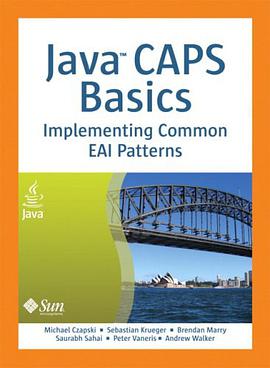
Use Java CAPS to Streamline IT Services and Leverage Legacy Applications Design patterns are a useful tool for streamlining enterprise integration and Web development projects: the mission-critical projects that directly impact your competitiveness. Enterprise Integration Patterns by Gregor Hohpe and Bobby Woolf (Addison-Wesley, 2004) described many of the most useful patterns for enterprise developers. Until recently, however, implementing the patterns in that classic reference required the extensive use of raw Java code. Now there's a better alternative: Using Sun's Java Composite Application Suite (Java CAPS), architects and developers can implement enterprise integration patterns succinctly, elegantly, and completely. In Java(t) CAPS Basics, Sun's own Java CAPS experts show how to quickly put these new tools and technologies to work in your real-world enterprise application integration projects. After reviewing the challenges of enterprise integration, they introduce Java CAPS and show how it can simplify the development of today's state-of-the-art "composite" applications. Next, they bridge the gap between abstract pattern languages and practical implementation details. You will learn essential Java CAPS concepts and methods in the context of the patterns you'll actually use for real-world message and system management. Coverage includes * Comparing approaches to enterprise application integration and finding ways to integrate non-invasively, with fewer changes and lower costs * Mastering the core integration tools provided by Java CAPS: eGate, eInsight, eWays and JMS * Using enterprise integration patterns to improve application reusability, scalability, resilience, security, and manageability * Implementing patterns for message exchange, correlation, infrastructure, routing, construction, transformation, and endpoints * Generating and using cryptographic objects such as X.5 09 Certificates, PKCS#12, and JKS Keystores * Using advanced techniques such as solution partitioning and subprocess implementation, many of which are covered nowhere else * Constructing two complete example solutions that bring together many of the patterns discussed and illustrated in this book The companion CD contains detailed illustrations for most of the relevant patterns and two complete Java CAPS-based case studies (with solutions) that implement a number of the patterns discussed in the book. In addition, Part II contains a chapter on cryptographic objects used to configure security-related aspects of the suite. It also provides more than sixty detailed examples designed to illustrate the concepts and patterns presented in this book. Built with JCAPS eDesigner, these graphical, component-based examples can easily be used by business analysts and others with or without strong coding skills.
作者简介
目录信息
读后感
用户评价
初翻这本名为《Java CAPS Basics》的书籍时,我原本期待能看到一些关于Java企业级应用开发中核心组件和基础架构的深入探讨。然而,读完前几章后,我发现它似乎将重点放在了一些更偏向于底层系统管理和配置的方面,而非我所熟知的面向对象的编程范式或现代微服务架构下的数据流处理。书中的图表和流程图大量涉及了复杂的网络拓扑和安全协议的握手过程,这让我不禁怀疑,这是否更像是一本系统管理员的指南,而非面向Java开发者的技术手册。我尝试在其中寻找关于JPA、Spring框架或者最新的Reactor响应式编程模型的只言片语,但收获甚微。倒是对如何配置一个健壮的WAS(WebSphere Application Server)集群,以及如何确保消息队列(MQ)的持久性策略,书中着墨颇多。这种知识的侧重点转移,让我在阅读时需要不断地调整自己的认知框架,这无疑增加了理解的难度,也让我对于“CAPS”这个缩写背后的具体技术栈产生了更深的困惑。整本书的叙事风格偏向于教科书式的陈述,缺乏实际项目中的疑难杂症剖析或最佳实践分享。
评分这本书的“学习体验”方面也存在显著的不足。它缺乏有效的自我检验机制。通读下来,我发现几乎没有贯穿始终的项目案例,也没有可以编译运行的、能展示所学概念如何协同工作的代码片段。所有的知识点似乎都是孤立存在的碎片,散落在不同的章节中,读者需要极强的自我驱动力和联想能力,才能将这些关于网络、存储、消息和容器的概念串联起来,并想象它们在真实的Java应用中是如何互动的。这种零散化的知识结构,使得阅读过程缺乏反馈和成就感,极大地消耗了学习的积极性。我更倾向于那些通过构建一个完整的、小型应用来逐步引入新概念的学习路径。相比之下,这本书更像是一本百科全书的索引页,列举了众多术语,却未能提供一个清晰的地图来引导读者探索知识的疆域,最终让我感觉收获的知识点散乱且难以固化,难以转化为实际的工程能力。
评分从内容深度来看,这本书似乎在“基础”和“深度”之间摇摆不定,最终落入了肤浅的泥潭。它罗列了许多配置项的参数说明,但对于这些参数背后的设计哲学和取舍逻辑,解释得非常模糊。例如,在讨论安全性模块时,它详细说明了如何配置一个证书链的路径,但对于理解SSL/TLS握手过程中公钥和私钥的作用,以及如何选择合适的加密套件以应对最新的安全威胁,却是一笔带过。这就像是提供了一份详细的螺丝刀使用说明书,但对螺栓和螺母的材料科学却避而不谈。对于我这种希望建立起牢固理论基础的读者而言,这种“知其然不知其所以然”的讲解方式是极其令人沮丧的。它更像是一本操作手册的汇编,而非一本能够培养批判性思维和架构设计能力的教材。期望从中学到扎实的Java核心技术内功的读者,可能会发现自己只是在重复输入一些官方文档中就能找到的命令序列,而未能获得更深层次的理解和洞察力。
评分这本书的排版和示例代码风格,给我一种穿越回上一个十年的错觉。字体选择和段落间距的处理,都透露出一种传统的、厚重的技术书籍气息,与当前主流技术社区追求的简洁、轻量化的阅读体验大相径庭。更令人费解的是,尽管书名里带有“Java”,但其中展示的许多配置脚本和命令行操作,更像是某种专有的集成环境(Enterprise Integration Environment)的命令行界面(CLI)的教学。我花了很长时间去理解其中关于“服务容器生命周期管理”的部分,它描述了一个冗长且依赖于特定硬件环境的启动流程,这与我日常使用的Docker或Kubernetes下的快速部署流程形成了鲜明对比。我特别留意了书中对异常处理的论述,但发现它似乎更侧重于系统级别的错误码解析,而不是Java异常体系(Checked/Unchecked Exceptions)的合理使用。对于一个渴求学习如何在云原生环境下利用Java强大特性的读者来说,这本书提供的解决方案似乎过于“重量级”和“定制化”,缺乏通用性和前瞻性,让人感觉仿佛在学习一个已经被市场边缘化的技术栈的细枝末节。
评分我带着对企业级服务协同的期待来阅读此书,希望能找到关于服务间如何高效、可靠地通信的洞见。然而,书中对通信模型的描述,似乎停留在一种较为静态和集中化的架构思维中。关于API网关、服务发现(如Eureka或Consul)的现代设计模式,书中并未提及。反而是花费了大量篇幅来解释如何通过一个中心化的总线(Bus)来路由和转换不同格式的消息,这个总线本身似乎被描述为一个具有极高权限和复杂状态维护的实体。我试图寻找关于RESTful API设计原则、HATEOAS的实际应用,或者gRPC在高性能RPC中的优势,但这些现代互操作性的基石在书中几乎找不到对应的章节。这种信息鸿沟使得这本书在我看来,更像是对一个特定遗留系统的技术文档的重述,而不是一本面向未来技术趋势的入门读物。它教会了我如何维护一个已有的、可能不太灵活的系统,却没能指引我如何构建一个适应未来弹性和可扩展性要求的应用。
评分 评分 评分 评分 评分