
具体描述
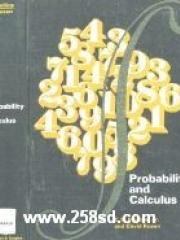
Preface<br > We have integrated two important topics, probability and calculus, in<br >way that is accessible to students whose interests are not necessarily mathe-<br >matical and whose preparation in mathematics includes only the normal high<br >school sequence of algebra, geometry, and trigonometry. Like the child<br >whose appreciation of music is heightened by studying an instrument, we<br >hope the student who has studied this book will be equipped to appreciate<br >mathematical techniques and to apply them to the solution of problem.,<br >which arise in whatever field he chooses for a career.<br > Designed for the freshman calculus course, this book attempts to develol:<br >the student s mathematical perspective and to train him to use mathematica<br >models in solving problems. Our discussion begins with discrete probability<br >which becomes the vehicle for introducing mathematical concepts and fol<br >motivating the study of calculus. When it becomes necessary to extend th(<br >finite sample space to countably infinite spaces, we introduce series. Her(<br >we lay the foundation for discussing the limit of a function through the no<br >tion of converging sequences. The study of calculus follows logically an(<br >takes up the major portion of the second half of the book. Two chapters or<br >continuous probability tie in the concepts and techniques of calculus wit!<br >probability. No chapter is specifically labeled statistics because numerou:<br >statistical applications are contained in the examples.<br > We use the natural example of finding the area of a nonrectangular figur(<br >as the source of formal definitions about the integral. The derivative is de<br > vdoped after the integral and serves as a method for evaluating integrals<br >as well as a way of discussing the theory of extreme values.<br > An important feature of the text is its wealth of examples and problem<br > culled from such diverse fields as sports, politics, business, economics<br > physics, engineering, meteorology, chemistry, biology, sociology, and psy<br > chology. In fact, each section is followed by approximately twenty an(<br > sometimes as many as fifty problems-several of which always mirror thq<br > illustrative examples. Each problem, some designed for computer solution<br > has been carefully chosen to display the power of mathematics in makinl<br > models. This abundance of examples and problems makes the text adaptabl,<br > to self-study and also gives the instructor greater flexibility in the classroon<br > by freeing him to pursue the more difficult concepts in detail.<br > The mathematics is presented independently of its applications so tha<br > students who may continue the study of these topics in advanced course<br > may do so without learning new terminology. Thus, we hope our presenta<br >
作者简介
目录信息
读后感
用户评价
从整体的结构平衡性来看,这本书成功地在纯理论和应用实践之间找到了一个微妙的平衡点,尽管倾向性略微偏向理论的深度挖掘。它花了大量篇幅来论证微积分工具如何精妙地作用于连续随机变量的分布函数之上,例如对多维高斯分布的雅可比行列式推导,其细节之丰富,足以让任何想考研或准备专业考试的读者感到踏实。然而,如果这本书的目标读者群体中包含大量希望快速掌握工程应用技巧的初级工程师,那么可能需要搭配一本更侧重于编程实现和软件工具的书籍来互补。因为书中对R或Python等编程语言中实现复杂模拟(如蒙特卡洛方法)的提及非常有限,更多的是停留在数学模型的构建层面。这本书更像是一部打地基的巨著,它确保了理论的根基无比牢固,但若想快速盖起应用的大厦,读者可能需要自行添砖加瓦,利用它提供的坚实框架去搭建上层建筑。
评分这本书的装帧设计着实让人眼前一亮,封面那种深沉的蓝色调配上鎏金的标题字体,透露出一种古典与现代交织的学术气息。初次翻阅时,我首先注意到的是其排版布局的匠心独运。大量的公式和定理被清晰地居中对齐,周围留白得当,极大地减轻了阅读的压迫感。作者在引入新概念时,往往会先用一段非常形象的日常案例来铺垫,比如用抛硬币的频率变化来解释大数定律的收敛性,这种做法极大地降低了初学者的畏难情绪。特别是关于概率密度函数的图形化展示部分,图例非常精美且标注细致入微,让人能够直观地感受到微积分在描述随机现象中的强大力量。不过,我个人觉得,在处理一些高阶的随机过程(比如鞅论的基础概念)时,作者似乎稍微有些过于简略,可能需要读者具备更扎实的实分析基础才能完全跟上其逻辑跳跃的速度。总的来说,这本书的物理呈现和前期的概念引导,无疑是教科书级别的典范,值得在书架上占据一个显眼的位置,作为工具书查阅也十分方便,那种厚重感本身就是一种知识的承诺。
评分这本书的配套资源和辅助材料设计得极为用心,虽然它们并非直接印在书页上,但其引导性贯穿了整个学习过程。书中频繁出现的“Further Exploration”小节,简直是为那些渴望深入研究的读者量身定制的宝藏。这些小节通常会引用一些重量级的原始论文或更前沿的研究方向,比如随机矩阵理论在金融建模中的应用实例,这些内容极大地拓宽了我的知识边界。我感觉作者不仅仅是在传授知识点,更像是在为我们指引一条通往专业研究的宏大地图。不过,作为一个长期依赖电子工具的学习者,我发现书中提供的在线数据集链接偶尔会出现失效或者版本不兼容的情况,这在一定程度上影响了实验验证的顺畅性,希望未来修订版能对这些外部资源的维护给予更多关注。总的来说,它为自我驱动的学习者提供了极佳的“导航系统”。
评分阅读体验上,这本书最让我印象深刻的是其章节之间的逻辑递进,简直像是在攀登一座精心设计的阶梯。它没有急于抛出那些令人望而生畏的抽象定义,而是遵循了一种“先观察现象,再抽象模型,最后数学化证明”的教学路径。例如,在讲解条件概率时,作者花了整整一章的篇幅来分析经典的“蒙提霍尔问题”,并且不仅给出了标准解法,还穿插了基于贝叶斯推断的深入剖析,甚至对比了不同提问方式对概率认知的心理影响。这种深度挖掘,远超出了我以往接触的任何教材。然而,美中不足的是,书中关于证明的严谨性有时显得过于“自信”。某些关键的代数推导过程,对于习惯了步步为营的读者来说,可能会觉得略显跳跃,需要读者自己手动补全中间步骤,这对于那些偏爱“手把手教学”风格的学习者来说,可能需要更多的耐心和草稿纸来配合。但换个角度看,这种适度的挑战性,也确实锻炼了我们独立思考和弥补逻辑链条的能力。
评分这本书的语言风格是那种非常典型的、带有英式学术传统的精准与克制。它很少使用过于花哨的修辞,每一个词语的选择似乎都经过了千锤百炼,旨在达到信息传递的最大效率。在阐述傅里叶变换在信号处理中的概率应用时,作者的论述简洁得令人敬畏,每一个定积分的上下限、每一个指标函数的使用,都精确无误地指向了核心的数学思想。我特别欣赏作者在引入统计推断章节时所采取的视角:将统计学视为一种“在不确定性下做出最佳决策的艺术”。这种哲学层面的引导,使得冷硬的公式顿时鲜活了起来,不再仅仅是数字的堆砌。尽管如此,我必须指出,这种极致的精确性,有时会使得阅读过程变得相对“缓慢”。你不能像读小说一样快速浏览,而是需要不断停下来,在脑海中默默地重构作者构建的数学结构,否则很容易在复杂的连乘和求和符号中迷失方向。
评分 评分 评分 评分 评分