
具体描述
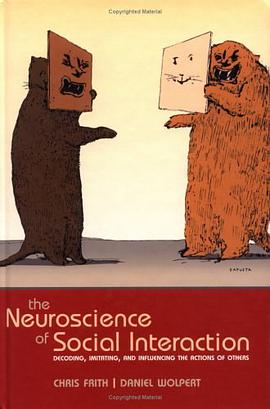
The first book to explore the neural bases of social interactions
Edited and written by leading researchers from psychology and neuroscience
An important addition to the emerging field of social neuroscience
Humans, like other primates, are intensely social creatures. One of the major functions of our brains must be to enable us to be as skilful in social interactions as we are in our interactions with the physical world (e.g. recognising objects and grasping them). Furthermore, any differences between human brains and those of our nearest relatives, the great apes, are likely to be linked to our unique achievements in social interaction and communication rather than our motor or perceptual skills. Unique to humans is the ability to mentalise (or mind read), that is to perceive and communicate mental states, such as beliefs and desires.
A key problem facing science is to uncover the biological mechanisms underlying our ability to read other minds and to show how these mechanisms evolved. To solve this problem we need to do experiments in which people (or animals) interact with one another rather than behaving in isolation. Such experiments are now being conducted in increasing numbers and many of the leading exponents of such experiments have contributed to this volume. 'The Neuroscience of Social Interactions' will be an important step in uncovering the biological mechanisms underlying social interactions - undoubtedly one of the major programmes for neuroscience in the 21st century.
Readership: Cognitive and social neuroscientists (graduate/research level)
作者简介
Christopher D. Frith, Wellcome Department of Imaging Neuroscience, Institute of Neurology, College London, UK, and Daniel Wolpert, Sobell Department of Motor Neuroscience and Movement Disorders, Institute of Neurology, University College London, UK
Contributors:
C D Frith & D M Wolpert
Aina Puce, Centre for Advanced Imaging, Dept of Radiology, West Virginia University, Morgantown WV, USA
David Perrett, School of Psychology, University of St Andrew's, Fife, UK
Gergely Csibra, Centre for Brain and Cognitive Development, School of Psychology, Birkbeck College, London, UK
Uta Frith, Institute of Cognitive Neuroscience, University College London, UK
Christopher D Frith FRS, Wellcome Department of Imaging Neuroscience, University College London, UK
Jens Rittscher, GE Global Research, One Research Circle, Niskayuna NY, USA
Andrew Blake, Microsoft Research, Cambridge, UK
Anthony Hoogs, GE Global Research, One Research Circle, Niskayuna NY, USA
Gees Stein, GE Global Research, One Research Circle, Niskayuna NY, USA
Andrew N Meltzoff, Center for Mind, Brain and Learning, University of Washington, Seattle WA, USA
Jean Decety, Center for Mind, Brain and Learning, University of Washington, Seattle WA, USA
Andreas Wohlschlager, Dept of Cognition and Action, Max Planck Institute for Psychological Research, Munich, Germany
Merideth Gattis, School of Psychology, University of Cardiff, Cardiff, UK
Harold Bekkering, Nijmegen Institute for Cognition and Information, University of Nijmegen, Nijmegen, The Netherlands
Vittorio Gallese, Istituto di Fisiologia Umana, Universita de Parma, Parma, Italy
R W Byrne, School of Psychology, University of St Andrew's, Fife, UK
Stefan Schaal, Computer Science & Neuroscience, University of Southern California, Los Angeles CA, USA
Auke Ijspeert, Computer Science & Neuroscience, University of Southern California, Los Angeles CA, USA
Aude Billard, Computer Science & Neuroscience, University of Southern California, Los Angeles CA, USA
Susan C Johnson, Dept of Psychology, Stanford University, Stanford CA, USA
R J R Blair, Unit on Affective Cognitive Neuroscience, NIMH, NIH, Bethesda MD, USA
Dale Griffin, Graduate School of Business, Stanford University, Stanford CA, USA
Richard Gonzalez, Dept of Psychology, University of Michigan, Ann Arbor MI. USA
David Sally, Johnson Graduate School of Management, Cornell University, Ithaca NY, USA
Daniel M Wolpert, Sobell Dept of Motor Neuroscience & Movement Disorders, Insitute of Neurology, London, UK
Kenji Doya, ATR Human Information Science Laboratories, Kyoto, Japan
Mitsuo Kawato, ATR Human Information Science Laboratories, Kyoto, Japan
目录信息
Biological motion: decoding social signals
1: A Puce & D Perrett: Electrophysiology and brain imaging of biological motion
2: G Csibra: Teleological and referential understanding of action in infancy
3: U Frith & C D Frith: Development and neurophysiology of mentalizing
4: J Rittscher, A Blake, A Hoogs & G Stein: Mathematical modelling of animate and intentional motion
Mirror Neurons: Imitating the Behaviour of Others
5: A N Meltzoff & J Decety: What imitation tells us about social cognition: a rapprochement between developmental psychology and cognitive neuroscience
6: A Wohlschlager, M Gattis & H Bekkering: Action generation and action perception in imitation: an instance of the ideomotor principle
7: V Gallese: The manifold nature of interpersonal relations: the quest for a common mechanism
8: R W Byrne: Imitation as behaviour parsing
9: S Schaal, A Ijspeert & A Billard: Computational approaches to motor learning by imitation
Mentalizing: Closing the Communication Loop
10: S C Johnson: Detecting agents
11: R J R Blair: Facial expressions, their communicatory functions and neuro-cognitive substrates
12: D Griffin & R Gonzalez: Models of dyadic social interaction
13: D Sally: Dressing the mind properly for the game
14: D M Wolpert, K Doya & M Kawato: The unifying computational framework for motor control and social interaction
· · · · · · (收起)