
具体描述
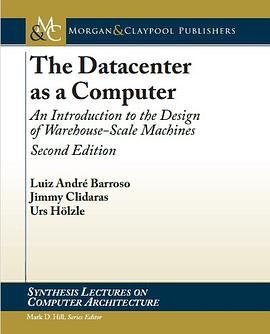
The Datacenter as a Computer: An Introduction to the Design of Warehouse-Scale Machines, Second edition
Synthesis Lectures on Computer Architecture
July 2013, 154 pages, (doi:10.2200/S00516ED2V01Y201306CAC024)
Luiz André Barroso
Google, Inc.
Jimmy Clidaras
Google, Inc.
Urs Hölzle
Google, Inc.
Abstract
As computation continues to move into the cloud, the computing platform of interest no longer resembles a pizza box or a refrigerator, but a warehouse full of computers. These new large datacenters are quite different from traditional hosting facilities of earlier times and cannot be viewed simply as a collection of co-located servers. Large portions of the hardware and software resources in these facilities must work in concert to efficiently deliver good levels of Internet service performance, something that can only be achieved by a holistic approach to their design and deployment. In other words, we must treat the datacenter itself as one massive warehouse-scale computer (WSC). We describe the architecture of WSCs, the main factors influencing their design, operation, and cost structure, and the characteristics of their software base. We hope it will be useful to architects and programmers of today’s WSCs, as well as those of future many-core platforms which may one day implement the equivalent of today’s WSCs on a single board.
Notes for the Second Edition
After nearly four years of substantial academic and industrial developments in warehouse-scale computing, we are delighted to present our first major update to this lecture. The increased popularity of public clouds has made WSC software techniques relevant to a larger pool of programmers since our first edition. Therefore, we expanded Chapter 2 to reflect our better understanding of WSC software systems and the toolbox of software techniques for WSC programming. In Chapter 3, we added to our coverage of the evolving landscape of wimpy vs. brawny server trade-offs, and we now present an overview of WSC interconnects and storage systems that was promised but lacking in the original edition. Thanks largely to the help of our new co-author, Google Distinguished Engineer Jimmy Clidaras, the material on facility mechanical and power distribution design has been updated and greatly extended (see Chapters 4 and 5). Chapters 6 and 7 have also been revamped significantly. We hope this revised edition continues to meet the needs of educators and professionals in this area.
Table of Contents: Acknowledgments / Note to the Reader / Introduction / Workloads and Software Infrastructure / Hardware Building Blocks / Datacenter Basics / Energy and Power Efficiency / Modeling Costs / Dealing with Failures / Closing Remarks / Bibliography / Author Biographies
作者简介
目录信息
读后感
用户评价
如果要用一个词来概括这部作品的精髓,那可能是“**系统化思维**”。它成功地将一个原本被割裂的、由无数供应商和技术栈拼凑而成的“数据中心”,重新塑造成了一个具有清晰边界、可量化、可预测的计算单元。作者对度量衡体系的强调尤为重要,他清晰地界定了哪些指标真正反映了系统的健康状态,而非仅仅是忙碌程度。从TCO(总拥有成本)到PUE(电能使用效率)的关联分析,再到对未来量子计算和边缘计算可能对核心数据中心架构带来的冲击的预判,无不展现出作者深厚的战略眼光。这本书的论据扎实,引用了大量实际案例(尽管没有直接点名,但读者可以体会到其背后是无数次生产环境的洗礼),它不是在描述“现状”,而是在描绘一个“最优解的演进路径”。对于任何希望从“操作员”成长为“架构师”的人来说,这本厚重的指南是里程碑式的参考资料。
评分这本书的阅读体验,就像是跟随一位技艺精湛的钟表匠,拆解一个微缩的宇宙。作者对于自动化和编排系统的论述,体现出对“最小干预”理念的极致追求。他不仅仅罗列了Kubernetes或类似工具的功能,而是深入探讨了配置管理、状态漂移检测以及自愈机制背后的控制论基础。其中对于“基础设施即代码”理念的哲学反思,让我印象深刻——它不仅仅是脚本的集合,更是一种维护系统一致性和可预测性的心智模式的转变。我尤其赞赏其中关于**灾难恢复与弹性**的章节,它摒弃了传统的热备冷备的简单二元对立,转而探讨了基于混沌工程思想的“持续验证”模型,这对于建立真正高可用性的系统至关重要。整本书的行文风格非常沉稳、严谨,偶尔穿插的类比非常贴切,使那些原本深奥的分布式系统理论变得平易近人,但绝不降低其专业水准。
评分我必须承认,这是一本需要坐下来,静下心来细细研读的作品,它不适合在通勤路上匆忙翻阅。它的价值在于其**深度和广度**的完美结合。在谈及安全问题时,作者并未停留在防火墙和ACL的层面,而是将视角拉到了“零信任”架构在数据中心内部的落地挑战,特别是东西向流量加密的性能开销与管理复杂度。这种对安全与性能之间永恒博弈的坦诚探讨,让我感到非常真实。此外,书中对“存储层”的解读也极具启发性,它不再将存储视为一个孤立的盒子,而是将其视为计算不可分割的一部分,探讨了NVMe over Fabrics(NVMe-oF)如何模糊了本地和远程存储的界限,以及这如何反作用于计算节点的调度策略。这是一种跨学科的整合思维,将存储、网络和计算资源视为一个统一的资源池进行优化,是未来数据中心设计的必然方向。
评分这部著作的叙述方式实在令人耳目一新,它不像传统的教科书那样死板地堆砌理论,而是以一种近乎故事化的笔触,带领读者深入到数据中心这个庞大而复杂的有机体之中。作者似乎是位经验丰富的架构师,他没有止步于硬件的罗列或者软件的介绍,而是将目光投向了数据中心作为整体的“生命体”如何运作。我尤其欣赏他对能源效率和可持续性的探讨,这部分内容并非空泛的口号,而是结合了实际的冷却技术、电源管理策略,以及新兴的液冷方案的深入剖析。读起来让人感觉不是在学习一门枯燥的技术,而是在探索一个正在不断进化的前沿领域。书中对虚拟化与容器化技术的集成描述得尤为精妙,那种不同抽象层次间的无缝切换,清晰地展现了现代计算基础设施的韧性与灵活性。特别是关于“Pod”概念的引入,提供了一个极具洞察力的框架,用以理解如何将原本分散的组件高效地整合为一个统一的计算平台。
评分坦白说,初次翻开这本书时,我有些担心它会过于偏重于底层物理设施的描述,但我很快发现我的担忧是多余的。作者的视野极其宏大,他成功地在物理层、网络层和应用层之间架设了一座座坚实的桥梁。关于网络拓扑的设计哲学,书中有着独到的见解,它超越了简单的BGP或OSPF配置讨论,深入到了如何设计一个能够承受大规模东西向流量的扁平化架构,以及应对“胖树”结构瓶颈的创新思路。在我看来,最精彩的部分是对“服务网格”在数据中心规模应用中的挑战与机遇的剖析。作者没有回避实际部署中的复杂性,比如服务发现的延迟、策略执行的一致性,并提出了几套极具操作性的权衡方案。这种深入到工程实践细节又不失理论高度的叙述方式,对于任何一个在超大规模基础设施中工作的人来说,都是无可替代的宝藏。读完这一章节,我对自己正在维护的系统有了更深层次的“内省”能力。
评分新书,正在看
评分别人推荐
评分新书,正在看
评分新书,正在看
评分新书,正在看