
具体描述
From Publishers Weekly
This slender tale of adultery written in 1777 has been rendered into graceful English by Proust translator Davis. The tale encompasses a breathless night for a 20-year-old aristocrat who is spirited away by Mme. de T— from the opera, where he is waiting on another woman, and taken to the lady's home outside of Paris. The luxurious chateau belongs to Mme. de T—'s estranged husband, though the husband and wife are apparently to be reconciled. The young man realizes he is to entertain the wife after her husband goes to bed, which he does until dawn, when his glorious night is ended by the arrival of the lady's previous lover, Marquis de —. In his introduction, Peter Brooks says the story is about the ethics of pleasure, and while scintillating and theatrical, the storytelling is too saccharine to be satisfying. (Oct.)
Copyright © Reed Business Information, a division of Reed Elsevier Inc. All rights reserved.
Review
"Denon's tale portrays the Epicurean aspects of slowness" --The Boston Globe
"One of the loveliest pieces of French prose." --Milan Kundera, The Art of the Novel
"A tale of adulterous love told with impeccable discretion. Balzac like it so much that he cited it in full in his Physiologie du mariage, warning off husbands while recommending it to bachelors as 'a delicious painting of manners of the last century." --The New Oxford Companion to Literature in French
"Captures with concision and panache the spirit of Libertinage so central to eighteenth-century French sociability...No Tomorrow is a tour de force of disabused analysis summarizing all the manipulations, illustions, and self-deceptions which were the essence of eighteenth-century libertinage." --Encyclopedia of Erotic Literature
Product Description
A Bilingual New York Review Books Original
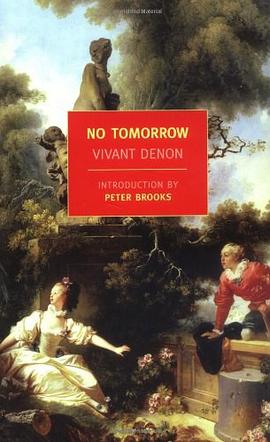
Vivant Denon's No Tomorrow is one of the masterpieces of eighteenth-century French libertine literature, a book to set beside Choderlos de Laclos' Les Liaisons dangereuses, except that where Laclos' icy novel tells of hellish depravity, Denon's ravishing novella is a paradisal diversion. This tale of seduction is itself a seduction, with a plot that could be said to slowly unveil itself before arriving at last at an unexpected consummation.
Summoned by Madame de T—— to her country house, the young hero of Denon's novella is taken on a tour of the grounds, only the beginning of a night that not only will be full of unanticipated delights but will give rise to unforeseen, perhaps unanswerable, questions. Lydia Davis's definitive translation of Denon's slim masterpiece is accompanied by the French text. Peter Brooks's illuminating introduction explores the mysteries of No Tomorrow's original publication and the subtleties of Denon's ethics of pleasure.
作者简介
About the Author
Dominique Vivant Denon (1747-1825), a member of the minor French nobility, was born in Burgundy and sent to Paris to study law—a field he soon abandoned in order to pursue literature and art. After writing a play that enjoyed a small succcess, Denon became a favorite of Louis XV, who in 1769 put him in charge of Madame de Pompadour’s gemstone collection. Dispatched on various diplomatic missions to Russia and Sweden, Denon eventually joined the French embassy in Naples, where he spent seven years studying, etching, and collecting antiquities. The 1789 revolution put Denon’s life at serious risk, but he was protected by his friendship with the painter David, who employed him as a designer of costumes for revolutionary pageants. Denon allied himself to Napoleon and took part in the Egyptian campaign, making sketches of monuments that were later published in his Travels in Upper and Lower Egypt (1802), a book that helped to inspire the Egyptian Revival in the decorative arts. In 1804 Napoleon made Denon the director-general of museums and the head of the Musée Napoleon, and it was Denon who oversaw the assembly of the extraordinary collection, drawn by the Emperor’s armies from all over Europe, that remains central to today’s Louvre. Forced into retirement after Napoleon’s downfall, Denon turned to assembling an illustrated history of art, left unfinished at the time of his death but published posthumously.
Peter Brooks is the author of Henry James Goes to Paris, Realist Vision, Troubling Confessions, Reading for the Plot, The Melodramatic Imagination, and a number of other books, including the historical novel World Elsewhere. He taught for many years at Yale, where he was Sterling Professor of Comparative Literature, and currently is Andrew W. Mellon Scholar at Princeton.
Lydia Davis is an American author and translator of French. She is a Professor of Creative Writing at the University at Albany, SUNY.
目录信息
读后感
用户评价
总而言之,“No Tomorrow”是一本能够触动心灵的书。它不仅仅是一个故事,更是一种关于生活、关于人性、关于选择的深刻探讨。作者以其独特的笔触,为我们展现了一个复杂而又迷人的世界,让我们在阅读中思考,在思考中成长。我强烈推荐这本书给所有热爱深度阅读的读者。
评分故事的开端总是最令人好奇的,而“No Tomorrow”正是如此。它并没有直接切入激烈的冲突,而是通过一系列细腻入微的生活片段,勾勒出人物的性格和他们所处的环境。我特别喜欢作者对细节的描绘,比如人物微微颤抖的手,眼神中一闪而过的复杂情绪,甚至是空气中弥漫的某种难以言喻的气息。这些细小的元素,如同散落在地上的珍珠,串联起来,便形成了整个故事的骨架。读着读着,我仿佛置身于那个世界,与书中的人物一同呼吸,一同感受着他们内心的波动。
评分“No Tomorrow”的语言风格同样令人惊艳。它不是那种华丽辞藻堆砌的浮夸,而是内敛而富有力量。句子结构多变,时而如涓涓细流,温柔地讲述;时而又如惊涛拍岸,激荡人心。作者对词语的选择极其考究,每一个词语都恰如其分地落在该在的位置,不会多一分,也不会少一分。这种对文字的精准驾驭,让整个阅读过程变得格外顺畅,也让故事的情感得以最大程度地传递。
评分我喜欢“No Tomorrow”的留白。作者并没有把所有事情都说得明明白白,而是给读者留下了足够的想象空间。那些未被言说的部分,反而更加引人深思,让我在合上书本后,仍然回味无穷。这种“意犹未尽”的感觉,是对一本好书最好的赞美。
评分这本书的封面设计就足够吸引人了,深邃的蓝色背景,上面是烫银的书名“No Tomorrow”,字体带着一种疏离感,仿佛在诉说着一段遥远而又迫切的故事。拿到手中,纸质的触感温润而厚实,散发着淡淡的油墨香,这是一种久违的阅读体验,让我对接下来的旅程充满了期待。我迫不及待地翻开第一页,作者的文字如同一幅精心绘制的画卷,缓缓在我眼前展开。叙事的节奏把握得恰到好处,没有丝毫拖泥带水,每一个词语都仿佛经过了精雕细琢,准确地传达了作者想要表达的情感和意境。
评分“No Tomorrow”的叙事角度也颇具匠心。它并没有局限于单一人物的视角,而是巧妙地在不同人物之间切换,让读者能够从多个维度去理解事件的发生和人物的动机。这种多视角的叙事方式,使得故事更加立体和饱满,也让我对事件的理解更加深刻。我不再是那个旁观者,而是成为了一个参与者,试图拼凑出事件的全貌。
评分我尤其欣赏作者在构建故事背景上的用心。无论是繁华都市的霓虹闪烁,还是偏僻小镇的宁静祥和,亦或是某个特定时代的历史痕迹,都被描绘得栩栩如生。这种对环境的细致刻画,不仅为故事提供了坚实的土壤,也极大地增强了阅读的沉浸感。我仿佛能闻到空气中的味道,听到远处的声响,感受到风吹过脸颊的触感。这种身临其境的感觉,是许多作品难以企及的。
评分“No Tomorrow”的结构设计也很有意思。它并非是简单线性叙事的堆叠,而是通过一些巧妙的伏笔和呼应,将整个故事紧密地联系在一起。这种精巧的结构,让我在阅读过程中不断地去猜测和期待,每一次的发现都带来新的惊喜。
评分随着情节的深入,我发现自己越来越沉浸其中。书中的人物并非是脸谱化的符号,而是活生生的人,他们有优点也有缺点,有理想也有彷徨。作者并没有回避人性的阴暗面,反而将其展现得淋漓尽致,但同时又给予了他们一丝温暖的希望。这种复杂性和真实感,让我对他们产生了强烈的共情。我时常在想,如果是我,在同样的情况下,又会做出怎样的选择?这种代入感,是“No Tomorrow”最成功的地方之一,它不仅仅是阅读,更是一种与角色共同经历的体验。
评分这本书的情感张力非常强。作者能够精准地捕捉到人物内心最细微的情感变化,并将之放大,让读者能够感同身受。从最初的期待、疑惑,到后来的紧张、欣喜,再到最终的思考和释然,我仿佛经历了一场情感的过山车。这种情感上的共鸣,让阅读“No Tomorrow”成为一种难忘的体验。
评分 评分 评分 评分 评分