
具体描述
Review
"A closely argued work, part of an excellent series on British idealists." -- Mark Garnett, Times Literary Supplement
"A valuable and commendable contribution to the study of Collingwood's philosophy" -- Richard Murphy, Collingwood and British Idealism Studies.
"Exegesis of the highest quality." -- Andrew Lockyer, History of Political Thought
Product Description
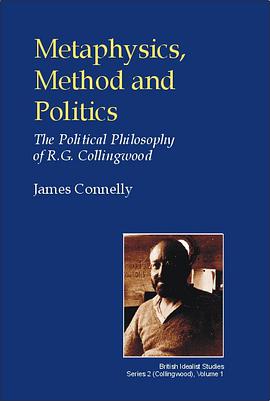
This book argues that R.G. Collingwood developed a rich and coherent account of politics and civilization. It situates Collingwood’s political philosophy within his broad philosophical approach and shows how he understood and placed political experience within the context of human experience as a whole. The book argues both that Collingwood’s overall philosophical approach is both coherent and unified and that his political philosophy should be considered as an integrated whole.
Part One demonstrates the overall unity of Collingwood’s philosophical project and firmly rejects the ‘radical conversion’ hypothesis which suggests that he underwent a fundamental change of mind and came to embrace a form of historical relativism incompatible with his earlier philosophy. Through an outline of Collingwood’s approach to the nature of philosophy, philosophical method and metaphysics it elucidates both their logical inter-relations and their emergence within his philosophical development.
Part Two explores Collingwood’s ‘political philosophy of civilization’, displaying it as a whole by drawing on a wide variety of sources. It considers the distinctive character of political action in relation to other ethical concepts and experience, the relation between political theory and practice and the nature of civilization. It concludes with a consideration of the dimensions of civilization in which political action is situated within an overall conception of the forms of human experience.
From the Inside Flap
British Idealist Studies Series 3: Collingwood =====================
Editor: David Boucher, Cardiff University
Editorial Board: W.H. Dray (Ottowa) Gary Browning (Oxford Brookes) Bruce Haddock (Cardiff) Rex Martin (Kansas) Guido Vanheeswijck (Antwerp) Jan van der Dussen (Open University, Netherlands)
Current series titles: 1. James Connelly Metaphysics, Method and Politics: The Political Philosophy of R.G. Collingwood (0 907845 31 2)
2. Marnie Hughes-Warrington ‘How Good an Historian Shall I Be?’ R.G. Collingwood, the Historical Imagination and Education (0 907845 61 4)
3. Stein Helgeby Action as History: The Historical Thought of R.G. Collingwood (0 907845 57 6)
About the Author
James Connelly is currently Professor of Political Thought and Head of the School of Human Sciences and Communication at Southampton Institute. He is co-author of Politics and the Environment: From Theory to Practice (with Graham Smith) and co-editor of the forthcoming new edition of Collingwood’s An Essay on Philosophical Method.
Excerpt. © Reprinted by permission. All rights reserved.
Introduction
============
Any philosophy of civilization or politics must situate its subject matter within the full context of human experience; and similarly, Collingwood’s political philosophy of civilization must be situated within his whole philosophy and philosophical approach. This, of course, presupposes that there is an overall philosophical approach and that Collingwood developed a consistent philosophy and consistent method. My claim is, therefore, twofold: first I claim that Collingwood developed a philosophy of politics and civilization, and that this philosophy has its roots in the early just as much as in the later work; and secondly, I claim that Collingwood developed a general philosophy which is for the most part consistent and best regarded as an integrated whole. This second claim, if justified, serves to ground the first claim by eliminating the contention that works from different periods are likely to be mutually inconsistent.
In the nature of things, the second part must come first: the attempt to exhibit the unity of Collingwood’s political and social philosophy presupposes the demonstration of the unity of his philosophy as a whole. In drawing upon diverse texts from different periods of Collingwood’s career in order to build a picture of his philosophy of civilization and politics, I have first of all to be confident that the procedure is justified. As we shall see in Chapter One, many critics have maintained that Collingwood’s work suffered some form of radical break or ‘radical conversion’. If this were so then it would clearly be inadmissible to juxtapose texts taken from different periods without first ascertaining either that these texts were unaffected by the ‘radical conversion’ or that there was no ‘radical conversion’. I shall accordingly argue, throughout Part One, that Collingwood’s philosophical work is best seen as a developing whole, admitting of differences both of emphasis and content, but not admitting of radical discontinuity. I shall attempt to demonstrate that Collingwood’s philosophy is a unity: this demonstration is presupposed in what follows, where I bring together disparate writings on politics and civilization in order to display them as constituting a coherent philosophy.
My presentation of Collingwood’s philosophy does not rely solely on published works: a substantial proportion of the material employed comes from unpublished manuscripts. These manuscripts have been used in order to supplement published writings through the use of added detail, and also through the provision of fresh material on all manner of topics either not dealt with in the published works , or at best, dealt with only briefly. Published works are primary in the sense that they, and they alone, were authorised for publication in permanent and accessible form. However, this does not invalidate the use of the manuscripts. Collingwood’s intentions in publishing a book are one thing: the difficulties and perplexities which arise in the course of a scholar’s efforts to assess these works as a whole are quite another. We are entirely justified in looking at unpublished manuscripts in the hope of answering questions arising from our reading of the published books and articles: and here, while the published works do not cease to be primary, the weight of investigation is necessarily thrown onto the unpublished manuscripts; and if they help us resolve disputes or answer questions which would otherwise be unresolved and unanswered, I hardly think that their importance or value can be denied.
The use of the manuscripts constitutes the core of my presentation. However, the view I take concerning the overall unity of Collingwood’s philosophy and philosophical method is not derived solely from the unpublished manuscripts, and could be argued for without recourse to them. But, given that the manuscripts are available in the public domain and increasingly available through re-issue of Collingwood’s main works, I thought it important to seize the opportunity presented by these manuscripts to amplify the published writings, to clarify points left unclear or insufficiently developed in them, and to supplement them with fresh material.
In what follows, Chapter One clears the ground, and Chapters Two and Three develop an account of the unity of Collingwood’s philosophy, thereby laying the foundations for what follows. In Part Two I begin to construct an account of Collingwood’s political philosophy of civilization. Chapter Four addresses Collingwood’s understanding of the relation of theory to practice: I correct the slightly misleading account in An Autobiography by drawing on manuscript and other sources as well as briefly examining T.H. Green’s position. Such a discussion is unavoidable in dealing with any author’s social or political thought: in Collingwood’s case it is inevitable given the great importance he attaches to the practical relevance of philosophy. I then outline the categories central to Collingwood’s moral and political philosophy. The ‘forms of action’ are characterised and their relation to action as a form of experience indicated.
Chapter Five is concerned with Collingwood’s understanding of political action: it includes a discussion of society, community, ruling and being ruled based largely on The New Leviathan. It also presents Collingwood’s views on punishment, mostly through the use of unpublished manuscripts: and sketches the place of punishment within the overall account of society and community as developed in The New Leviathan. Chapter Six addresses the concept of civilization central to The New Leviathan: I use that book, along with manuscripts and earlier drafts, in order to draw out the meaning of the concept. In doing so I also bring in Collingwood’s interesting discussion of civilization as an ideal which is to be found in an early draft manuscript of The New Leviathan.
Chapter Seven, The Dimensions of Civilization, takes its title from a phrase Collingwood uses in the 1936 manuscript, ‘Man Goes Mad’. The dimensions are emotion, tradition and intelligence and I attempt to indicate how the brief account of these things in ‘Man Goes Mad’ fits into the much more detailed accounts provided in The Principles of Art, The Idea of History, An Autobiography and The New Leviathan.
Finally, in Chapter Eight, I summarise and restate the overall thesis of the book.
作者简介
目录信息
读后感
用户评价
《Metaphysics, Method and Politics》最让我着迷的一点,在于它对于“方法”的强调。作者似乎认为,一个恰当的方法,不仅能帮助我们更好地认识世界,更能塑造我们如何去改造世界。他对于不同方法论流派的梳理和批判,并非仅仅是为了学术上的严谨,更是为了指明在纷繁复杂的现实世界中,我们应该如何有效地行动,如何去构建一个更理想的社会。这种理论与实践的紧密结合,是这本书给我带来的最深刻的启示之一。
评分啊,这本书,Metaphysics, Method and Politics,拿到手的时候就觉得沉甸甸的,不仅是纸张的厚度,更是内容上的分量。我必须得说,在翻开第一页之前,我内心是充满期待,又带着一丝忐忑的。标题本身就足够引人遐想,形而上学、方法论、政治学,这三个词汇的并置,就好比在最坚实的基石上搭建起最精密的机械,再辅以最宏大的建筑蓝图,简直是思想的炼金术。我常常会想,作者是如何将这看似独立却又息息相关的领域巧妙地融合在一起的。是在探索世界本源(形而上学)的过程中,发现了某种普适性的探究方法(方法论),并以此为基础,构建了对社会秩序与权力运作(政治学)的深刻洞察吗?或者,是政治实践中的困境,促使作者回溯到最根本的存在论问题,并在方法论的工具箱里寻找解决之道?这种可能性本身就足够迷人。
评分当我深入到政治学的章节时,我发现自己已经完全被这本书的思想所吸引。作者并非那种仅仅描绘政治图景的观察家,他更像是是一位深度的解剖师,用他前面构建的形而上学和方法论的工具,去剖析权力、制度、个体行为以及社会变迁的内在逻辑。我印象最深刻的是他对“政治”本身的定义,它似乎超越了狭义的权力斗争,而触及到人类社会组织中最根本的动力和价值冲突。他对于不同政治形态的分析,不仅仅是历史的梳理,更是对那些支撑这些形态的形而上学预设的揭示。
评分在方法论的论述上,这本书可以说是为我打开了一扇全新的窗户。我一直认为,任何学科的进步,都离不开有效的研究方法。而《Metaphysics, Method and Politics》在这方面所展现出的深刻见解,绝对是其最令人称道的亮点之一。作者不仅仅是罗列了各种方法,更重要的是,他深入剖析了这些方法背后的哲学基础,以及它们在不同研究情境下的适用性和局限性。我感觉作者似乎在不断地追问,“我们是如何知道的?”以及“我们应该如何去探索?”这种对认知过程的持续反思,使得他的方法论部分充满了生命力,而非僵化的教条。
评分说实话,我花了相当长的时间来消化这本书的某些章节,特别是那些深入探讨形而上学核心概念的部分。作者在处理本体论、认识论以及可能存在的诸如自由意志、因果关系等议题时,那种严谨而又不失创新的笔触,着实让我耳目一新。他并没有简单地重复前人的论断,而是试图在既有的框架中注入新的理解,甚至是对一些长期以来被认为是毋庸置疑的观点提出了挑战。我尤其欣赏他在逻辑推演上的清晰度,尽管某些概念本身就极其抽象,但他总是能循序渐进地引导读者进入其思想的脉络,仿佛在迷宫中为我们点亮一盏盏指路明灯。这种写作风格,既是对智识的尊重,也是对读者的耐心负责。
评分在阅读这本书的过程中,我常常会因为作者的某个论断而陷入沉思。他对于政治现实的解读,总是充满了令人不安的洞察力,但他又不会停留在消极的批判层面。相反,他总是试图从形而上学的根源,以及方法论的视角,去探寻改变现状的可能性。我感觉到,作者在写作时,心中始终燃烧着对人类福祉的关怀,他试图用他严谨的学术探索,为我们指明前进的方向。
评分我必须承认,这本书的某些部分对我的智力来说是一次不小的挑战。作者在处理一些极为复杂的哲学概念时,所使用的术语和论证方式,要求读者具备相当的哲学背景和耐心。但我坚信,正是这种挑战,才使得它的价值更加凸显。就像攀登一座高峰,过程固然艰辛,但登顶后的风景,却是无与伦比的。我反复阅读了其中几段,并尝试将其中的观点与我自己的理解进行比对,这个过程本身就是一种极大的智力锻炼。
评分这本书给我的感受,不仅仅是知识的获取,更是一种思维方式的重塑。在阅读过程中,我发现自己开始习惯性地去审视日常生活中遇到的各种现象背后的形而上学假设,并且尝试用更系统、更严谨的方法去理解它们。作者在书中展现的那种跨学科整合的能力,让我意识到,许多看似独立的问题,其实都存在着深层的联系。他就像一位经验丰富的向导,带领我们在广阔的思想领域里进行一场令人振奋的探险。
评分总而言之,这本书给我带来的体验是多层次的。它既是一次智力上的盛宴,也是一次对世界观的洗礼。作者在《Metaphysics, Method and Politics》中构建的思想体系,不仅具有学术上的重要性,更具有深刻的现实意义。他鼓励我们去质疑,去探究,去用更清晰的方法理解我们所处的复杂世界,并在此基础上,积极地去塑造我们想要的未来。
评分我不得不说,《Metaphysics, Method and Politics》是一本我愿意反复研读的书。它的内容如此丰富,思想如此深刻,每一次重读,似乎都能有新的发现和领悟。作者在将形而上学的抽象思考、方法论的严谨分析与政治学的现实关怀融为一体时,所展现出的卓越才华,足以让任何一位对思想深度有追求的读者受益匪浅。
评分 评分 评分 评分 评分