
具体描述
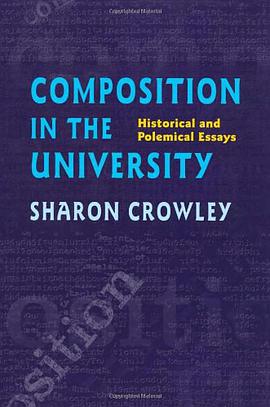
"Composition in the University" examines the required introductory course in composition within American colleges and universities. Crowley argues that due to its association with literary studies in English departments, composition instruction has been inappropriately influenced by humanist pedagogy and that modern humanism is not a satisfactory rationale for the study of writing. Crowley envisions possible nonhumanist rationales that could be developed for vertical curricula in writing instruction, were the universal requirement not in place. "Composition in the University" examines the required introductory course in composition within American colleges and universities. According to Sharon Crowley, the required composition course has never been conceived in the way that other introductory courses have been--as an introduction to the principles and practices of a field of study. Rather it has been constructed throughout much of its history as a site from which larger educational and ideological agendas could be advanced, and such agendas have not always served the interests of students or teachers, even though they are usually touted as programs of study that students "need." If there is a master narrative of the history of composition, it is told in the institutional attitude that has governed administration, design, and staffing of the course from its beginnings--the attitude that the universal requirement is in place in order to construct docile academic subjects. Crowley argues that due to its association with literary studies in English departments, composition instruction has been inappropriately influenced by humanist pedagogy and that modern humanism is not a satisfactory rationale for the study of writing. She examines historical attempts to reconfigure the required course in nonhumanist terms, such as the advent of communications studies during the 1940s. Crowley devotes two essays to this phenomenon, concentrating on the furor caused by the adoption of a communications program at the University of Iowa. "Composition in the University" concludes with a pair of essays that argue against maintenance of the universal requirement. In the last of these, Crowley envisions possible nonhumanist rationales that could be developed for vertical curricula in writing instruction, were the universal requirement not in place. Crowley presents her findings in a series of essays because she feels the history of the required composition course cannot easily be understood as a coherent narrative since understandings of the purpose of the required course have altered rapidly from decade to decade, sometimes in shockingly sudden and erratic fashion. The essays in this book are informed by Crowley's long career of teaching composition, administering a composition program, and training teachers of the required introductory course. The book also draw on experience she gained while working with committees formed by the Conference on College Composition and Communication toward implementation of the Wyoming Resolution, an attempt to better the working conditions of post-secondary teachers of writing.
作者简介
目录信息
读后感
用户评价
这部《Composition in the University》的标题着实抓人眼球,让我想起了我当年在象牙塔里摸爬滚打的那段日子。我翻开书,期待着能找到一些关于大学写作核心原则的深入剖析,或许是关于议论文构建的精妙布局,亦或是对学术引证规范的细致解读。然而,我发现这本书的侧重点似乎完全偏离了我的预期。它更像是一部关于“大学生活本身”的散文集,而非严格意义上的写作指南。书中花了大量篇幅描述新生入学时的迷茫、在图书馆度过的漫长夜晚,以及与室友之间那些鸡毛蒜皮却又深刻影响心智的互动。我理解这些经历对一个年轻人的成长至关重要,但作为一本以“Composition”命名的书籍,我更希望看到的是结构、逻辑和修辞的真谛。书中偶尔提及的写作技巧,也多是点到为止,缺乏实操性的案例支撑,读起来总觉得隔靴搔痒,无法真正帮助我提升笔力。它更像是一份对校园生活的温柔怀旧,而不是一本能够指导我如何清晰、有力地表达思想的工具书。
评分这本书最让我感到困惑的一点是,它似乎对“学术诚信”和“研究方法”采取了一种极其松散的态度。鉴于“Composition in the University”这个主题,我本能地认为书中会对信息来源的可靠性、有效引用以及避免抄袭等关键议题给予足够的重视。然而,书中对于如何进行严谨的文献综述几乎只字未提,即便偶尔提及“引用”,也仅是草草带过,没有给出任何关于APA、MLA或其他主流格式的指导。相反,书中花了大量笔墨去探讨“个人体验的至高无上性”,似乎暗示着主观感受可以凌驾于客观事实之上。这种对学术基石的轻描淡写,让我对这本书的教育价值产生了深深的疑虑。大学写作的基础,恰恰在于对现有知识体系的尊重和有效整合,而这本书似乎在无意中弱化了这一点。
评分我不得不承认,这本书的语言风格非常独特,几乎可以用“晦涩”来形容。它大量运用了后现代主义的碎片化叙事手法,章节之间跳跃极大,主题的转换常常毫无预兆,让人有一种在迷宫中穿行的感觉。我试图从中寻找一些关于“如何在大学论文中确立有力论点”的清晰路径,但读到的更多是关于作者自身对“知识建构的虚无性”的哲学沉思。那些句子冗长且充满复杂的从句,仿佛在挑战读者的耐心和理解力。每一次当我以为我捕捉到了一个核心论点时,下一段文字就会将我带入一个完全不同的语境,让我不得不回顾前文,试图拼凑出作者的意图。这或许是作者有意为之,试图模仿大学论文中常见的“论证的复杂性”,但对于一个期望获得实用指导的读者来说,这种表达方式无疑是巨大的阅读障碍。它更像是一部哲学家的手稿,而非面向大学生的实用教程。
评分如果以一本“大学新生写作入门”的标准来衡量,《Composition in the University》的失败在于它过于注重形而上的探讨,而完全忽略了“可操作性”。我需要知道如何克服“空白页恐惧症”,如何有效地进行头脑风暴,如何将一个模糊的想法转化为一个有力的论点,并用清晰的层次结构将其呈现出来。这本书没有提供任何实用的清单、练习题,或者经过验证的写作流程图。它更像是邀请读者进行一场漫无边际的精神漫游,而不是提供一把攀登知识高峰的脚手架。对于那些真正需要提高作业分数、渴望在课堂辩论中清晰发言的学生来说,这本书提供的精神慰藉远少于实际的工具价值。它更适合那些已经对写作技巧了如指掌,只是想寻找一些哲学共鸣的资深学者,而不是那些正在学步的年轻写作者。
评分从装帧和排版来看,这本书的编辑质量也令人不敢恭维。作为一本旨在教授“清晰表达”的书籍,其内部版面设计却显得杂乱无章。字体大小不一,段落间距时而过密,时而疏松,更不用提那些似乎随机出现、毫无关联的插图——它们更像是从某个早期实验艺术杂志中随意剪贴而来的。阅读过程中,我的注意力总是被这些视觉上的干扰分散,难以沉浸于文字内容本身。一个关于“写作”的指南,理应在形式上就体现出对清晰度和逻辑性的尊重,而这本书在这方面表现得极其随意。这种内在的混乱感,与我对一本优秀的学术辅助读物所抱有的期待形成了鲜明的反差,让人不得不质疑作者或编者是否真正理解了“结构美学”在信息传递中的重要作用。
评分 评分 评分 评分 评分