
具体描述
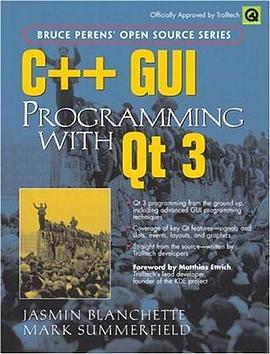
Preface The Qt toolkit is a C++ class library and a set of tools for building multiplatformGUI programs using a "write once, compile anywhere" approach. Qt letsprogrammers use a single source tree for applications that will run on Windows95 to XP, Mac OS X, Linux, Solaris, HP-UX, and many other versions ofUnix with X11.A version of Qt is also available for Embedded Linux, with thesame API. The purpose of this book is to teach you how to write GUI programs using Qt 3.The book starts with "Hello Qt" and quickly moves on to more advanced topics,such as creating custom widgets and providing drag and drop. The text iscomplemented by a CDthat contains the source code of the example programs.The CD also provides Qt and Borland C++ for Windows, Qt for Unix, and Qtfor Mac OS X. Appendix A explains how to install the software. The book focuses on explaining good idiomatic Qt 3 programming techniquesrather than simply rehashing or summarizing Qt's extensive online documentation.And because we are involved in the development of Qt 4, we have triedto ensure that most of what we teach here will still be valid and sensible forQt 4. It is assumed that you have a basic knowledge of C++. The code examples usea subset of C++, avoiding many C++ features that are rarely needed whenprogramming Qt. In the few places where a more advanced C++ construct isunavoidable, it is explained as it is used. Qt made its reputation as a multiplatform toolkit, but because of its intuitiveand powerful API, many organizations use Qt for single-platform development.Adobe PhotoshopAlbum is just one example of a mass-marketWindowsapplication written in Qt. Many sophisticated software systems in verticalmarkets, such as 3D animation tools, digital film processing, electronic designautomation (for chip design), oil and gas exploration, financial services, andmedical imaging, are built with Qt. If you are making a living with a successfulWindows product written in Qt, you can easily create new markets in theMac OS X and Linux worlds simply by recompiling. Qt is available under various licenses. If you want to build commercialapplications, you must buy a commercial license; if you want to build opensource programs,you can use a non-commercial Qt edition. (The editions of Qton the CD are non-commercial.) Qt is the foundation on which the K DesktopEnvironment (KDE) and the many open source applications that go with itare built. In addition to Qt's hundreds of classes, there are add-ons that extend Qt'sscope and power. Some of these products, like the Qt/Motif integration moduleand Qt Script for Applications (QSA), are supplied by Trolltech, while othersare provided by companies and by the open source community. See http://www.trolltech.com/products/3rdparty/ for information on Qt add-ons. Qt alsohas a well-established and thriving user community that uses the qt-interestmailing list; see http://lists.trolltech.com/ for details. The book is divided into two parts. Part I covers all the concepts and practicesnecessary for programming GUI applications using Qt. Knowledge of thispart alone is sufficient to write useful GUI applications. Part II covers centralQt topics in more depth and provides more specialized and advanced material.The chapters of Part II can be read in any order, but they assume familiaritywith the contents of Part I.
作者简介
目录信息
读后感
用户评价
阅读这本书的过程,与其说是学习编程技术,不如说是一次对 C++ 早期面向对象 GUI 范式的深入考古。作者在讲解 Widgets 继承和自定义控件时,展现了非常深入的底层理解,那种对事件循环(Event Loop)如何驱动用户交互的剖析,细致到了令人生畏的地步。不同于现代框架倾向于隐藏复杂性,这本书似乎更鼓励读者“直面复杂性”,去手动管理资源句柄,去体会每一次重绘(Repaint)背后的绘图上下文(Painting Context)的生命周期。在涉及网络编程和数据库连接的部分,我发现书中所介绍的类库和 API 已经完全被新的模块所取代,例如 MOC 脚本的编写规范和当时Qt Designer 的界面文件格式,都充满了时代印记。这迫使我不得不经常查阅外部文档来核对现代 Qt 库中对应的功能模块,使得学习曲线显得非常陡峭和不连贯。对于一个追求效率的开发者而言,这本书提供的“知识迁移成本”实在太高了。
评分从一个注重代码可维护性和长期项目的角度来看,这本书中关于内存管理和对象生命周期的处理方式,是其最让我感到与现代实践脱节的部分。虽然 Qt 3 引入了 QObject 的父子关系来辅助内存管理,但书中对裸指针的使用频率和对 `delete` 调用的细致把控,让我不禁感到后背发凉,仿佛又回到了 C++98 的黄金时代。相比之下,现代 Qt 版本中对智能指针的采纳和自动垃圾回收机制的增强,极大地简化了这些令人头疼的问题。这本书中的例子代码,如果未经大量修改直接用于当前的开发环境,很可能会引发难以追踪的内存泄漏或悬空指针错误。因此,这本书与其说是教你如何用 Qt 3 编程,不如说是在用一个非常具体的、过时的工具集,间接地阐述了 C++ 软件工程的基本原则。它的教育意义大于其实用价值,需要读者具备深厚的 C++ 功底才能去芜存菁。
评分这本关于使用 Qt 3 进行 C++ GUI 编程的书籍,在我看来,更像是一份详尽的“历史文献”,而非一本面向现代开发者的实践指南。当我翻开它时,首先感受到的是那个时代特有的技术氛围,Qt 3 的架构和设计哲学与我们现在习以为常的 Qt 5 或 Qt 6 存在着显著的代沟。书中对信号与槽机制的讲解是扎实的,这是 Qt 的核心,无论哪个版本,理解这一点至关重要。然而,书中大量篇幅花费在处理诸如 MOC(Meta-Object Compiler)的特定版本行为、手动内存管理中的一些晦涩细节,以及针对特定旧版操作系统的兼容性考量上,这些对于一个想要快速搭建现代跨平台应用的新手来说,无疑是一种负担。我特别注意到作者在处理布局管理器(Layout Managers)时,那种步步为营的讲解方式,虽然逻辑清晰,但放在今天,我们可能只需要几行 QGridLayout 或 QML 的声明就能轻松完成,这让我深切体会到软件工具链发展的速度之快。总而言之,这本书的价值更多在于追溯 Qt 发展的脉络,而非直接指导我完成一个能顺利编译并部署到主流平台的项目。
评分我必须承认,书中对一些基础图形操作和对话框设计的阐述,具有一种近乎教科书式的经典美感。作者讲解如何手动创建和绘制简单的几何图形,如何定制控件的渲染管道,那种细致入微的步骤分解,是很多现代“高层抽象”框架所不具备的。这种详尽描述,让读者能够清晰地看到像素是如何被‘绘制’到屏幕上的,对于理解计算机图形学的基本原理非常有帮助。然而,这种详尽的代价是极高的开发效率。当我试图在书中找到关于现代网络通信、多线程处理(特别是涉及现代并发模型时)或者如何利用 GPU 加速绘图的内容时,发现几乎是空白的。这本书的视野被严格限制在了 Qt 3 提供的能力范围内,这使得它在面对当前富媒体、高并发的软件需求时,显得力不从心。它更像是一个特定历史时期的技术快照,值得收藏,但不适合作为当前项目的首选参考资料。
评分这本书在面向对象设计原则的阐述上,尤其是在如何利用 C++ 的特性来构建可扩展的 GUI 框架方面,提供了一些值得肯定的思路。作者对于抽象基类和纯虚函数的运用,以及如何设计一个清晰的模块化结构来应对小型到中型项目的需求,展示了一种严谨的工程态度。但这种严谨性,在实际操作中却常常被旧有的库依赖所束缚。例如,书中关于样式表(Stylesheets)的讨论,与现在 QSS(Qt Style Sheets)的丰富功能相比,显得极为基础和受限,很多视觉效果的实现需要依赖大量的手动绘图代码,而不是通过简单的 CSS 语法就能搞定。我欣赏作者试图在有限的工具集内榨取出最大潜能的努力,但这更像是一种“在镣铐中跳舞”,而非现代高效的开发模式。这种对“底层控制”的执着,使得阅读体验在很多时候变成了一种对旧有编程范式的反思,而不是学习新技能的兴奋。
评分1. 每个创业的人都需要有个能养他几年的老婆 2. 任何时间都有一些事情在世界的某个地方发生着。。。
评分1. 每个创业的人都需要有个能养他几年的老婆 2. 任何时间都有一些事情在世界的某个地方发生着。。。
评分1. 每个创业的人都需要有个能养他几年的老婆 2. 任何时间都有一些事情在世界的某个地方发生着。。。
评分1. 每个创业的人都需要有个能养他几年的老婆 2. 任何时间都有一些事情在世界的某个地方发生着。。。
评分1. 每个创业的人都需要有个能养他几年的老婆 2. 任何时间都有一些事情在世界的某个地方发生着。。。