
具体描述
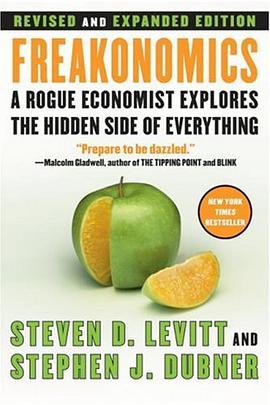
Which is more dangerous, a gun or a swimming pool? What do schoolteachers and sumo wrestlers have in common? Why do drug dealers still live with their moms? How much do parents really matter? How did the legalization of abortion affect the rate of violent crime? These may not sound like typical questions for an econo-mist to ask. But Steven D. Levitt is not a typical economist. He is a much-heralded scholar who studies the riddles of everyday life—from cheating and crime to sports and child-rearing—and whose conclusions turn conventional wisdom on its head. Freakonomics is a groundbreaking collaboration between Levitt and Stephen J. Dubner, an award-winning author and journalist. They usually begin with a mountain of data and a simple question. Some of these questions concern life-and-death issues; others have an admittedly freakish quality. Thus the new field of study contained in this book: freakonomics. Through forceful storytelling and wry insight, Levitt and Dubner show that economics is, at root, the study of incentives—how people get what they want, or need, especially when other people want or need the same thing. In Freakonomics , they explore the hidden side of . . . well, everything. The inner workings of a crack gang. The truth about real-estate agents. The myths of campaign finance. The telltale marks of a cheating schoolteacher. The secrets of the Klu Klux Klan. What unites all these stories is a belief that the modern world, despite a great deal of complexity and downright deceit, is not impenetrable, is not unknowable, and—if the right questions are asked—is even more intriguing than we think. All it takes is a new way of looking. Freakonomics establishes this unconventional premise: If morality represents how we would like the world to work, then economics represents how it actually does work. It is true that readers of this book will be armed with enough riddles and stories to last a thousand cocktail parties. But Freakonomics can provide more than that. It will literally redefine the way we view the modern world.
作者简介
史蒂芬·列维特,1994年在麻省理工大学取得经济学博士学位。1997年进入芝加哥大学执教短短两年时间列维特就成为芝加哥大学经济学院终身教授。2002年列维特被选为美国科学院经济学部委员。列维特还担任《政治经济学杂志》(JPE)的编辑和《经济学季刊》(OJE)的编辑。
史蒂芬·都伯纳,《纽约时报》和《纽约客》长期撰稿人,著有畅销书《骚动的灵魂》和《一个英雄崇拜者的自白》。
目录信息
读后感
Freakonomics已经在纽约时报畅销书排行榜上待了46周。这本书现在也有了中文简体版,译名是《魔鬼经济学》。从原书名看,freakonomics=freak+economics,是作者自创的一个词汇,意思大概就是用economics的方法来研究一些 freak的现象,或者也可以理解成freak研究的经济学,因此...
评分我是一个经济学盲。 因为我是一个经济学盲,所以对于这本号称能够“敲破你脑袋”的书产生了兴趣。不夸张的说,这是我读的第一本和经济沾边的书,可是它并没有像承诺的那样,敲破我的脑袋,或者“彻底改变”我“看世界的角度”。事实上,我根本没觉得自己看世界的方式因为这本...
评分非常推荐这本书, 最近利用在地铁以及厕所时间在读. 读这本书的过程是极其愉快的,总可以打破自己很多习以为常,默认的观念,这本书让我想起来了另外一本书 ,outliers,都是在对我们很多习惯的观念进行分析与思考,结果是会让我们发现,实际上多少约定俗成的观念实际上是错...
评分可别看到“经济学”三个字就望而却步。这实在是一本相当有趣的读物。 正如副标题“解释隐藏在表象之下的真实世界”,此书的目的便是用经济学的分析方法去解释一些在我们平常看来和经济无关的事情。看看书的目录你便明白这一点了,“学校老师跟相扑运动员之间有何共同之处”...
评分用晚上三个小时的时间,看完了现在比较流行的一本书Freakonomics: A Rogue Economist Explores the Hidden Side of Everthing (Steven Levitt & Stephen Dubner, 2006)的中译本(刘祥亚译,广东经济出版社)。 其实很早自己就有了这本书的英文原版,看了一半,觉得很好玩,所...