
具体描述
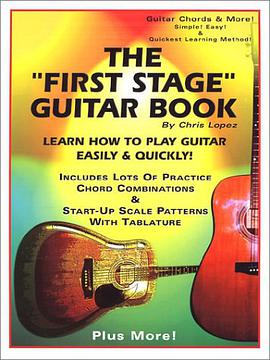
Boldly Ilustrated See and Do Approach... Only the Good Guitar Stuff Free of All That Wordy Fluff The First Stage Guitar Book is a must have simplified pool of guitar playing information to carry along as your trusted companion to get any beginning new guitar playing enthusiasts moving forward. For starters, it is a guitar book without a lot of words and words, but is a See and Do guitar book that presents the basics for every beginning guitar player in bold and easy to understand fingering diagram illustrations. Here is a list of some of the basic but important learning to play guitar information contained in The First Stage Guitar Book, the source to building a great foundation for the beginning guitar playing enthusiast: How to tune the guitar. How to hold and strum the guitar. How to play chord progressions without reading music. Learn the most commonly played guitar chords in both Open and Barre forms. Learn how to play the most commonly played guitar chords in all keys: Majors, Minors, Minor 7ths, Dominant 7ths, Major 7ths, 9ths along with practice chord progressions galore. A number of simple and boldly illustrated practice chord diagrams to show you how to move from chord to chord with ease. Learn the most commonly and easiest fingering patterns and the best sounding fingering patterns along with suggested tips on how to enhance the sound of a chord. Instantly change a chord of the same name from a major chord to a minor to a minor seventh or dominant seventh chord by just lifting a finger (i.e., an F Major to an F Minor to an F Minor Seventh to an F7) Kick your chord progressions into rock 'n' roll by adding 7th chords in every key along with illustratedaccompanying chord progressions. Get into the blues mood with 9th chords in every key along with accompanying illustrated chord progressions. Simple technique on how to transpose a chord progression to suit your voice. How to play scale patterns without reading music in both staff and ta and notation. Start-Up Scale Patterns With Tablature are given in easy to understand illustrated diagrams along with chord progressions to accompany the scale patterns in matching keys. Put your own melodies together with the easy to understand CHORD COMBINATION CHART leaving you without the guessing of which chord goes with which chord, available only in The First Stage Guitar Book. You will discover and experience immediate progress on your way to learning how to play the guitar and then use it toward your favorite style of music, rock 'n' roll, blues, country, popular, folk, etc., for as long as you play the guitar. There are more than just two or three chords and scales in this simple and clearly illustrated learn how to play guitar book. The First Stage Guitar Book. contains the easiest and best sounding chord fingering patterns from every key as well as some of the most basic scale patterns suitable for the beginning guitar player.
作者简介
目录信息
读后感
用户评价
翻阅过程中,我注意到一个非常人性化的设计:几乎每一章的末尾,都会设置一个“自我诊断与调适”的小环节。它不是那种简单的问答测试,而是鼓励读者停下来,审视自己过去几页的学习成果,并提供了一套详细的“常见误区自检清单”。比如,对于和弦按压不清的问题,它没有直接说“按紧点”,而是引导你去检查“手指关节的弯曲角度是否合理”、“虎口与琴颈的接触点是否过度用力”等一系列细微之处。这种高度关注个体差异的处理方式,极大地减少了初学者在遇到瓶颈时的挫败感。此外,书中穿插的许多“大师的秘密”小提示,更是让人醍醐灌顶。比如,关于如何用最少的力气按出清晰的和弦音,作者提供了一个关于“利用重力和杠杆原理”的微小调整建议,这个建议看似简单,但实践后发现,它极大地缓解了我右手虎口的疲劳感。这本书的编写者显然是深谙教学心理学,他们懂得如何将复杂的物理原理,转化成初学者可以立即上手的、直观的动作指南。
评分这本《The First Stage Guitar Book》的封面设计简直是视觉的盛宴,那种复古与现代交织的风格,让人一眼就心生亲近感。我拿到书的时候,首先被它精良的印刷质量所吸引,纸张的质感厚实而细腻,即便是频繁翻阅,也丝毫没有廉价感。内页的排版布局也极其用心,每一个和弦图和指法标记都清晰得像是艺术品,即便是对吉他一窍不通的“小白”,也能感受到编排者的诚意与专业度。更令人惊喜的是,它似乎并未局限于传统的枯燥教学,而是巧妙地融入了一些关于吉他历史和著名吉他手的轶闻,这些“花边”内容让学习过程变得不再单调乏味,仿佛我不是在啃一本教科书,而是在阅读一本充满情怀的音乐杂志。我特别欣赏作者在引入基础乐理知识时所采用的那种润物细无声的教学方式,它不像其他教材那样上来就抛出大量的术语,而是通过一个个生动的例子,让你在不知不觉中掌握了乐理的精髓。这种循序渐进,又不失趣味性的设计,无疑为初学者铺就了一条平坦而愉快的入门大道。我甚至觉得,光是把这本书放在书架上,它本身就是一件提升家居品味的摆设。
评分说实话,我对很多入门吉他教材的“套路”早就感到厌倦了——无非是C、G、Am、F这几个万年不变的和弦,然后就是慢得令人发指的练习曲。但这本书的开篇就给我带来了极大的冲击。它没有急于让我去按压那些硌得手指生疼的品丝,而是花了大篇幅去探讨“如何正确地握持吉他”以及“正确的坐姿对音色和手感的影响”。这一点非常关键,因为很多自学的人恰恰忽略了这些基础中的基础,导致后期发力不协调甚至受伤。作者对细节的执着达到了近乎偏执的程度,例如,对于拨片厚度的选择,竟然列出了不同风格演奏(扫弦、指弹、推弦)的最佳范围,并且配上了详细的图解来解释不同厚度对音头和延音的影响。这种深度探讨,在我看来,已经超越了“初级”的范畴,它是在为建立一个“正确的吉他思维框架”打地基。我立刻尝试了书上建议的几个放松练习,效果立竿见影,原本僵硬的手腕似乎一下子获得了新生。这本书的价值,不在于教你弹什么歌,而在于教你如何**成为**一个吉他手。
评分如果要用一个词来概括这本书给我的感受,那一定是“广博而精准”。它在技术层面的严谨性令人赞叹,但在内容广度上却超出了我的预期。我原以为“First Stage”的书籍顶多只会涵盖基础的指弹技巧,但这本书却非常前瞻性地引入了对不同音色模拟的探讨。例如,它探讨了如何通过拨弦力度和手指触弦位置的微小变化,来模仿“木吉他”和“钢弦吉他”在音色上的基础差异,甚至还简单介绍了电吉他入门时对“Clean Tone”的初步理解。这种将不同乐器领域知识进行融汇贯通的做法,让读者在学习吉他的同时,也构建起了一个更宏大的音乐世界观。它教会我,吉他不仅仅是吉他,它是一个声音的门户,通向更广阔的音乐领域。阅读这本书的过程,更像是一次精心策划的音乐“探险”,每翻开一页,都有新的惊喜和更深层次的理解等待着我。这绝对是一本值得反复研读的经典之作。
评分这本书的叙事风格有一种非常独特的、近乎哲学思辨的魅力。它很少使用命令式的“你必须”或“你要学会”,更多的是以一种引导者和伙伴的姿态出现。例如,在讲解如何进行第一次换弦时,作者并没有简单地给出步骤,而是阐述了“弦张力与音准稳定性的辩证关系”,让你理解为什么要换弦,以及换弦的时机判断标准,而不是机械地执行操作。这使得学习过程充满了主动探索的乐趣。最让我震撼的是,书中对“节奏感”的剖析,简直是神来之笔。它没有停留在数拍子上,而是引入了诸如“音乐的呼吸”和“律动的呼吸”等概念,甚至引用了古典音乐理论中对复拍子和自由速度的讨论,并将其巧妙地简化到吉他初学者的语境中。这种跨界的融合,让原本枯燥的节奏练习变得充满了画面感和情感张力。我感觉这本书不仅仅是在教授技巧,更是在培养我对音乐的整体感知能力和深度理解力,这对于一个志在长久玩音乐的人来说,是无价的财富。
评分 评分 评分 评分 评分