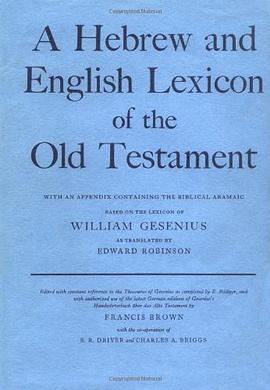

具体描述
Students who wish to advance their Hebrew studies face a daunting choice in terms of lexicons. Only three are worth mentioning for advanced study:
First is BDB which is beginning to show its age, and is principally flawed in that the English definitions in it are often in need of English translation. That said, BDB remains one of the finest ever scholarly achievements, and one would be naive to think it is a work that can be ignored or bypassed. I have found it to contain superior articles on many Hebrew words, especially on the particles. The quality of scholarship is of the highest order and created a legacy that looms large over the world of Hebrew scholarship, and can be felt in more recent works like Clines, see below. BDB also has an advantage over other lexicons in that it is only one contained volume, making it easy to look up words. Many scholars, including a well known international scholar with whom I recently corresponded, still prefer BDB over other works. The edition printed by Oxford is of the highest order in terms of publication standards.
Second, is the four volume lexicon translated by M.E.J. Richardson: The Hebrew and Aramaic Lexicon of the Old Testament (HALOT). This work is now available in two editions, and is printed by Brill: a costly four volume set which just happens to be one of the most beautifully printed set of books I have ever seen, and a cheaper student's edition in two volumes. The font size of the two editions differs, including the quality of publication. Those who can afford it should buy the more expensive set, but those who cannot afford it, will find the smaller edition adequate. This lexicon extensively uses comparative philology for its definitions and is a translation of a German work that took many years to complete. Many regard it as the finest Hebrew lexicon today. The translation by Richardson is outstanding, and I have not as yet read a review anywhere which contested his renderings. However, because the work comes via German, I have found many of the definitions in HALOT to be unnatural English. I also wonder whether the English speaking world ought to depend for its knowledge of Hebrew on the translation by one individual of a German set--regardless of the quality of that set.
The third lexicon worth consideration is the incomplete set (only six volumes have been published) by Clines, The Dictionary of Classical Hebrew. This dictionary is printed by Sheffield Academic Press and has also been very well printed, although the quality of publication does not quite match the Brill set. The only caveat is the price, but it is no more expensive than the four volume set of HALOT. Clines approaches his definitions in a way quite different from HALOT in that there is no comparative philology. Clines believes that the meaning of words are determined by their use in a given context (in the tradition of James Barr). Some see this as a disadvantage. (Notably, Richardson, in a critical review in JSS.) The great advantage though of DCH over HALOT, is that it is careful in every instance to set words in their syntactical relations, making it easy to locate a word, and to understand how it functions in a sentence. Students who want to know more than just a word's meaning will greatly benefit from this. In this respect, DCH is a hundred miles ahead of its competitors. Also, the glosses given under each entry make it a treasure trove for students, who wish to learn basic definitions. There are no such glosses in HALOT, where the ordering of words also, is not in terms of frequency of use, but in terms of concreteness. In addition one finds statistical analysis of words in DCH, which is not the case consistently in HALOT. Another advantage of Clines over HALOT is that every word and phrase in DCH is translated into English. Finally, one should say that the definitions offered in DCH, have a natural English flow, always makes sense, and stand in the great tradition of English Bibles and that of BDB (the definitions in BDB and Clines often correspond). If one wants definitions that stand wholly outside this tradition, one ought to turn rather to HALOT. In an ideal world, one would like to own both HALOT and DCH. But if one cannot afford both, the choice, as far as this reviewer is concerned, is clear.
作者简介
H.W.F. Gesenius (mid 1800's) is acclaimed as the Noah Webster of Old Testament Hebrew lexicons (dictionary). He brings to the Old Testament a wonderful blend of Christian/Jewish background and insight.
目录信息
读后感
用户评价
**作为资深研究者的深度使用体验** 对于我们这些常年与《圣经》文本打交道的学者而言,任何一部新的工具书的问世都是值得关注的事件。我更看重的是它在处理那些语义模糊、存在多种解释的可能性词汇时所展现出的洞察力。这本书在这方面表现得非常出色,它没有急于给出唯一的“标准答案”,而是倾向于并列展示各个时代、不同学派对特定词语的理解演变。例如,在解析一些核心神学术语时,作者似乎花费了极大的篇幅去追溯其在迦南地及周边文化中的早期语境,这为我们理解《旧约》作者的原始意图提供了宝贵的线索。这种“多维透视”的编纂方式,极大地丰富了我对文本层次感的把握。唯一美中不足的是,如果能在排版上增加一些对比性的图表或流程图来梳理复杂的词义演变路径,或许能进一步提升检索效率,尤其是在处理那些跨越多个章节和书籍的罕见词汇时,我常常需要在一个漫长的词条中“游泳”,期望能找到关键的节点提示。
评分**关于其作为教学辅助工具的潜力评估** 我曾尝试将这本书推荐给我的研究生课程,作为高级希伯来文的辅助教材。从课堂反馈来看,它无疑是极具价值的——那些细致入微的词形变化分析、对不同抄本间差异的标注,对于培养学生严谨的文本批评思维非常有帮助。学生们普遍反映,一旦他们能够掌握这本书的查阅逻辑,他们对词汇的掌握深度是显著提升的。然而,我们必须承认,它的“门槛”设置得非常高。对于尚未完全熟练掌握标准希伯来文语法的学习者来说,直接使用这本书可能会产生挫败感。它假定读者已经具备了一定的基础知识储备,能够理解各种语言学术语(如“零形”、“不定过去式”等)的含义,并能快速适应其独特的交叉引用系统。因此,它更适合作为“进阶”或“精修”阶段的参考书,而非入门教材。如果能配有一份配套的简明使用指南,或许能更好地发挥其在教学中的潜力。
评分**对未来版本或后续研究的展望和建议** 尽管这是一部极其扎实的参考工具,但站在一个长期研究者的角度来看,任何工具书都有其可供迭代优化的空间。我非常期待未来能够看到一个电子版本或在线数据库的配合。想象一下,如果能有一个强大的搜索功能,允许我们根据特定语境下的频率、特定作者(如以赛亚书或诗篇)的使用情况进行筛选,那将是革命性的。此外,当前的词条侧重于词汇本身的语义和历史考证,如果能更系统地增加一些“主题关联词汇群”的梳理,例如关于“公义”、“圣洁”等核心概念的词汇网络图谱,将会极大地帮助构建宏观的神学框架。目前的版本更像是一系列精准的“点”的集合,而我渴望看到一些将这些点连接起来的“线”与“面”的展示,以更直观地呈现《旧约》思想的复杂织锦。总而言之,这是一部坚实的基础,但未来数字化的整合和主题关联性的增强,会使其价值更上一层楼。
评分**首次接触这本词典时的期待与感受** 当我第一次在书店里翻开这本厚重的词典时,那种扑面而来的学术气息和严谨感立刻吸引了我。我本身对于《旧约》的研究一直停留在比较基础的层面,主要依赖于一些普及性的导读材料,对于希伯来文的词根和语境的深入理解始终感到力不从心。这本书的封面设计虽然朴实,但其标题——“希伯来文与英文《旧约》词汇解析”——本身就预示着它是一部工具书中的重量级作品。我原本期望它能提供清晰的词义划分和丰富的例句引用,以帮助我构建一个更稳固的文本理解框架。然而,初翻时的体验是,它似乎更倾向于提供详尽的词源学追溯和罕见用法的罗列,这对于初学者来说,无疑是一个巨大的挑战。我花了好一阵子才适应它那种密集的排版和对细节的执着,它不是那种可以快速查阅、得到一个简单定义的字典,更像是一部需要投入大量时间去钻研的参考资料。它散发出的那种古典的、不妥协的学术精神,让我意识到这绝对不是一本能让人轻松“浏览”完的书,而是一个需要我付出精力的“合作伙伴”。
评分**编辑排版与实际使用的便利性考量** 坦白说,这本书的物理形态和内页设计,是它在使用过程中最需要适应的部分。它采用了非常紧凑的版面布局,试图在一页纸内塞入尽可能多的信息量,这在节省书架空间的同时,也对读者的视力提出了一定的要求。字体选择和行间距的处理,明显偏向于信息密度,而不是阅读的舒适性。我尤其注意到,索引和交叉引用系统的组织方式,虽然逻辑严密,但查找起来需要一定的耐心。举个例子,当你从一个词条跳转到另一个相关的概念时,那串冗长的编号往往要求你频繁地翻阅书中的不同部分。这使得“快速比对”的体验不如预期般流畅。当然,理解这种设计取向也是可以理解的——毕竟,一本详尽的学术词典的核心价值在于内容的完整性,而非轻便易携性。对于经常需要携带它去图书馆或研讨会的人来说,它的分量和厚度是一个不容忽视的物理负担。
评分 评分 评分 评分 评分