
具体描述
"TheFreakonomicsof big data." —Stein Kretsinger, founding executive of Advertising.com
Award-winning | Used by over 30 universities | Translated into 9 languages
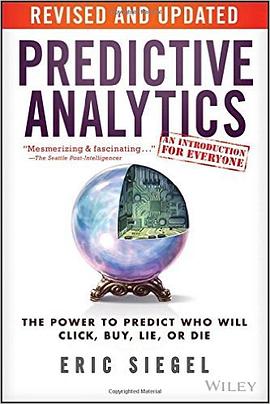
An introduction for everyone. In this rich, fascinating — surprisingly accessible — introduction, leading expert Eric Siegel reveals how predictive analytics works, and how it affects everyone every day. Rather than a “how to” for hands-on techies, the book serves lay readers and experts alike by covering new case studies and the latest state-of-the-art techniques.
Prediction is booming. It reinvents industries and runs the world. Companies, governments, law enforcement, hospitals, and universities are seizing upon the power. These institutions predict whether you're going to click, buy, lie, or die. Why? For good reason: predicting human behavior combats risk, boosts sales, fortifies healthcare, streamlines manufacturing, conquers spam, optimizes social networks, toughens crime fighting, and wins elections. How? Prediction is powered by the world's most potent, flourishing unnaturalresource: data. Accumulated in large part as the by-product of routine tasks, data is the unsalted, flavorless residue deposited en masse as organizations churn away. Surprise! This heap of refuse is a gold mine.Big dataembodies an extraordinary wealth of experience from which to learn. Predictive Analyticsunleashes the power of data. With this technology,the computer literally learns from data how to predict the future behavior of individuals. Perfect prediction is not possible, but putting odds on the future drives millions of decisions more effectively, determining whom to call, mail, investigate, incarcerate, set up on a date, or medicate. In this lucid, captivating introduction — now in its Revised and Updated edition — former Columbia University professor and Predictive Analytics World founder Eric Siegel reveals the power and perils of prediction:
What type of mortgage risk Chase Bank predicted before the recession. Predicting which people will drop out of school, cancel a subscription, or get divorced before they even know it themselves. Why early retirement predicts a shorter life expectancy and vegetarians miss fewer flights. Five reasons why organizations predict death — including one health insurance company. How U.S. Bank and Obama for America calculated — and Hillary for America 2016 plans to calculate — the way to most strongly persuade each individual. Why the NSA wants all your data: machine learning supercomputers to fight terrorism. How IBM's Watson computer usedpredictive modelingto answer questions and beat the human champs on TV'sJeopardy! How companies ascertain untold, private truths — how Target figures out you're pregnant and Hewlett-Packard deduces you're about to quit your job. How judges and parole boards rely on crime-predicting computers to decide how long convicts remain in prison. 182 examples from Airbnb, the BBC, Citibank, ConEd, Facebook, Ford, Google, the IRS, LinkedIn, Match.com, MTV, Netflix, PayPal, Pfizer, Spotify, Uber, UPS, Wikipedia, and more.
How does predictive analytics work? This jam-packed book satisfies by demystifying the intriguing science under the hood. For future hands-on practitioners pursuing a career in the field, it sets a strong foundation, delivers the prerequisite knowledge, and whets your appetite for more.
A truly omnipresent science, predictive analytics constantly affects our daily lives. Whether you are a consumer of it — or consumed by it — get a handle on the power ofPredictive Analytics.
作者简介
From the Back Cover
TRANSLATED INTO 9 LANGUAGES USED IN COURSES AT MORE THAN 30 UNIVERSITIES In this rich, fascinating—and surprisingly accessible—introduction, leading expert Eric Siegel reveals how predictive analytics works, and how it affects everyone every day. Trendsetters like Chase, Facebook, Google, Hillary for America, HP, IBM, Match.com, Netflix, the NSA, Pfizer, Target, and Uber are seizing upon the power of big data to predict human behavior—including yours. Why? Predictive analytics reinvents industries and runs the world. Read on to discover how it combats risk, boosts sales, fortifies healthcare, optimizes social networks, toughens crime fighting, and wins elections. "What Nate Silver did for poker and politics, this does for everything else." —David Leinweber, author of Nerds on Wall Street "The Freakonomics of big data." —Stein Kretsinger, founding executive, Advertising.com "A deeply informative dive into a topic that is critical to virtually every sector of business today." —Geoffrey Moore, author of Crossing the Chasm "Moneyball for business, government, and healthcare." —Jim Sterne, founder, eMetrics Summit Learn more: www.ThePredictionBook.com
Read more
About the Author
ERIC SIEGEL, PhD, is the founder of Predictive Analytics World and executive editor of The Predictive Analytics Times. A former Columbia University professor, he is a renowned speaker, educator, and leader in the field.
Read more
目录信息
读后感
用户评价
这本书的封面设计简直是直击灵魂,那种深邃的蓝色调配上醒目的橙色标题,一下子就抓住了我这个常年混迹于数据分析圈子的人的眼球。说实话,我对“预测”这个词向来抱有一种近乎偏执的好奇心,因为它似乎代表着对未来的一种掌控感,尽管我们都知道这更像是一种基于概率的艺术。我翻开第一章时,就被作者那种直截了当的叙事风格给吸引住了。他没有一开始就抛出一堆复杂的数学公式,而是先用几个极具冲击力的商业案例开场,比如一家电商如何通过分析用户的微小行为轨迹,成功预判了某个产品在特定时间段内的销售额波动。这种从结果倒推过程的叙事手法非常高明,它瞬间拉高了我的阅读兴趣,让我迫不及待地想知道,究竟是哪些“魔力”在驱动着这些预测的实现。书里对数据收集和清洗的细致描述,也让我这种实战派深有体会,毕竟在现实世界中,八成的时间都花在了处理那些“脏数据”上,作者却能用一种近乎轻松的笔调,将这个枯燥的过程讲得像是在解一个精妙的谜题。整体而言,第一印象是,这不仅仅是一本技术手册,更像是一部关于如何将信息转化为洞察力的“权力指南”。
评分这本书的结构安排和内容组织,体现出一种罕见的层次感。它不像某些工具书那样线性地堆砌知识点,而是像攀登一座山峰,步步深入,视野不断开阔。从最基础的回归分析和分类问题入手,逐步过渡到时间序列预测和自然语言处理中的情感分析。尤其是在讲解如何构建一个端到端的预测项目时,作者的步骤分解得极其清晰:从定义问题、数据获取、特征选择、模型训练、到最终的部署和监控,每一个环节都有详尽的说明和实际操作的建议。我个人在尝试将理论知识转化为实际生产力时常常感到迷茫,但这本书提供的那个“项目生命周期”模板,简直是雪中送炭。它不仅教会了我技术,更重要的是,它教会了我如何像一个专业的项目经理一样去规划和执行一个数据科学任务。这种系统性的思维框架的建立,对我日常工作的指导意义,远超任何单一的技术细节。
评分这本书最让我感到震撼的是其对伦理边界和预测社会影响的深刻反思。在许多技术书籍热衷于展示“能做什么”的时候,这本书却勇敢地将笔墨聚焦于“应该做什么”和“不该做什么”。我记得有一段内容讨论了信用评分模型中可能存在的隐性偏见(Bias),作者并未将此简单归咎于算法本身,而是深入剖析了训练数据中固有的社会不平等如何被模型无情地放大,最终导致对特定人群的不公平待遇。这种对算法公平性和透明度的关注,在这个AI日益渗透的时代显得尤为重要和及时。我读到这里时,不禁停下来沉思了很久,它迫使我作为一个数据的实践者,去思考每一次模型部署背后所附带的社会责任。作者在引用法律案例和哲学思辨时,处理得恰到好处,没有陷入空泛的道德说教,而是将其与实际的数据治理实践紧密结合起来。这本书提供的不是一个工具箱,而是一个道德指南针。
评分我对这类主题的书籍一向抱持着审慎的态度,因为市面上充斥着太多夸大其词、徒有其表的“速成宝典”。然而,深入阅读这本书的中间部分,我发现它的深度和广度远超我的预期。特别是当作者开始探讨高级机器学习模型在处理非结构化数据时的应用时,那种严谨的逻辑推演和对模型局限性的清醒认识,让我感到非常踏实。有一章节专门分析了欺诈检测系统,它详细阐述了如何构建一个能够实时识别异常交易模式的算法框架,其中涉及到的特征工程(Feature Engineering)的讨论,简直是教科书级别的范例。我尤其欣赏作者在解释复杂概念时所采用的类比,他能将高维度的数学概念,转化成日常生活中触手可及的场景,比如用“迷宫寻路”来比喻深度学习中的梯度下降过程。这不仅极大地降低了非技术背景读者的理解门槛,也让专业人士能从新的角度重新审视这些经典算法。这种平衡感做得极佳,让这本书既有学术上的严谨性,又不失大众传播的易读性,绝非一般同类书籍能企及。
评分读完这本书的最后部分,我感到一种强烈的智力满足感,这是一种源自于对复杂事物有了清晰掌控感后的愉悦。作者在收尾部分,将目光投向了更远的未来,探讨了诸如因果推断(Causal Inference)和可解释性AI(XAI)等前沿领域,暗示了下一波预测分析的浪潮将不再满足于“是什么”和“会怎样”,而是追问“为什么”和“如何干预”。这种对行业前瞻性的把握,让我确信这本书的价值不会随着时间迅速贬值。它成功地建立了一个坚实的理论基石,同时又为读者指明了持续学习的方向。对我而言,这本书最大的贡献在于,它彻底改变了我看待“数据”的方式——它不再是冰冷的数字集合,而是隐藏着人类行为模式和未来可能性的密码。阅读过程本身就是一次思维的重塑,它不仅提升了我的技术能力,更重要的是,它深化了我对数据驱动决策背后复杂性的理解和敬畏。
评分 评分 评分 评分 评分