
具体描述
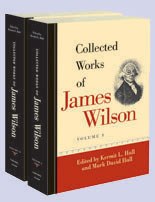
This two-volume set brings together a collection of writings and speeches of James Wilson, one of only six signers of both the Declaration of Independence and the United States Constitution, and one of the most influential members of the federal Constitutional Convention in 1787. Wilson’s writings and speeches had a significant impact on the deliberations that produced the cornerstone documents of our democracy. Wilson’s signal contribution to the founding of our national government was his advocacy for both a strong national government and an open and democratic political system, a position that set him apart from both Alexander Hamilton and Thomas Jefferson.
Wilson’s writings form one of the most significant bodies of thought about the relationship between a distinctively American form of democracy and a distinctly American constitutional system. Wilson wrote extensively on the concepts of separation of powers, the authority of the judiciary to review acts of the other branches, and the development of principles of representative government. This collection of Wilson’s writings includes his famous law lectures, a number of noteworthy essays and speeches, some of which are presented together for the first time, and his opinions in several Supreme Court cases. Together, the writings in this volume illustrate that Wilson’s words more nearly foreshadowed the nation’s future than those of his better remembered contemporaries such as Alexander Hamilton, James Madison, and Thomas Jefferson. In addition to providing the reader with a historical view of the nature of American democracy, the power of courts and judges, the independence of the executive branch, and the power of law to structure social relations, this book speaks directly to the ongoing debate about the scope and nature of judicial review and the place of law and judicial structures in the conduct of society.
This is a welcome fourth edition of James Wilson's collected works. More comprehensive than its predecessors, this two-volume selection combines several speeches and essays with the important series of law lectures that Wilson gave to the College of Philadelphia (now the University of Pennsylvania) between 1790 and 1792. Prior to his death in 1798, Wilson carefully recorded these lectures in fifty-two notebooks, hoping to publish them as the American equivalent of Sir William Blackstone's Commentaries on the Laws of England. Wilson's financial ruin prevented him from completing this plan, but his son, Bird, faithfully edited and published the notebooks in 1804. These law lectures, together with some additional material, comprised the first edition of Wilson's works. A second, less complete, collection was printed in 1896. Robert G. McCloskey then edited a third and, until now, standard selection in 1967. With McCloskey's two-volume set long out-of-print, this new Liberty Press edition, edited by Kermit L. Hall and Mark David Hall, aims "to stimulate new research and analysis of Wilson's contributions in the ongoing effort to determine accurately his rightful place in the founding era" of the United States (p. xiii). It will also encourage new scholarship on the connections between Scottish and American thought in the eighteenth century.
Wilson remains an understudied figure. Born in 1742 at Carskerdo, Fife, and educated at the University of St. Andrews, he emigrated to America in 1765 and played a critical role in the founding of the United States. After establishing himself as a lawyer in Carlisle, Pennsylvania, he was a consistent advocate of popular sovereignty, strong national government, and the separation of powers. One of only six persons to sign both the Declaration of Independence and the Constitution, Wilson strongly influenced the Philadelphia Convention of 1787. He subsequently became a leading proponent of ratification, powerfully shaping federalist arguments in favor of the Constitution and against the Bill of Rights. Appointed to the United States Supreme Court in 1789, he went on to write the court opinion in the case of Chisholm v. Georgia (1793) that prompted the Eleventh Amendment. However, his life ended in disgrace. Bankrupted by failed land and business ventures, Wilson fled Pennsylvania in 1796. He was twice arrested and jailed by his creditors. On the run, he suffered an obscure death in Edenton, North Carolina.
The earliest document in this edition is Wilson's pamphlet, Considerations on the Nature and Extent of the Legislative Authority of the British Parliament, which he wrote in 1768 but did not publish until 1774. An attack on Parliamentary sovereignty, this tract helped to establish Wilson as a Whig leader. It was after the Revolution, however, that Wilson truly rose to the fore. Reflecting this fact, only three documents in this collection date from the 1770s. In contrast, five pieces focus on the 1780s debates surrounding the controversial Bank of North America and the drafting and ratification of the Constitution, two are speeches from 1789 and 1790 dealing with changes to the Pennsylvania state constitution, and five relate to Wilson's service as a federal judge. In addition, this collection includes a mid-1790s essay, "On the Improvement and Settlement of Lands in the United States," as well as an undated piece, "On the History of Property."
The bulk (two-thirds) of this edition is given over to Wilson's law lectures. In this respect, and in similar fashion to McCloskey's volumes, this collection sticks close to Bird Wilson's 1804 publication. It adds, however, a new introduction and bibliographical essay, McCloskey's translations of Latin phrases, additional annotations on individuals mentioned by Wilson, and McCloskey's bibliographical glossary. Also, some Wilson material appears here that was not printed in the previous collections. The two main additions are James Madison's notes on Wilson's contributions to the Philadelphia Convention of 1787, and the "State House Yard Speech" that Wilson gave in Philadelphia on 6 October 1787. Reprinted throughout the colonies, the latter was, according to the historian Bernard Bailyn, "the most famous, to some the most notorious, federalist statement of the time."
作者简介
James Wilson (1742–1798) emigrated from Scotland in 1765 and was one of the major architects of the American judicial system. In addition to his participation in the Federal Constitutional Convention and the Pennsylvania Constitutional Convention of 1789–90, he served as a member of Congress, the director of the original Bank of North America, and an associate justice of the Supreme Court.
Wilson was one of six men to sign both the Declaration of Independence and the Constitution, played critical roles in the ratification debates and the Pennsylvania Constitutional Convention, and served on the Supreme Court from 1789 until his death in 1798. Yet his legacy has received minimal attention. This two-volume set collects his writings and his lectures on law delivered at the College of Philadelphia. Editor Kermit Hall, a constitutional law scholar and legal historian, and former president of the U. at Albany, State U. of New York, provides an extensive introduction; Mark David Hall (political science, George Fox University) prepared the bibliographical essay.
目录信息
读后感
用户评价
这套书的内容,让我对美国早期思想界的复杂性有了全新的认识。它远不止于我们教科书里被简化和提炼出的那些“光辉篇章”,而是展现了一个充满辩论、妥协与深刻自我怀疑的知识群体。威尔逊的某些观点,比如他对司法权力的界定,在当时显然是极具争议性的,甚至与他同时代的一些重要人物产生了激烈的思想碰撞。我花了很多时间去查阅那些被他引用的、或被他反驳的原始文献,试图还原那个充满活力的思想交锋现场。这本书的价值,恰恰在于它保存了那些“不那么正确”但也至关重要的观点,让我们看到了一个完整且充满张力的思想生态系统。这套文集提供了一个极其宝贵的窗口,让我们得以窥见制度建立之初,知识分子们在理想与现实之间艰难抉择的内心挣扎,那份历史的厚重感是通过阅读这些未经美化的原始文本才能真正体会的。
评分读完这文集,我最大的感受是威尔逊的思维跨度之大和论证之严谨,简直让人叹为观止。尤其是在对自然法和宪政原则的阐述部分,他那种层层递进、滴水不漏的逻辑推理,仿佛是在构建一座精密的思想迷宫,每一步都指向一个无可辩驳的结论。我曾试图用现代政治哲学的框架去解构他的观点,但很快发现,他的出发点和论证体系有着强烈的时代烙印和深刻的洞察力,绝非简单的旧瓶装新酒。某些关于“人民主权”的论述,在那个年代被提出时,其革命性和前瞻性是难以想象的。我特别留意了他在处理具体法律案例时的那种冷静和对人性的洞察,这让他不仅仅是一个理论家,更是一位实践的智者。读他的文字,需要极大的专注力,因为他不会用花哨的辞藻来掩盖思想的空泛,每一个句子都承载着沉甸甸的分量,需要反复咀嚼才能体会其中的深意。
评分从语言风格上来说,威尔逊的行文风格极其古典,充满了十八世纪晚期法律和哲学写作的典型特征,对于习惯了当代简洁明快表达的读者来说,初读可能会感到有些晦涩和繁复。他善于运用拉丁文的句式结构,使得长难句层出不穷,修饰语和从句的使用极为密集,这要求读者必须保持极高的阅读耐性和对上下文的把握能力。然而,一旦适应了这种节奏,那种磅礴的气势和古典韵味便会逐渐显现出来。他似乎总是在与柏拉图、洛克和孟德斯鸠对话,言辞之间透露出一种跨越时空的知识傲慢与自信。我尤其欣赏他处理复杂概念时那种近乎于音乐般的排比句式,虽然冗长,但极富节奏感和说服力,仿佛在进行一场精心编排的法庭辩论,让人在不知不觉中被他牵引至他期望达成的结论。
评分这两卷书的排版和注释系统,是任何一个严肃研究者都无法忽视的宝贵财富。我发现编者在对一些关键术语和历史典故进行详尽的脚注说明时,展现了极高的学术水准。这些注释不仅解释了文本本身的含义,更重要的是,它们勾勒出了威尔逊思想的知识背景和时代语境,使得一些晦涩难懂的段落豁然开朗。例如,他对某个具体法律术语的溯源和演变过程的梳理,简直可以作为一篇独立的学术论文来阅读。这表明,这套文集并非简单的文本堆砌,而是一项严谨的、耗费心血的整理工作。对于希望深入理解美国宪政思想源头的人来说,这些注释提供的额外信息,其价值甚至不亚于正文本身,它们是连接过去与现在的坚实桥梁,确保了我们对这段历史的理解不会出现偏差。
评分这本书的装帧简直是艺术品,皮革的质感温润如玉,每一次翻动指尖都能感受到岁月的沉淀。内页的纸张选得极好,墨迹清晰,字迹工整,即便放了这么多年,依然没有泛黄的迹象。我特意去研究了一下装订工艺,发现它采用了传统的线装,配合着烫金的书名,透露出一种低调的奢华。打开书本,那股淡淡的、混合着陈年纸张和皮革的独特气味扑面而来,瞬间把我拉回了那个时代。这不仅仅是一套书,更像是一件可以世代传承的珍藏品。我对图书的物理形态有着近乎苛刻的要求,而这套《詹姆斯·威尔逊文集》在每一个细节上都无可挑剔,从书脊的弧度到扉页的留白,都充满了匠心。光是欣赏这两卷书摆在书架上的样子,就足以令人心旷神怡。我希望未来的阅读者也能像我一样,珍惜这份实体书带来的独特体验,而不是仅仅依赖于电子扫描件。这套书的重量和手感,是任何数字版本都无法模拟的庄重感和厚实感。
评分 评分 评分 评分 评分