具体描述
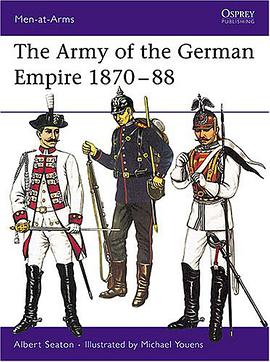
The army of the German Empire was born out of the once great Prussian army that Napoleon Bonaparte had humbled at the Battle of Jena-Auerstadt in 1806, during the Napoleonic Wars. The eventual defeat of Napoleon initiated a slow process of military reform that gained momentum during the pan-German and expansionist policies of King William I of Prussia and his chancellor Bismarck. This book charts the consolidation of Prussian power and details the structure of the new imperial army that was created after the triumph of the Franco-Prussian War of 1870. Uniforms and equipment are also examined in full detail.
Prussian Steel, Imperial Ambition: A Chronicle of the German Empire's Military Might The German Empire, a nation forged in the crucible of war and unified by the iron will of its statesmen and soldiers, stands as a formidable presence in late 19th and early 20th-century European history. Its military, meticulously crafted and relentlessly honed, was the linchpin of its ascendancy, a symbol of its newfound power and its unwavering determination to carve a significant place on the world stage. This chronicle delves into the intricate tapestry of the German Empire's armed forces, exploring the doctrines, the institutions, the innovations, and the men who shaped its formidable reputation. It is a narrative not merely of battles and campaigns, but of the very spirit that animated this colossal war machine, examining its evolution from the fragmented states of the German Confederation to the unified, highly disciplined, and technologically advanced force that would come to dominate the continent’s military thinking. At the heart of the Empire's military success lay the Prussian legacy. The wars of unification under Bismarck, particularly the Austro-Prussian War of 1866 and the Franco-Prussian War of 1870-1871, served as a brutal yet effective proving ground. These conflicts showcased the superior Prussian general staff system, a revolutionary approach to military planning and execution that emphasized flexibility, rapid mobilization, and decisive battlefield engagement. The meticulously cultivated Prussian military tradition, with its emphasis on discipline, obedience, and a profound sense of duty, was seamlessly integrated into the fabric of the newly formed Imperial Army. This was not simply a matter of inheriting tactics; it was a deep-seated cultural and institutional commitment to military excellence that permeated every level of society. The General Staff, under brilliant minds like Helmuth von Moltke the Elder, became the intellectual engine of the German Army. Its role extended far beyond mere operational planning. It was responsible for strategic forecasting, logistical coordination, the development of new military technologies, and the continuous refinement of tactical doctrines. The meticulous staff rides, the exhaustive war games, and the rigorous study of past campaigns instilled in officers an unparalleled understanding of warfare in all its permutations. This intellectual prowess, combined with a highly professional officer corps drawn from the aristocracy and the educated middle class, created a formidable decision-making apparatus that could react swiftly and effectively to the ever-changing demands of the battlefield. The concept of "Auftragstaktik," or mission-type tactics, empowered junior officers to take initiative within the broader strategic framework, fostering adaptability and resilience in the face of unexpected challenges – a stark contrast to the more rigid command structures of many of its contemporaries. The rank-and-file soldier, the backbone of the Imperial Army, was equally vital. Conscription formed the bedrock of the German military, ensuring a vast pool of trained reservists that could be mobilized with astonishing speed. The annual recruit intake subjected young men to rigorous training, instilling in them the discipline, physical endurance, and combat skills necessary for effective soldiery. This system fostered a deep sense of national identity and shared purpose, as military service was seen as a patriotic duty and a crucial rite of passage. The Landwehr and Landsturm, reserve forces and militia, provided a crucial depth to the Empire’s military potential, allowing for sustained campaigns and effective defense of the homeland. The shared experience of military service, the camaraderie forged in the barracks and on the training grounds, contributed to a cohesive and loyal fighting force. Technological innovation was another defining characteristic of the German Empire's military. From the development of advanced artillery and breech-loading rifles to the early adoption of machine guns and the pioneering use of military aviation, the German Army consistently sought to leverage the latest scientific and industrial advancements. The Krupp works, a titan of German industry, was instrumental in equipping the army with state-of-the-art artillery, renowned for its power and accuracy. The adoption of the Dreyse needle gun, and later the Gewehr 88 and the iconic Mauser rifles, provided German infantry with a significant advantage in firepower. The strategic importance of railways for rapid troop and matériel deployment was fully recognized and exploited, allowing for swift concentrations of force that often caught adversaries off guard. This relentless pursuit of technological superiority was not merely about acquiring new weapons; it was about integrating them into existing doctrines and training soldiers to exploit their full potential. The German Navy, though initially a secondary consideration to the dominant army, grew in stature and ambition under Kaiser Wilhelm II. The vision of Admiral Alfred von Tirpitz, with his "Risk Theory" and his aggressive naval construction program, sought to challenge British maritime supremacy. The creation of a powerful fleet, comprising modern battleships and cruisers, was intended to deter potential adversaries and project German power across the globe. While ultimately unable to achieve parity with the Royal Navy, the German High Seas Fleet represented a significant investment and a symbol of the Empire's aspirations for colonial expansion and global influence. The development of naval doctrine, the training of crews, and the construction of naval bases were all part of this ambitious undertaking, reflecting a growing recognition of the interconnectedness of land and sea power in the modern era. The Great War, however, would serve as the ultimate test and, ultimately, the undoing of the German Empire's military might. The Schlieffen Plan, a testament to the General Staff's strategic thinking, aimed for a swift victory over France by bypassing its fortified defenses and encircling its armies. While initially successful in its strategic aims, its execution faltered, leading to a prolonged and brutal war of attrition on the Western Front. The realities of trench warfare, the immense casualties, and the relentless pressure from the Allied powers would expose the limitations of even the most sophisticated military machine. The immense sacrifices made by the German soldiers, their unwavering courage in the face of overwhelming odds, remain a poignant chapter in the history of the Great War. Beyond the battlefield, the military permeated German society. The officer corps held significant social and political prestige, and military service was widely seen as an essential component of good citizenship. The emphasis on order, discipline, and duty extended beyond the barracks, influencing social norms and political discourse. This deep integration of the military into the nation's identity contributed to a pervasive sense of national pride and a readiness to defend the Empire's interests by force if necessary. The widespread popularity of military parades, the reverence for military heroes, and the active role of veterans' organizations all underscore this profound connection. This chronicle, therefore, aims to provide a comprehensive and nuanced exploration of the German Empire's military. It will examine the foundational principles that guided its development, the institutional structures that sustained it, the technological advancements that propelled it forward, and the human element – the soldiers and commanders who brought it to life. It is a story of ambition, of organization, of innovation, and ultimately, of a military force that, for a time, reshaped the destiny of Europe and left an indelible mark on the annals of warfare. By dissecting the intricate workings of this formidable military apparatus, we gain a deeper understanding not only of the German Empire itself but also of the broader geopolitical forces that shaped the tumultuous era in which it existed. It is a study that eschews simplistic narratives and seeks to illuminate the complexities, the triumphs, and the ultimate tragedies of a nation built on the foundation of military strength.