具体描述
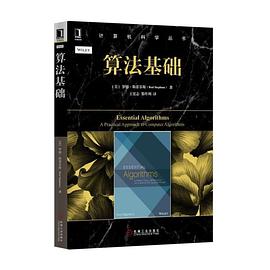
Algorithms are at the heart of every nontrivial computer application, and algorithmics is a modern and active area of computer science. Every computer scientist and every professional programmer should know about the basic algorithmic toolbox: structures that allow efficient organization and retrieval of data, frequently used algorithms, and basic techniques for modeling, understanding and solving algorithmic problems.
This book is a concise introduction addressed to students and professionals familiar with programming and basic mathematical language. Individual chapters cover arrays and linked lists, hash tables and associative arrays, sorting and selection, priority queues, sorted sequences, graph representation, graph traversal, shortest paths, minimum spanning trees, and optimization. The algorithms are presented in a modern way, with explicitly formulated invariants, and comment on recent trends such as algorithm engineering, memory hierarchies, algorithm libraries and certifying algorithms. The authors use pictures, words and high-level pseudocode to explain the algorithms, and then they present more detail on efficient implementations using real programming languages like C++ and Java.
The authors have extensive experience teaching these subjects to undergraduates and graduates, and they offer a clear presentation, with examples, pictures, informal explanations, exercises, and some linkage to the real world. Most chapters have the same basic structure: a motivation for the problem, comments on the most important applications, and then simple solutions presented as informally as possible and as formally as necessary. For the more advanced issues, this approach leads to a more mathematical treatment, including some theorems and proofs. Finally, each chapter concludes with a section on further findings, providing views on the state of research, generalizations and advanced solutions.
作者简介
Prof. Kurt Mehlhorn was appointed a Fellow of the ACM (1999) "for important contributions in complexity theory and in the design, analysis, and practice of combinatorial and geometric algorithms." A Professor of Computer Science at Saarland University since 1975, and a director of the Max-Planck-Institut für Informatik in Saarbrücken, he has coauthored over 250 refereed papers/articles, in collaboration with 200 researchers. Other awards include the Leibniz Award of the German Research Foundation in 1986 and the Konrad Zuse Medal of the German Society for Informatics in 1995.
Prof. Peter Sanders is a Professor of Computer Science at the University of Karlsruhe. A leading researcher in the area of theoretical and experimental algorithm analysis, in particular related to efficient algorithms for parallel processing and communication in networks, his responsibilities include organizing the European Symposium on Algorithms in Karlsruhe in 2008.
The authors have considerable experience teaching on the topic of algorithms and working on related industrial projects.
目录信息
Introduction
Representing Sequences By Arrays and Linked Lists
Hash Tables and Associative Arrays
Sorting and Selection
Priority Queues
Sorted Sequences
Graph Representation
Graph Traversal
Shortest Paths
Minimum Spanning Trees
Generic Methods of Optimization
Appendix
References
Index
· · · · · · (收起)
读后感
用户评价
我一直认为,真正的知识在于其思想的深度和应用的广度。这本书的名字,对我来说,就像一个承诺,承诺着一种思维方式的革新。我购买它的初衷,更多的是想通过它来提升自己的逻辑思维能力和解决问题的能力。我知道,学习算法和数据结构,不仅仅是为了写出更快的程序,更是为了理解计算的本质,理解效率的含义。我期望这本书能够引导我思考“为什么”,而不是仅仅告诉我“是什么”。我希望它能让我明白,为什么某些算法在特定情况下表现优异,而另一些则不然,这种理解往往比死记硬背公式更重要。我希望它能帮助我构建一个完整的知识框架,让我能够将不同的算法和数据结构融会贯通,而不是零散地记忆。我期待它能让我看到,这些看似枯燥的理论,是如何支撑起我们今天所见的各种复杂而精妙的计算机系统的,从而引发我对计算科学更深层次的思考。
评分坦白说,我买这本书纯粹是出于一种“投资未来”的考虑。在如今这个技术飞速发展的时代,我觉得掌握一些基础的、通用的知识至关重要。算法和数据结构,我一直觉得是计算机科学的基石,是程序员的“内功”。我平时的工作虽然接触不到非常复杂的算法,但偶尔遇到一些性能瓶颈或者需要优化代码的时候,就会感到自己的知识储备不足。我希望这本书能够提供一些实用的技巧和方法,让我能更有效地处理日常开发中的问题。我期待它能解释清楚,为什么某些数据结构比其他结构更适合特定的场景,以及如何根据问题的特点来选择最合适的算法。我希望它能帮助我建立起一个清晰的知识体系,让我能够举一反三,融会贯通。当然,我也希望书中能有一些经典的算法案例分析,让我看到理论是如何应用于实践的,并且能给我一些启发,让我知道在未来的学习和工作中,我还可以往哪个方向深入。
评分这本《算法与数据结构》给我留下的最深刻印象,与其说内容本身,不如说它所营造的阅读体验。我拿到书的那一刻,就被它的印刷质量所折服。纸张的触感温润而坚韧,字体清晰锐利,排版布局合理,每一页都散发着一种低调的精致。我喜欢翻阅它的感觉,仿佛在触摸一件艺术品。我之前也看过不少技术书籍,但很多都像白开水一样乏味,要么就是过于艰涩,让人望而却步。而这本书,在某种程度上,却能让我沉浸其中。它不是那种让你一口气读完的快餐读物,更像是一壶需要慢慢品味的陈酿。虽然我还没来得及深入研究每一个章节,但仅从它的整体风格来看,我就能感受到作者的用心。它不像是一本冷冰冰的技术手册,反而更像是一位经验丰富的老师,在循循善诱地引导我。我期待它能带我领略算法世界的宏伟与优雅,就像欣赏一场精心编排的舞蹈,每一个动作都精准到位,流畅自然。
评分我一直对那些能够将抽象概念具象化的书籍抱有特别的喜爱。当我在书店看到《算法与数据结构》这本书时,它封面设计的那种简洁而不失力量感,给我留下了一个非常好的第一印象。我当时就在想,这本书会不会就像一个导游,带领我走进一个之前我只在远处眺望过的神秘国度?我希望它能用通俗易懂的语言,将那些听起来高深莫测的算法和数据结构,比如链表、树、图,以及排序、查找等经典算法,化繁为简。我不太喜欢那种堆砌公式、只讲理论的书,我更倾向于通过生动的图示、清晰的流程图,或者是一些贴近实际生活的例子,来理解这些概念。我期待这本书能给我带来一种“原来如此”的顿悟感,让我能够真正理解这些概念的由来,以及它们是如何被设计出来的。我希望它能帮助我建立起一种算法思维,让我以后在面对问题时,能够从更优化的角度去思考解决方案。
评分这本书,说实话,我当初买的时候是被封面吸引的。那种深邃的蓝色,上面泛着金属光泽的字体,给我一种非常专业、严谨的感觉,就好像它里面藏着解开世界奥秘的钥匙一样。我一直对计算机科学中的一些核心概念很感兴趣,但总觉得缺了那么一块拼图,而这本书的名字——“算法与数据结构”——听起来就正是我一直在寻找的。想象一下,学习如何高效地组织信息,如何设计出能解决复杂问题的精妙步骤,这本身就充满了智慧的魅力。我期望这本书能帮我理清那些常常让我感到困惑的理论,例如动态规划的精髓,或者图论中各种遍历算法的实际应用。我知道数据结构是构建一切的基础,就像砖瓦一样,而算法则是建造宏伟建筑的蓝图和施工方法。我希望这本书能够深入浅出地讲解这些内容,用清晰的语言和生动的例子,让我能够真正理解它们背后的逻辑,而不是死记硬背。我甚至幻想,读完之后,我能像个魔法师一样,用代码驾驭数据,解决那些看似棘手的编程难题。
评分 评分 评分 评分 评分