
具体描述
Google Earth's ancestor: a snapshot of urban life, circa 1600
History's most opulent collection of town maps and illustrations
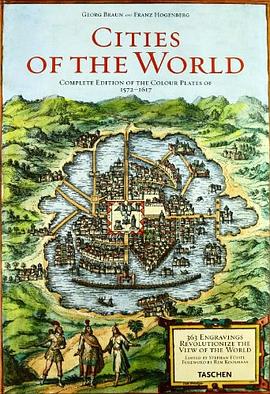
The complete reprint of all 363 color plates from Braun and Hogenberg's survey of town maps, city views, and plans of Europe, Africa, Asia and Central America, with dozens of unusual details, two folding maps, as well as selected extracts from the original text and an in-depth commentary. First published in Cologne 1572-1617.
More than four centuries after the first volume was originally published in Cologne, Braun and Hogenberg's magnificent collection of town map engravings, Civitates orbis terrarum, has been brought back to life with this reprint taken from a rare and superbly preserved original set of six volumes, belonging to the Historische Museum in Frankfurt. Produced between 1572 and 1617 - just before the extensive devastation wreaked by the Thirty Years' War - the work contains 564 plans, bird's-eye views, and map views of all major cities in Europe, plus important cities in Asia, Africa, and Latin America. Edited and annotated by theologian and publisher Georg Braun, and largely engraved by cartographer Franz Hogenberg, the Civitates was intended as a companion volume for Abraham Ortelius's 1570 world atlas, Theatrum orbis terrarum. Over a hundred different artists and cartographers contributed to the sumptuous artwork, which not only shows the towns but also features additional elements, such as figures in local dress, ships, ox-drawn carts, courtroom scenes, and topographical details, that help convey the situation, commercial power, and political importance of the towns they accompany.
The Civitates gives us a comprehensive view of urban life at the turn of the 17th century. TASCHEN's reprint includes all of the city plates, accompanied by selected extracts from Braun's texts on the history and contemporary significance of each urban center as well as translations of the Latin cartouches. A detailed commentary places each city map in its cartographical and cultural context, and examines earlier sources and later editions. Rounding off this comprehensive publication is a separate introductory essay examining the Civitates in its cultural and historical context. From Paris and London to Cairo and Jerusalem, readers will find many a familiar city to zoom back in time to and explore - in fact, many of the maps can still be used for orientation in historical town centers today.
作者简介
About the author:
Stephan Füssel is director of the Institute of the History of the Book at the Johannes Gutenberg University of Mainz, and holder of the Gutenberg Chair at the same university. He has published prolifically on the early days of printing, the sale and publication of books between the 18th and 20th centuries and the future of communications. Füssel is also the editor of TASCHEN`s Chronicle of the World of 1493 and Luther Bible of 1534.
About the contributing author:
Rem Koolhaas is a co-founder of the Office for Metropolitan Architecture. Having worked as a journalist and script writer before becoming an architect, in 1978 he published Delirious New York, a retroactive Manifesto for Manhattan. In 1995, his book S,M,L,XL summarized the work of OMA and established connections of contemporary society and architecture. Amongst many international awards and exhibitions he received the Pritzker Prize (2000) and the Praemium Imperiale (2003).
目录信息
读后感
用户评价
我向来对那些致力于保存人类文化遗产的出版项目抱持最高的敬意,而这本《世界城市》无疑是其中的佼佼者。它不是那种速朽的流行读物,而是一部可以世代传承的参考工具书。它的价值在于“定格”——它将人类文明史上某些关键时刻的城市样貌,用最精致的艺术手法固定了下来。我翻阅时,经常会暂停下来,想象自己就是那个绘制者,站在高处,俯瞰着下面熙熙攘攘的人群,试图用最少的线条勾勒出最复杂的现实。这种沉浸式的体验是其他任何媒介都无法替代的。对于任何一个对地理、艺术史、建筑史或早期现代社会感兴趣的人来说,这本书都应该放在书架最显眼的位置,因为它不仅仅是一本书,它是一份来自过去的、被精心保存的珍贵遗产。
评分这本书带给我最大的震撼,在于它所展现的“全球视野”的早期形态。在那个信息传播如此缓慢的时代,Braun和Hogenberg是如何收集到横跨欧亚非大陆的这些城市资料的?这本身就是一个值得探究的课题。当我并排放置巴黎、威尼斯和巴格达的图景时,我看到的不仅仅是建筑风格的差异,更是不同文明在面对相似的城市治理挑战时所采取的不同策略。比如,在交通拥堵和卫生条件方面,有些城市的处理方式显得非常超前,而另一些则固守着落后的布局。这种跨文化的比较视角,让单纯欣赏地图的乐趣提升到了一个更具批判性的层面。我甚至开始思考,现代城市规划中提出的那些“宜居城市”概念,是不是在几百年前的这些规划者那里就已经有所体现,只是被我们遗忘了?
评分这本《世界城市》真是一部令人叹为观止的画册,收藏的那些古老地图和版画,简直是时空穿梭的钥匙。我一翻开书,立刻就被那种扑面而来的历史厚重感所吸引。你知道吗,那些细致入微的城市景观,不仅仅是地理的记录,更像是凝固的社会切片。比如,对比一下早期描绘罗马的那些图景和后来更精确的航海图上的城市轮廓,你会清晰地看到建筑风格的变迁、港口设施的演化,甚至是城市边界的扩张与收缩。我特别欣赏编者在选取这些图像时的眼光,他们似乎懂得,最好的历史叙事,往往藏在那些宏大叙事之外的微小细节里——城墙的垛口、街角的小酒馆、甚至是河边晾晒衣物的颜色,都透露着那个时代特有的生活气息和权力结构。如果不是亲眼所见,我很难相信文艺复兴时期的人们是如何构想和描绘他们所居住的世界的。这书简直是历史爱好者和城市规划研究者的宝库,我敢说,光是研究其中几幅地图上的细节,就能写出一篇博士论文了。
评分说实话,我原本以为这会是一本枯燥的地图集,毕竟“Braun/Hogenberg”这个名字听起来就带着一股学院派的严肃气息。然而,实际体验完全超出了预期。这本书的装帧设计和纸张质感本身就值得称赞,厚实的纸张完美地承托住了那些精美绝伦的铜版画,色彩的还原度高得惊人,让那些数百年前的油墨痕迹都仿佛触手可及。我花了整整一个下午,只是沉浸在几张描绘中东大城市——像君士坦丁堡或开罗——的插图中。那些描绘的异域风情,那种繁复而热烈的色彩运用,与欧洲同时期的城市图景形成了鲜明的对比,这让我对当时欧洲对“远方”的想象有了更直观的认识。这本书的价值绝不仅仅在于它的信息量,更在于它提供了一种看待历史的视角:通过城市的外观,我们可以解码当时的贸易路线、宗教信仰和军事防御体系。它不是让你去读历史,而是让你直接“看”历史。
评分最近迷上了研究城市演变,手里也收了不少相关的画册,但《世界城市》这本书,在资料的广度和深度上,确实达到了一个难以企及的高度。让我印象最深的是它对一些已经消失或面目全非的城市的记录。譬如,那些描绘中世纪早期甚至更早的城镇鸟瞰图,那种朴素的、功能至上的布局,与今天我们熟悉的任何一座现代化都市都有着天壤之别。我尤其关注它对水系和防御工事的处理,那些曾经环绕城市的护城河、高耸的塔楼,在今天很多都已成为博物馆里的陈列品,但在书中,它们依然是城市生命线的一部分,是权力意志的象征。这本书的编撰者显然在考证上下足了功夫,图注简洁却信息量巨大,每一张图的绘制者、时间背景,乃至可能参考的原始资料,都有迹可循。这使得这本书从一本单纯的图册,升华成了一部严肃的图像学参考书。
评分地图之美让我心旌荡漾
评分非常感动于人类为了解自身所作出的努力。
评分很多熟悉的城市 连lund都有~
评分Danke schoen. @cloudvast
评分Danke schoen. @cloudvast