
具体描述
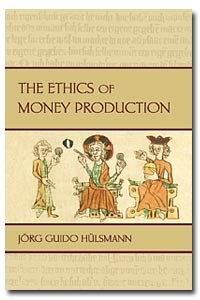
This pioneering work, in hardback, by Jörg Guido Hülsmann, professor of economics at the University of Angers in France and the author of Mises: The Last knight of Liberalism, is the first full study of a critically important issue today: the ethics of money production.
He is speaking not in the colloquial sense of the phrase "making money," but rather the actual production of money as a commodity in the whole economic life. The choice of the money we use in exchange is not something that needs to be established and fixed by government.
In fact, his thesis is that a government monopoly on money production and management has no ethical or economic grounding at all. Legal tender laws, bailout guarantees, tax-backed deposit insurance, and the entire apparatus that sustains national monetary systems, has been wholly unjustified. Money, he argues, should be a privately produced good like any other, such as clothing or food.
In arguing this way, he is disputing centuries of assumptions about money for which an argument is rarely offered. People just assume that government or central banks operating under government control should manage money. Hulsmann explores monetary thought from the ancient world through the middle ages to modern times to show that the monopolists are wrong. There is a strong case in both economic and ethical terms for the idea that money production should be wholly private.
He takes on the "stabilization" advocates to show that government management doesn't lead to stability but to inflation and instability. He goes further to argue against even the theoretical case for stabilization, to say that money's value should be governed by the market, and that that the costs associated with private production are actually an advantage. He chronicles the decline of money once nationalized, from legally sanctioned counterfeiting to the creation of paper money all the way to hyperinflation. In his normative analysis, the author depends heavily on the monetary writings of 14th century Bishop Nicole Oresme, whose monetary writings have been overlooked even by historians of economic thought. He makes a strong case that "paper money has never been introduced through voluntary cooperation. In all known cases it has been introduced through coercion and compulsion, sometimes with the threat of the death penalty. … Paper money by its very nature involves the violation of property rights through monopoly and legal-tender privileges."
The book is also eerily prophetic of our times:
Consider the current U.S. real-estate boom. Many Americans are utterly convinced that American real estate is the one sure bet in economic life. No matter what happens on the stock market or in other strata of the economy, real estate will rise. They believe themselves to have found a bonanza, and the historical figures confirm this. Of course this belief is an illusion, but the characteristic feature of a boom is precisely that people throw any critical considerations overboard. They do not realize that their money producer—the Fed—has possibly already entered the early stages of hyperinflation, and that the only reason why this has been largely invisible was that most of the new money has been exported outside of the U.S… Because a paper-money producer can bail out virtually anybody, the citizens become reckless in their speculations; they count on him to bail them out, especially when many other people do the same thing. To fight such behavior effectively, one must abolish paper money. Regulations merely drive the reckless behavior into new channels.
Hulsmann has provided not only a primer in understanding our times, but a dramatic extension of the work of Menger, Mises, Hayek, Rothbard, and others to map out an economically radical and ethically challenging case for the complete separation of money and state, and a case for the privatization of money production. It is a sweeping and learned treatise that is rigorous, scholarly, and radical.
Table of Contents
Preface
Introduction
Money Production and Justice
Remarks about Relevant Literature
Part 1: The Natural Production of Money
Monies
The Division of Labor without Money
The Origin and Nature of Money
Natural Monies
Credit Money
Paper Money and the Free Market
Electronic Money
Money Certificates
Certificates Physically Integrated with Money
Certificates Physically Disconnected from Money
Money within the Market Process
Money Production and Prices
Scope and Limits of Money Production.
Distribution Effects
The Ethics of Producing Money
The Ethics of Using Money
Utilitarian Considerations on the Production of Money
The Sufficiency of Natural Money Production
Economic Growth and the Money Supply
Hoarding
Fighting Deflation
Sticky Prices
The Economics of Cheap Money
Monetary Stability
The Costs of Commodity Money
Part 2: Inflation
General Considerations on Inflation
The Origin and Nature of Inflation
The Forms of Inflation
Private Inflation: Counterfeiting Money Certificates
Debasement
Fractional-Reserve Certificates
Three Origins of Fractional-Reserve Banking
Indirect Benefits of Counterfeiting in a Free Society .
The Ethics of Counterfeiting
Enters the State: Fiat Inflation through Legal Privileges
Treacherous Clerks
Fiat Money and Fiat Money Certificates
Fiat Inflation and Fiat Deflation
Legalized Falsifications
Legalizing Debasement and Fractional Reserves
The Ethics of Legalizing Falsifications
Legal Monopolies
Economic Monopolies versus Legal Monopolies
Monopoly Bullion
Monopoly Certificates
The Ethics of Monetary Monopoly
Legal-Tender Laws
Fiat Equivalence and Gresham’s Law
Bimetallism
Legal-Tender Privileges for Money Certificates
Legal-Tender Privileges for Credit Money
Business Cycles
Moral Hazard, Cartelization, and Central Banks
Monopoly Legal Tender
The Ethics of Legal Tender
Legalized Suspensions of Payments
The Social Function of Bankruptcy
The Economics of Legalized Suspensions
The Ethics of Legalized Suspensions
Paper Money
The Origins and Nature of Paper Money
Reverse Transubstantiations
The Limits of Paper Money
Moral Hazard and Public Debts
Moral Hazard, Hyperinflation, and Regulation
The Ethics of Paper Money
The Cultural and Spiritual Legacy of Fiat Inflation
Inflation Habits
Hyper-Centralized Government
Fiat Inflation and War
Inflation and Tyranny
Race to the Bottom in Monetary Organization
Business under Fiat Inflation
The Debt Yoke
Some Spiritual Casualties of Fiat Inflation
Suffocating the Flame
Part 3: Monetary Order and Monetary Systems
Monetary Order
The Natural Order of Money Production
Cartels of Credit-Money Producers
Fiat Monetary Systems in the Realm of the Nation-State
Toward National Paper-Money Producers: European Experiences
Toward National Paper-Money Producers: American Experiences
The Problem of the Foreign Exchanges
International Banking Systems, 1871–1971
The Classical Gold Standard
The Gold-Exchange Standard
The System of Bretton Woods
Appendix: IMF and World Bank after Bretton Woods
International Paper-Money Systems, 1971– ?
The Emergence of Paper-Money Standards
Paper-Money Merger: The Case of the Euro
The Dynamics of Multiple Paper-Money Standards
Dead End of the World Paper-Money Union
Conclusion
Two Concepts of Capitalism
Monetary Reform
References
Index of Names
Index of Subjects
作者简介
约尔格 · 吉多 · 许尔斯曼(Guido Hülsmann),出生于 1966 年,现为法国昂热大学法律、经济与管理学院经济学教授,美国米塞斯研究院高级研究员。主要研究领域包括金融市场的政治经济学、货币银行学等。2007 年出版的Mises:The Last Knight of Liberalism 是第一本关于路德维希 · 冯 · 米塞斯的长篇传记,在一千多页的篇幅中,详细叙述了米塞斯的生平,并在历史背景中解读其作品和思想。其他专著还包括:Kritik der Dominanztheorie(1993)、Logik der Währungskonkurrenz(1996)、Ordnung und Anarchie(2007)、The Ethics of Money Production(2008)、Praxeological Papers(即出)。
目录信息
读后感
2010年3月10日,美国犹他州参议院以17:7通过一项法案,要求犹他州认可金银币为本州法定货币。这项法案上周五在州众院以47:26已获得通过。不少人认为这是历史的倒退。这些人看到的仅仅是纸币倒退回金银币的外在形式。而我们要考察的历史进步,是特权秩序的终末以及自然秩序新...
评分首先我承认我很欠打,欠打的第一条理由就是。我没看过这书,却在这里大放厥词。 通俗易懂的讲,就是。国家拥有发行货币的权利,更甚者。中国的央行是人民的银行,是国家的银行,是银行的银行。而美联储则是私人的银行,是银行的银行,是人民的银行。是不是很讽刺? 这本书为...
评分http://www.cenet.org.cn/article.asp?articleid=48249 通货膨胀有害的观念是经济科学的一大主题。但是大多数教科书低估了有害的程度,因为它们把通胀过分狭隘地定义为持续的货币购买力下降,也不重视通胀的具体形态。要完全领会通胀的破坏性本质,我们必须牢记通胀源于对...
用户评价
阅读体验上,这本书展现出一种罕见的学术热情和清晰的表达能力。作者似乎对传统经济学的主流叙事抱有一种健康的怀疑态度,并勇于挑战那些被奉为圭臬的“市场自然规律”。我特别喜欢那些穿插在严肃论述中的历史轶事,它们不仅丰富了文本的趣味性,更重要的是,它们有力地佐证了作者关于人性在金融体系中如何被扭曲的论点。全书行文流畅,逻辑链条坚不可摧,即使是首次接触这些复杂主题的读者,也能跟上作者的思路。它成功地将“金钱”这一我们日常生活中最习以为常的事物,提升到了一个必须进行严肃道德审视的哲学高度。读完后,你会发现自己对每一次的消费、每一次的储蓄决策,都会不自觉地带入一种审视的眼光,这无疑是对读者心智产生的一次深刻洗礼。
评分这部作品的探讨深度和广度令人印象深刻,它成功地将宏观的金融体系与微观的伦理困境紧密地编织在一起。作者似乎有着一种近乎学者的严谨态度,在分析当前货币生产机制的固有缺陷时,没有停留在简单的道德谴责层面,而是深入挖掘了其背后的制度根基和历史演变。我尤其欣赏其对“价值存储”和“交换媒介”双重属性的解构,这使得我们能更清晰地看到,当货币的创造权力集中于少数实体手中时,如何不可避免地滋生出系统性的不公。书中对通货膨胀的伦理含义的剖析,堪称精妙,它不仅仅是经济学上的名词解释,更是一场关于财富再分配的深刻社会批判。读完之后,你会发现,过去那些看似中立的经济现象,现在都被蒙上了一层厚厚的道德阴影,迫使读者重新审视自己与金钱之间的关系。这种挑战既有观点的力量,远超普通财经读物所能企及的范畴,它更像是一部关于现代经济哲学的入门指南,只是它的论证对象异常尖锐和现实。
评分这本书的写作结构非常精巧,它不是线性的叙事,而更像是一个层层递进的论证迷宫,引导读者一步步深入到货币伦理的内核。我发现自己不断地停下来,反复阅读某些段落,因为它们提出的问题太具有颠覆性了。例如,作者对于“无形税收”的描述,将法定货币体系下政府和央行对储蓄者财富的隐性侵蚀,描绘得淋漓尽致,那种带着古典自由主义色彩的忧虑被表达得既激动人心又极富逻辑性。全书的论调并非是全然的悲观,它在揭示问题的同时,也暗示了若干条潜在的改革路径,尽管这些路径在现实中可能充满争议和实施的艰巨性。这种平衡感非常难得,使得本书在保持批判锋芒的同时,避免了陷入纯粹的抱怨或乌托邦式的幻想,它立足于现实,探讨可能性,这种务实的理想主义是其魅力所在。
评分此书的气质非常独特,它成功地融合了经济学家的精确分析、历史学家的宏大视野以及社会评论家的犀利笔触。作者对于“公平铸币”的探讨,绝非空泛的道德说教,而是建立在一系列扎实的历史案例和金融模型分析之上,使得其论点极具说服力。书中对“时间偏好”与“社会福利”之间张力的剖析尤其精彩,它揭示了短期投机行为在系统层面上对代际正义的侵蚀。整个阅读过程就像是跟随一位技艺高超的向导,穿行于金融世界的迷宫之中,每一次转折都伴随着对既有认知结构的冲击。它不是那种读完后就束之高阁的书籍,而更像是会成为案头常备的参考,时不时地需要翻阅其中的某一个章节,以校准自己对当前经济秩序的理解,那种对系统深层机制的挖掘,令人敬佩。
评分与其说这是一本关于金钱的书,不如说这是一场关于权力本质的解剖。作者的叙事风格充满了历史的厚重感,仿佛带着我们穿越了几个世纪的金融变迁,从早期的贵金属标准到现代的浮动汇率体系,每一步的制度更迭都伴随着权力中心的转移和新形态剥削的诞生。书中对“创造信用”这一行为的细致描摹,揭示了现代银行体系中一个核心的悖论:信贷的扩张是经济增长的驱动力,但其过程却往往以牺牲长期稳定和普遍公平为代价。我特别欣赏作者如何巧妙地运用类比和案例研究,将那些晦涩难懂的金融工具,转化为普通人也能理解的伦理抉择。这使得本书的受众范围得以扩展,不再局限于经济学专业人士。那种深切的紧迫感贯穿始终,仿佛作者在敲响警钟,提醒我们如果不正视货币生产过程中的道德瑕疵,我们所构建的社会结构将持续面临瓦解的风险,其洞察力之敏锐,令人赞叹。
评分用 kindle 看的第7本书,总共8小时左右。让我对货币有了个全新认识
评分用 kindle 看的第7本书,总共8小时左右。让我对货币有了个全新认识
评分用 kindle 看的第7本书,总共8小时左右。让我对货币有了个全新认识
评分用 kindle 看的第7本书,总共8小时左右。让我对货币有了个全新认识
评分用 kindle 看的第7本书,总共8小时左右。让我对货币有了个全新认识