
具体描述
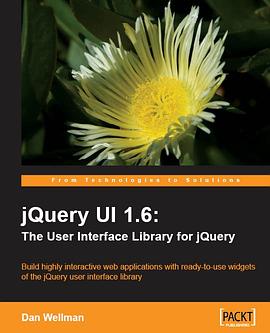
jQuery UI 1.6: The User Interface Library for jQuery, written by Dan Wellman, is a book that contains an in-depth explanation of jQuery UI, information on how to use it in the real world, and is also quite handy for reference. Perfect for user interface designers and developers who need to learn to utilise jQuery UI quickly.
Product Description
Modern web application user interface design requires rapid development and proven results. jQuery UI, a trusted plugin for the jQuery JavaScript library, gives you a trusted platform on which to build rich and engaging interfaces with maximum compatibility, stability, and a minimum of time and effort.
jQuery UI has a series of ready-made, great-looking user interface widgets and a comprehensive set of core interaction helpers designed to be implemented in a consistent and developer-friendly way. With all this, the amount of code that you need to write personally to take a project from conception to completion is drastically reduced This book has been written to maximize your experience with the library by breaking down each component and walking you through examples that progressively build upon your knowledge, taking you from beginner to advanced usage in a series of easy to follow steps.
In this book, you'll learn how each component can be initialized in a basic default implementation and then see how easy it is to customize its appearance and configure its behaviour to tailor it to the requirements of your application. You'll look at the properties and methods exposed by each component's API and see how these can be used to bring out the best in each component.
Events play a key role in any modern web applications if it is to meet the expected minimum requirements of interactivity and responsiveness, and each chapter will show you the custom events fired by each component and how these events can be intercepted and acted upon.
Approach
An example-based approach leads you step-by-step through the implementation and customization of each library component and its associated resources in turn. To emphasize the way that jQuery UI takes the difficulty out of user interface design and implementation, each chapter ends with a `fun with' section that puts together what you've learned throughout the chapter to make a usable and fun page. In these sections you'll often get to experiment with the latest associated technologies like AJAX and JSON.
From the Publisher
Who this book is written for?
This book is for front-end designers and developers that need to quickly learn how to use the jQuery UI User Interface Library. To get the most out of this book you should have a good working knowledge of HTML, CSS and JavaScript, and will need to be comfortable using jQuery, the underlying foundation of jQuery UI.
What you will learn from this book?
Organize different sections of related content as tabs and accordins and save space on your page
Display messages, images, and interactive content like forms using the dialog widget
Use sliders for volume and color control of your applications by dynamically scrolling left and right, displaying different ranges
Allow your site visitors to select dates from the calendar using date picker widget
Enrich your interface with auto complete: start typing the first few letters of a name in your address book and the application will do the rest
Provide a drag-and-drop mechanism to let users directly rearrange elements around the page
Make a range of elements of a group selectable and take collective actions on them
Create a page with content boxes on it that can be sorted into various positions to suit the visitors personal preference
Add flair to your actions with animation effects
Approach
An example-based approach leads you step-by-step through the implementation and customization of each library component and its associated resources in turn. To emphasize the way that jQuery UI takes the difficulty out of user interface design and implementation, each chapter ends with a ‘fun with’ section that puts together what you’ve learned throughout the chapter to make a usable and fun page. In these sections you’ll often get to experiment with the latest associated technologies like AJAX and JSON.
Who this book is written for
This book is for front-end designers and developers that need to quickly learn how to use the jQuery UI User Interface Library. To get the most out of this book you should have a good working knowledge of HTML, CSS and JavaScript, and will need to be comfortable using jQuery, the underlying foundation of jQuery UI.
作者简介
jQuery UI 1.6: The User Interface Library for jQuery, written by Dan Wellman, is a book that contains an in-depth explanation of jQuery UI, information on how to use it in the real world, and is also quite handy for reference. Perfect for user interface designers and developers who need to learn to utilise jQuery UI quickly.
目录信息
读后感
用户评价
初读《**Web开发者工具箱深度解析**》,我的第一反应是:哇,这本书的作者肯定是个代码洁癖患者,或者说,他对“清晰”有着近乎苛刻的追求。它最吸引我的地方,在于对**前端工程化和自动化构建**流程的系统性梳理。从早期的Grunt/Gulp到如今Webpack/Rollup的生态演变,它没有停留在工具的表面介绍,而是深入挖掘了每个配置项背后的编译原理和模块打包策略。例如,它花了整整一个部分来讲解Tree Shaking的实现机制,包括如何通过AST(抽象语法树)来精确判断哪些代码是死代码并予以剔除,这对于那些长期被庞大应用体积困扰的开发者来说,简直是雪中送炭。此外,对于**版本控制和协作流程**的讨论也非常前沿,它不仅仅提到了Git的基本操作,还详细阐述了诸如Git Flow、Pull Request审查机制在大型团队中的应用,强调了代码质量保障的重要性。这本书的价值在于,它帮你从“写代码”的层面,提升到了“管理代码体系”的层面,真正体现了“工欲善其事,必先利其器”的精髓。
评分天呐,最近终于把手头那本《**交互式网页设计进阶**》给啃完了,说实话,这本书的覆盖面之广,简直让人叹为观止。它不像那种只盯着一两门技术死磕的硬核教材,反倒是提供了一个宏观的视角,让你明白前端开发的各个模块是如何协同工作的。我印象最深的是其中关于**无障碍设计(Accessibility)**的那一章,作者没有仅仅停留在理论层面,而是给出了大量的实操案例,讲解了如何使用WAI-ARIA属性来增强那些复杂的自定义控件的用户体验。光是那部分,就让我对“为所有人设计”这句话有了更深刻的理解。书中还花了相当大的篇幅来讨论**现代前端框架的演变历程**,从早期的MVC模式到后来的组件化思想,分析了不同范式的优缺点,特别是对数据流管理的那一套梳理得非常清晰,即便是对React或Vue已经有一定了解的读者,也能从中找到不少启发性的思考点。另外,书中对**性能优化**的讲解也极其到位,涉及到的不仅仅是前端代码的压缩和懒加载,还深入到了浏览器渲染机制,比如repaint和reflow的触发条件,以及如何利用DevTools进行精准的性能瓶颈分析。总而言之,这是一本非常注重“为什么”和“怎么样”的综合性读物,适合希望建立完整知识体系的开发者。
评分我最近刚翻完的这本《**从零开始构建高性能Web应用**》,内容实在太实在太硬核了,完全没有水分。它专注于提升应用的“速度与激情”。开篇就极其大胆地提出了对**HTTP/2和HTTP/3(QUIC)协议**的深入剖析,解释了多路复用和头部压缩是如何从根本上解决传统HTTP瓶颈的,并且还附带了在实际服务器配置中应用这些新特性的具体步骤。更让我惊喜的是,书中关于**数据缓存策略**的论述,简直可以作为缓存策略的“百科全书”。它细致地对比了浏览器本地存储(LocalStorage、SessionStorage、IndexedDB)的适用场景,并给出了基于Cache-Control头和ETag的服务器端缓存的最佳实践指南。对于那些需要处理大量实时数据的应用开发者来说,书中对**WebSocket和Server-Sent Events(SSE)**的对比分析尤其宝贵,清晰地指出了何时使用哪种技术能达到最佳的资源利用率。这本书读下来,你会感觉自己像是上了一堂高强度的性能调优大师课,每一个章节都充满了可立即落地的干货。
评分不得不提《**现代JavaScript深度探索**》这本书,它完全颠覆了我对JS这门语言的理解。这本书的视角非常独特,它没有过多关注框架的使用,而是把核心放在了**JavaScript引擎的内部工作原理**上。作者花了大量的篇幅来拆解V8引擎的黑盒,详细解释了JIT(Just-In-Time)编译、隐藏类(Hidden Classes)以及垃圾回收(Garbage Collection)机制是如何影响代码执行效率的。这部分内容非常烧脑,但一旦理解了,你写出来的代码自然而然就会更加“引擎友好”。此外,书中对**异步编程模型**的讲解也是我读过的最透彻的。它不仅涵盖了Promise和Async/Await,还回溯到了事件循环(Event Loop)的底层实现,甚至对比了Node.js和浏览器环境下的微任务队列差异。更令人印象深刻的是,它探讨了**模块化规范的演进**,从CommonJS到ES Modules,并分析了为什么后者是更优的选择,包括静态分析的优势。这本书不适合初学者,但对于希望将自己的JS功力推向极致的资深开发者而言,它无疑是一本不可多得的内功心法宝典。
评分这本书,姑且称之为《**面向未来的用户界面构建指南**》吧,简直是为那些痴迷于“用户体验细节”的“偏执狂”量身定做的圣经。它的叙事方式非常独特,不是那种教科书式的平铺直叙,更像是一场由经验丰富的大师带领你进行的深度访谈。其中关于**动态布局和响应式设计**的章节,绝对是我见过最细致的。作者没有简单地抛出媒体查询(Media Queries),而是深入探讨了CSS Grid和Flexbox在处理复杂网格系统时的最佳实践,特别是如何利用它们来构建那些在不同设备上都能保持视觉和谐的“液态”界面。我特别喜欢其中提到的一段话:“好的UI,是能让用户忘记它存在的那个界面。”为了实现这种“无感”体验,书中详细剖析了**动画和过渡效果**的心理学基础,解释了缓动函数(Easing Functions)如何影响用户对时间流逝的主观感知,并给出了大量关于微交互(Micro-interactions)设计的宝贵建议。如果你正在寻找如何让你的产品不再只是“能用”,而是“好用到让人上瘾”的秘诀,这本书里的设计哲学和技术细节绝对能给你醍醐灌顶的感觉。
评分 评分 评分 评分 评分