
具体描述
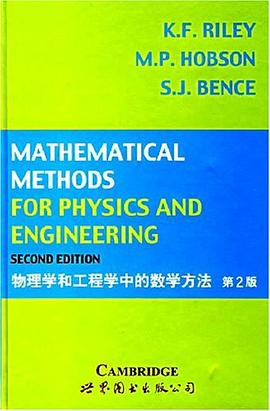
Since the publication of the first edition of this book, both through teaching the material it covers and as a result of receiving helpful comments from colleagues, we have become aware of the desirability of changes in a number of areas. The most important of these is that the mathematical preparation of current senior college and university entrants is now less thorough than it used to be. To match this, we decided to include a preliminary chapter covering areas such as polynomial equations, trigonometric identities, coordinate geometry, partial fractions, binomial expansions, necessary and sufficient condition and proof by induction and contradiction.
作者简介
目录信息
preface to the first edition
1 preliminary algebra
1.1 simple functions and equations
polynomial equations; factorisation; properties of roots
1.2 trigonometric identities
single angle; compound-angles; double- and half-angle identities
1.3 coordinate geometry
1.4 partial fractions
complications and special cases
1.5 binomial expansion
1.6 properties of binomial coefficients
1.7 some particular methods of proof
proof by induction; proof by contradiction; necessary and sufficient conditions
1.8 exercises
1.9 hints and answers
2 preliminary calculus
2. 1 differentiation
differentiation from first principles: products; the chain rule; quotients; implicit differentiation; logarithmic differentiation; leibnitz' theorem; special points of a function: curvature: theorems of differentiation
2.2 integration
.integration from first principles; the inverse of differentiation; by inspection; sinusoidal jhnctions; logarithmic integration; using partial fractions;substitution method; integration by parts; reduction formulae; infinite and improper integrals; plane polar coordinates; integral inequalities; applications of integration
2.3 exercises
2.4 hints and answers
3 complex numbers and hyperbolic functions
3.1 the need for complex numbers
3.2 manipulation of complex numbers
addition and subtraction; modulus and argument; multiplication; complex conjugate; division
3.3 polar representation of complex numbers multiplication and division in polar form
3.4 de moivre's theorem
trigonometric identities;finding the nth roots of unity: solving polynomial equations
3.5 complex logarithms and complex powers
3.6 applications to differentiation and integration
3.7 hyperbolic functions
definitions; hyperbolic-trigonometric analogies; identities of hyperbolic functions: solving hyperbolic equations; inverses of hyperbolic functions;calculus of hyperbolic functions
3.8 exercises
3.9 hints and answers
4 series and limits
4.1 series
4.2 summation of series
arithmetic series; geometric series; arithmetico-geometric series; the difference method; series involving natural numbers; transformation of series
4.3 convergence of infinite series
absolute and conditional convergence; series containing only real positive terms; alternating series test
4.4 operations with series
4.5 power series
convergence of power series; operations with power series
4.6 taylor series
taylor's theorem; approximation errors; standard maclaurin series
4.7 evaluation of limits
4.8 exercises
4.9 hints and answers
5 partial differentiation
5.1 definition of the partial derivative
5.2 the total differential and total derivative
5.3 exact and inexact differentials
5.4 useful theorems of partial differentiation
5.5 the chain rule
5.6 change of variables
5.7 taylor's theorem for many-variable functions
5.8 stationary values of many-variable functions
5.9 stationary values under constraints
5.10 envelopes
5.11 thermodynamic relations
5.12 differentiation of integrals
5.13 exercises
5.14 hints and answers
6 multiple integrals
6.1 double integrals
6.2 triple integrals
6.3 applications of multiple integrals
areas and volumes; masses, centres of mass and centroids; pappus' theorems; moments of inertia; mean values of functions
6.4 change of variables in multiple integrals
change of variables in double integrals; evaluation of the integral i =change of variables in triple integrals; general properties of jacobians
6.5 exercises
6.6 hints and answers
7 vector algebra
7.1 scalars and vectors
7.2 addition and subtraction of vectors
7.3 multiplication by a scalar
7.4 basis vectors and components
7.5 magnitude of a vector
7.6 multiplication of vectors
scalar product; vector product; scalar triple product; vector triple product
7.7 equations of lines, planes and spheres
7.8 using vectors to find distances
point to line; point to plane; line to line; line to plane
7.9 reciprocal vectors
7.10 exercises
7.11 hints and answers
8 matrices and vector spaces
8.1 vector spaces
basis vectors; inner product; some useful inequalities
8.2 linear operators
8.3 matrices
8.4 basic matrix algebra
matrix addition; multiplication by a scalar; matrix multiplication
8.5 functions of matrices
8,6 the transpose of a matrix
8.7 the complex and hermitian conjugates of a matrix
8.8 the trace of a matrix
8.9 the determinant of a matrix
properties of determinants
8.10 the inverse of a matrix
8.11 the rank of a matrix
8.12 special types of square matrix
diagonal; triangular; symmetric and antisymmetric ; orthogonal; hermitian and anti-hermitian; unitary; normal
8.13 eigenvectors and eigenvalues
ora normal matrix; of hermitian and anti~herrnitian matrices; ora unitary matrix; ora general square matrix
8.14 determination of eigenvalues and eigenvectors
degenerate eigenvalues
8.15 change of basis and similarity transformations
8.16 diagonalisation of matrices
8.17 quadratic and hermitian forms
stationary properties of the eigenvectors ; quadratic surfaces
8.18 simultaneous linear equations
range; null space; n simultaneous linear equations in n unknowns; singular value decomposition
8.19 exercises
8.20 hintsand answers
9 normal modes
9.1 typical oscillatory systems
9.2 symmetry and normal modes
9.3 rayleigh-ritz method
9.4 exercises
9.5 hints and answers
10 vector calculus
10.1 differentiation of vectors
composite vector expressions; differential of a vector
10.2 integration of vectors
10.3 space curves
10.4 vector functions of several arguments
10.5 surfaces
10.6 scalar and vector fields
10.7 vector operators
gradient of a scalar field: divergence of a vector field: curl of a vector field
10.8 vector operator formulae
vector operators acting on sums and products; combinations of grad, div and curl
10.9 cylindrical and spherical polar coordinates
10.10 general curvilinear coordinates
10.11 exercises
10.12 hints and answers
11 line, surface and volume integrals
11.1 line integrals
evaluating line integrals; physical examples; line integrals with respect to a scalar
11.2 connectivity of regions
11.3 green's theorem in a plane
11.4 conservative fields and potentials
11.5 surface integrals
evaluating surface integrals; vector areas of surfaces; physical examples
11.6 volume integrals
volumes of three-dimensional regions
11.7 integral forms for grad, div and curl
11.8 divergence theorem and related theorems
green's theorems; other related integral theorems; physical applications
11.9 stokes' theorem and related theorems
related integral theorems: physical applications
11.10 exercises
11.11 hints and answers
12 fourier series
12.1 the dirichlet conditions
12.2 the fourier coefficients
12.3 symmetry considerations
12.4 discontinuous functions
12.5 non-periodic functions
12.6 integration and differentiation
12.7 complex fourier series
12.8 parseval's theorem
12.9 exercises
12.10 hints and answers
13 integral transforms
13.1 fourier transforms
the uncertainty principle; fraunhofer diffraction: the dirac &-function: relation of the 6-function to fourier transforms; properties of fourier transjorms; odd and even functions; convolution and deconvolution; correlation functions and energy spectra; parseval's theorem; fourier transforms in higher dimensions
13.2 laplace transforms
laplace transforms of derivatives and integrals; other properties of laplace transforms
13.3 concluding remarks
13.4 exercises
13.5 hints and answers
14 first-order ordinary differential equations
14.1 general form of solution
14.2 first-degree first-order equations
separable-variable equations; exact equations; inexact equations, integrating factors; linear equations; homogeneous equations; isobaric equations: bernoulli's equation; miscellaneous equations
14.3 higher-degree first-order equations
equations soluble for p; for x; for y; clairaut's equation
14.4 exercises
14.5 hints and answers
15 higher-order ordinary differential equations
15.1 linear equations with constant coefficients
finding the complementary function yc(x): finding the particular integral yp(x); constructing the general solution ye(x)+ yp(x): linear recurrence relations: laplace transform method
15.2 linear equations with variable coefficients
the legendre and euler linear equations; exact equations; partially known complementary function; variation of parameters; green's functions; canonical form for second-order equations
15.3 general ordinary differential equations
dependent variable absent; independent variable absent; non-linear exact equations; isobaric or homogeneous equations; equations homogeneous in x or y alone; equations having y = aex as a solution
15.4 exercises
15.5 hints and answers
16 series solutions of ordinary differential equations
16.1 second-order linear ordinary differential equations
ordinary and singular points
16.2 series solutions about an ordinary point
16.3 series solutions about a regular singular point
distinct roots not differing by an integer; repeated root of the indicial equation; distinct roots differing by an integer
16.4 obtaining a second solution
the wronskian method; the derivative method; series form of the second solution
16.5 polynomial solutions
16.6 legendre's equation
general solution for integer 1 ; properties of legendre polynomials
16.7 bessers equation
general solution for non-integer v; general solution for integer v; properties of bessel functions
16.8 general remarks
16.9 exercises
16.10 hints and answers
17 eigenfunction methods for differential equations
17.1 sets of functions
some useful inequalities
17.2 adjoint and hermitian operators
17.3 the properties of hermitian operators
reality of the eigenvalues; orthogonality of the eigenfunctions; construction of real eigenfunctions
17.4 sturm-liouville equations
valid boundary conditions; putting an equation into sturm-liouville form
17.5 examples of sturm-liouville equations
legendre's equation; the associated legendre equation; bessel's equation; the simple harmonic equation; hermite's equation; laguerre's equation; chebyshev's equation
17.6 superposition of eigenfunctions: green's functions
17.7 a useful generalisation
17.8 exercises
17.9 hints and answers
18 partial differential equations: general and particular solutions
18.1 important partial differential equations
the wave equation; the diffusion equation; laplace's equation; poisson's equation; schrodinger's equation
18.2 general form of solution
18.3 general and particular solutions
first-order equations; inhomogeneous equations and problems; second-order equations
18.4 the wave equation
18.5 the diffusion equation
18.6 characteristics and the existence of solutions
first-order equations; second-order equations
18.7 uniqueness of solutions
18.8 exercises
18.9 hints and answers
19 partial differential equations: separation of variables and other methods
19.1 separation of variables: the general method
19.2 superposition of separated solutions
19.3 separation of variables in polar coordinates
laplace's equation in polar coordinates: spherical harmonics: other equations in polar coordinates; solution by expansion; separation of variables for inhomogeneous equations
19.4 integral transform methods
19.5 inhomogeneous problems-green's functions
similarities to green's functions for ordinary differential equations: general boundary-value problems: dirichlet problems; neumann problems
19.6 exercises
19.7 hints and answers
20 complex variables
20.1 functions of a complex variable
20.2 the cauchy-riemann relations
20.3 power series in a complex variable
20.4 some elementary functions
20.5 multivalued functions and branch cuts
20.6 singularities and zeroes of complex functions
20.7 complex potentials
20.8 conformal transformations
20.9 applications ofconformal transformations
20.10 complex integrals
20.11 cauchy's theorem
20.12 cauchy's integral formula
20.13 taylor and laurent series
20.14 residue theorem
20.15 location of zeroes
20.16 integrals of sinusoidal functions
20.17 some infinite integrals
20.18 integrals of multivalued functions
20.19 summation of series
20.20 inverse laplace transform
20.21 exercises
20.22 hints and answers
21 tensors
21.1 some notation
21.2 change of basis
21.3 cartesian tensors
21.4 first- and zero-order cartesian tensors
21.5 second- and higher-order cartesian tensors
21.6 the algebra of tensors
21.7 the quotient law
21.8 the tensors and
21.9 isotropic tensors
21.10 improper rotations and pseudotensors
21.11 dual tensors
21.t2 physical applications of tensors
21.13 integral theorems for tensors
21.14 non-cartesian coordinates
21.15 the metric tensor
21.16 general coordinate transformations and tensors
21.17 relative tensors
21.18 derivatives of basis vectors and christoffel symbols
21.19 covariant differentiation
21.20 vector operators in tensor form
21.21 absolute derivatives along curves
21.22 geodesics
21.23 exercises
21.24 hints and answers
22 calculus of variations
22.1 the euler-lagrange equation
22.2 special cases
f does not contain y explicitly; f does not contain x explicitly
22.3 some extensions
several dependent variables; several independent variables; higher-order derivatives: variable end-points
22.4 constrained variation
22.5 physical variational principles
fermat's principle in optics; hamilton's principle in mechanics
22.6 general eigenvalue problems
22.7 estimation ofeigenvalues and eigenfunctions
22.8 adjustment of parameters
22.9 exercises
22.10 hints and answers
23 integral equations
23.1 obtaining an integral equation from a differential equation
23.2 types of integral equation
23.3 operator notation and the existence of solutions
23.4 closed-form solutions
separable kernels; integral transform methods; differentiation
23.5 neumann series
23.6 fredholm theory
23.7 schmidt-hilbert theory
23.8 exercises
23.9 hints and answers
24 group theory
24.1 groups
definition of a group; examples of groups
24.2 finite groups
24.3 non-abelian groups
24.4 permutation groups
24.5 mappings between groups
24.6 subgroups
24.7 subdividing a group
equivalence relations and classes; congruence and cosets; conjugates and classes
24.8 exercises
24.9 hints and answers
25 representation theory
25.1 dipole moments of molecules
25.2 choosing an appropriate formalism
25.3 equivalent representations
25.4 reducibility of a representation
25.5 the orthogonality theorem for irreducible representations
25.6 characters
orthogonality property of characters
25.7 counting irreps using characters
summation rules for irreps
25.8 construction of a character table
25.9 group nomenclature
25.10 product representations
25.11 physical applications of group theory
bonding in molecules: matrix elements in quantum mechanics: degeneracy of normal modes: breaking of degeneracies
25.12 exercises
25.13 hints and answers
26 probability
26.1 venn diagrams
26.2 probability
axioms and theorems; conditional probability; bayes' theorem
26.3 permutations and combinations
26.4 random variables and distributions
discrete random variables; continuous random variables
26.5 properties of distributions
mean: mode and median: variance and standard deviation: moments:
central moments
26.6 functions of random variables
2617 generating functions
probability generating functions; moment generating functions; characteristic functions; cumulant generating functions
26.8 important discrete distributions
binomial; geometric; negative binomial; hypergeometric ; poisson
26.9 important continuous distributions
gaussian : log-normah exponential; gamma; chi-squared; cauchy ; breitwigner : uniform
26.10 the central limit theorem
26.11 joint distributions
discrete bivariate ; continuous bivariate ; marginal and conditional distributions
26.12 properties of joint distributions
means; variances; covariance and correlation
26.13 generating functions for joint distributions
26.14 transformation of variables in joint distributions
26.15 important joint distributions
multinominah multivariate gaussian
26.16 exercises
26.17 hints and answers
27 statistics
27.1 experiments, samples and populations
27.2 sample statistics
averages; variance and standard deviation; moments; covariance and correlation
27.3 estimators and sampling distributions
consistency, bias and efficiency; fisher's inequality: standard errors; confidence limits
27.4 some basic estimators
mean; variance: standard deviation; moments; covariance and correlation
27.5 maximum-likelihood method
ml estimator; trans]ormation invariance and bias; efficiency; errors and confidence limits; bayesian interpretation; large-n behaviour; extended ml method
27.6 the method of least squares
linear least squares; non-linear least squares
27.7 hypothesis testing
simple and composite hypotheses; statistical tests; neyman-pearson; generalised likelihood-ratio: student's t: fisher's f: goodness of fit
27.8 exercises
27.9 hints and answers
28 numerical methods
28.1 algebraic and transcendental equations
rearrangement of the equation; linear interpolation; binary chopping; newton-raphson method
28.2 convergence of iteration schemes
28.3 simultaneous linear equations
gaussian elimination; gauss-seidel iteration; tridiagonal matrices
28.4 numerical integration
trapezium rule; simpson's rule; gaussian integration; monte carlo methods
28.5 finite differences
28.6 differential equations
difference equations; taylor series solutions; prediction and correction; runge-kutta methods; isoclines
28.7 higher-order equations
28.8 partial differential equations
28.9 exercises
28.10 hints and answers
appendix gamma, beta and error functions
a1.1 the gamma function
al.2 the beta function
al.3 the error function
index
· · · · · · (收起)
读后感
用户评价
说实话,这本书的难度曲线设置得相当陡峭,尤其是在涉及一些更偏向理论物理的章节时,比如张量分析和群论在晶体结构中的应用。我感觉作者在构建这些理论框架时,完全没有迁就初学者的学习习惯,而是坚持采用了一种高度抽象和严谨的数学语言。这对于我这种背景偏向机械工程的读者来说,无疑是一次严峻的挑战。我不得不频繁地停下来,翻阅其他基础参考书来补充关于拓扑学和微分几何的知识,才能真正跟上作者的论证节奏。然而,尽管过程充满艰辛,但一旦跨越了某个关键的知识点,那种豁然开朗的感觉是无与伦比的。作者将抽象的数学工具完美地嵌入到具体问题情境中,比如如何用张量来描述材料的非均匀变形,或者如何利用群论的对称性简化量子力学中的能级计算。这本书的价值就在于,它迫使你超越简单的应用层面,去思考更深层次的结构性原理,它培养的不是一个公式的“使用者”,而是一个能够运用数学思维解决未知问题的“构建者”。
评分我花了好几个周末才勉强读完这本书的前半部分,坦白说,它的深度远超出了我最初的预期。我原本以为这会是一本侧重于计算技巧和公式应用的工具书,但事实证明,作者的野心远不止于此。他似乎在试图构建一座连接纯粹数学与应用科学之间的宏伟桥梁。特别是在涉及数值分析和优化理论的部分,作者的处理方式简直是教科书级别的典范。他没有直接抛出那些令人望而生畏的迭代算法,而是先用历史的视角追溯了这些方法的起源,解释了它们在解决实际问题时遇到的瓶颈,然后才引入现代高效的求解策略。这种“知其所以然”的教学方法,让原本枯燥的算法学习过程变得富有故事性。我尤其喜欢其中关于误差分析的章节,作者非常细致地剖析了不同近似方法在不同工况下的稳定性问题,这对于任何一个从事精密工程计算的人来说,都是至关重要的实战经验。读完这一部分,我感觉自己看待工程模拟结果的方式都变得更加审慎和批判性了,不再盲目相信屏幕上的数字,而是开始探究其背后的数学基础和潜在的局限性。
评分我是一个对仿真建模非常感兴趣的工程师,我购买这本书主要就是冲着它在随机过程和偏微分方程求解方法上的描述。总体来说,这部分内容是令人满意的,它提供了一个扎实的数学基础,让我能够理解有限元方法(FEM)和蒙特卡洛模拟背后的理论依据。作者在阐述随机微分方程(SDEs)如何应用于布朗运动和噪声分析时,表现出了极高的专业水准,公式推导严密且逻辑清晰,没有出现任何含糊不清的地方。不过,有一点小小的遗憾,那就是在实际的编程实现指导上略显不足。书中更多的是停留在数学模型的建立和解析解的探讨上,对于如何将这些模型高效地转化为实际的计算机代码,例如并行计算的策略或者特定库函数的选择,提及得比较少。当然,这或许是定位使然,毕竟它更偏向于一本理论教材而非编程指南。但对于像我这样希望快速将理论转化为工程实践的人来说,如果能在附录中增加一些基于MATLAB或Python的示例代码块,那无疑会使这本书的实用价值提升一个档次。
评分这本书给我最深刻的印象,是它对数学在现代科学研究中的“哲学”地位的强调。作者花费了大量的篇幅,去探讨数学是如何从描述自然现象的工具,逐步演变成驱动科学发现本身的内在语言。这种宏大的叙事视角,让原本冷冰冰的数学符号焕发出了生命力。例如,在讨论傅里叶分析时,作者不仅仅介绍了如何进行频谱分解,而是着重探讨了信息论中信号与噪声的根本区别,并将此概念延伸到处理工程测量数据的不确定性上。阅读过程中,我常常会思考,我们所依赖的物理定律,本质上是不是只是特定数学结构在三维时空中的一种特殊表现形式?这本书成功地在读者心中播下了这种探究欲的种子。它不是一本让你快速拿到答案的书,而是一本引导你提出更深刻问题的书。它需要读者投入大量的时间和精力去消化和内化其中的思想体系,但最终的回报是巨大的——它重塑了你对“数学”和“工程”这两个领域的理解边界。
评分这本书的封面设计非常吸引人,那种深邃的蓝色和银色的字体搭配,立刻给人一种严谨而又充满探索精神的感觉。我是在一个朋友的推荐下拿到这本书的,他当时只说这本书对理解高等数学在实际应用中的强大威力很有帮助。翻开第一页,我立刻被作者清晰的思路和逻辑严密的论述所折服。书中对微积分、线性代数等基础理论的阐述,并没有像许多教科书那样堆砌公式和复杂的证明,而是巧妙地穿插了大量的工程实例,比如结构力学中的应力分析、电路理论中的傅里叶变换应用等等。最让我印象深刻的是,作者在讲解偏微分方程时,没有仅仅停留在数学形式上,而是深入探讨了热传导、流体力学等物理现象背后的本质规律,让人感觉数学不再是抽象的符号游戏,而是理解世界的强大工具。这种将纯粹的理论与工程实践紧密结合的叙事方式,极大地激发了我深入学习的兴趣,感觉就像是拿到了一把能够解锁复杂工程问题的万能钥匙。这本书的排版也十分考究,图表清晰直观,即便是初次接触这些复杂概念的读者,也能相对顺畅地跟上作者的思路,非常适合作为自学或者作为专业课程的参考用书。
评分此书几乎是把整个大学所需的数学集合在一起,而不是传统的数理方法教材。在这一点上,我还是觉得读专门教材更划算一些。
评分此书几乎是把整个大学所需的数学集合在一起,而不是传统的数理方法教材。在这一点上,我还是觉得读专门教材更划算一些。
评分此书几乎是把整个大学所需的数学集合在一起,而不是传统的数理方法教材。在这一点上,我还是觉得读专门教材更划算一些。
评分此书几乎是把整个大学所需的数学集合在一起,而不是传统的数理方法教材。在这一点上,我还是觉得读专门教材更划算一些。
评分此书几乎是把整个大学所需的数学集合在一起,而不是传统的数理方法教材。在这一点上,我还是觉得读专门教材更划算一些。