
具体描述
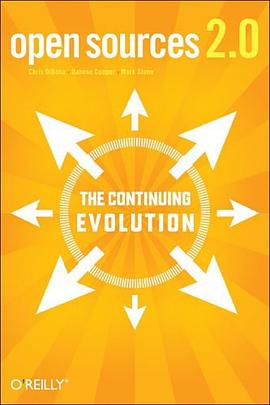
Open Sources 2.0 is a collection of insightful and thought-provoking essays from today's technology leaders that continues painting the evolutionary picture that developed in the 1999 book Open Sources: Voices from the Revolution .
These essays explore open source's impact on the software industry and reveal how open source concepts are infiltrating other areas of commerce and society. The essays appeal to a broad audience: the software developer will find thoughtful reflections on practices and methodology from leading open source developers like Jeremy Allison and Ben Laurie, while the business executive will find analyses of business strategies from the likes of Sleepycat co-founder and CEO Michael Olson and Open Source Business Conference founder Matt Asay.
From China, Europe, India, and Brazil we get essays that describe the developing world's efforts to join the technology forefront and use open source to take control of its high tech destiny. For anyone with a strong interest in technology trends, these essays are a must-read.
The enduring significance of open source goes well beyond high technology, however. At the heart of the new paradigm is network-enabled distributed collaboration: the growing impact of this model on all forms of online collaboration is fundamentally challenging our modern notion of community.
What does the future hold? Veteran open source commentators Tim O'Reilly and Doc Searls offer their perspectives, as do leading open source scholars Steven Weber and Sonali Shah. Andrew Hessel traces the migration of open source ideas from computer technology to biotechnology, and Wikipedia co-founder Larry Sanger and Slashdot co-founder Jeff Bates provide frontline views of functioning, flourishing online collaborative communities.
The power of collaboration, enabled by the internet and open source software, is changing the world in ways we can only begin to imagine.Open Sources 2.0 further develops the evolutionary picture that emerged in the original Open Sources and expounds on the transformative open source philosophy.
作者简介
目录信息
Acknowledgments
List of Contributors
Introduction
Part I: Open Source: Competition and Evolution
Chapter 1: The Mozilla Project: Past and Future
Founding of the Mozilla Organization: Obvious for Developers, a Bold Step for Management
Young Adulthood!the Mozilla Foundation
The Future
Chapter 2: Open Source and Proprietary Software Development
Proprietary Versus Open Source?
Comfort
Distributed Development
Collaborative Development
Software Distribution
How Proprietary Software Development Has Changed Open Source
Some Final Words
Chapter 3: A Tale of Two Standards
The POSIX Standard
First Implementation Past the Post
Future Proofing
Wither POSIX?
The Win32 (Windows) Standard
The Tar Pit: Backward Compatibility
World Domination, Fast
Wither Win32?
Choosing a Standard
Chapter 4: Open Source and Security
Many Eyes
Open Versus Closed Source
Digression: Threat Models
The Future
Interesting Projects
Conclusion
Chapter 5: Dual Licensing
Business and Politics
Open Source: Distribution Versus Development
A Primer on Intellectual Property
Dual Licensing
Practical Considerations
Trends and the Future
Global Development
Open Models
The Future of Software
Chapter 6: Open Source and the Commoditization of Software
Commoditization and the IT Industry
Decommoditization: The Failure of Open Systems
Linux: A Response from the Trenches
"So, How Do You Make Money from Free Software?"
The First Business Models for Linux
Linux Commercialization at a Crossroads
Proprietary Linux?
What's at Stake?
Chapter 7: Open Source and the Commodity Urge: Disruptive Models for a Disruptive Development Process
Introduction
A Brief History of Software
A New Brand of Intellectual Property Protection
Open Distribution, Not Source
Open Source Business Models
Conclusion
Chapter 8: Under the Hood: Open Source and Open Standards Business Models in Context
Open Standards
Open Source Software
The Real Business Model
Open Source Complements
Open Standards Complements
Conclusion
Chapter 9: Open Source and the Small Entrepreneur
Introduction
Freemacs and Open Source
Freemacs and Business
Packet Drivers
Packet Driver Income
Qmail
Open Source Economics
Where Do We Go from Here?
For Further Reading
Chapter 10: Why Open Source Needs Copyright Politics
From Movable Type to MovableType
Copyright in Code
Secondary Liability
Anticircumvention
The Threat to Research
Technology Mandates
What About That Media Server?
Chapter 11: Libre Software in Europe
Brief Summary of an Already Long History
The Development Community
The Organization of the Community
Libre Software in the Private Sector
Public Administrations and Libre Software
Legal Issues
Libre Software in Education
Research on Libre Software
The Future Is Hard to Read....
Chapter 12: OSS in India
Business
Government
Challenges in Local Adoption of OSS
OSS in Education
Conclusion
Chapter 13: When China Dances with OSS
What OSS Was and Is in China
SWOT Analysis of OSS in China
Where OSS Is Going for China and Beyond
Chapter 14: How Much Freedom Do You Want?
Livre Versus Gratis
Background for Freedom: The Market
Developing the Software Livre Movement
Not About Price, but About Choice
Choice Requires More Than Free Software
How Java Technology Can Help
Java Provides the Other Side of the Choice
Walking the Path
What to Do?
We Are Getting There
References
Part II: Beyond Open Source: Collaboration and Community
Chapter 15: Making a New World
Chapter 16: The Open Source Paradigm Shift
Software as Commodity
Network-Enabled Collaboration
Customizability and Software-as-Service
Building the Internet Operating System
Conclusion
Chapter 17: Extending Open Source Principles Beyond Software Development
How Did It Happen and How Does It Work?
Working as a Group
Dealing with the Disrupters
The Difference Between Doing Legal Research in Public and Writing Software in Public
Why and When It Works
Chapter 18: Open Source Biology
The Rise of Modern Biotechnology
Intellectual Property and Growing Challenges
Open Source Biology
Synthetic Biology and Genomic Programming
The Risk of Biological Hacking
Future Trends in Open Source Biology
Chapter 19: Everything Is Known
The PACT Project
The World Trade Center Recovery Effort
Facilitating Emergent Collaboration
Acknowledgments
References
Chapter 20: The Early History of Nupedia and Wikipedia: A Memoir
Some Recent Press Reports
Nupedia
The Origins of Wikipedia
Wikipedia's First Few Months
A Series of Controversies
My Resignation and Final Few Months with the Project
Final Attempts to Save Nupedia
Conclusions
Chapter 21: Open Beyond Software
Sports Equipment Innovation by Users and Their Communities
Community-Based Innovation and Development: An Even Broader Phenomenon
Reframing: Where Does Innovation Come From?
Conclusion
References
Chapter 22: Patterns of Governance in Open Source
The Empirical Problem Set: What Are We Aiming At?
The Theoretical Problem: How Is Knowledge Distributed?
Design Principles for a Referee Function
What Should We Do Differently?
Chapter 23: Communicating Many to Many
The Origins of Slashdot
Slashdot in the Early Days
The Slashdot Effect
Trolls, Anonymous Cowards, and Insensitive Clods
Columbine
Slashdot Grows Up
September 11
Conclusion
Part III: Appendixes
Appendix A: The Open Source Definition
The Open Source Definition, Version 1.9
Appendix B: Referenced Open Source Licenses
The BSD License
The GNU General Public License (GPL)
The Sleepycat License
The Creative Commons License
Appendix C: Columns from Slashdot
Simple Solutions
Why Kids Kill
Colophon
· · · · · · (收起)
读后感
用户评价
这本书最让我感到震撼的,是它在跨学科对话上的无畏和精准。通常,一本专注于某一领域的书籍,其视角往往会受限于自身学科的“藩篱”,但此书显然打破了这种局限。它像是搭建了一个虚拟的圆桌会议,邀请了来自完全不同思想体系的代表人物进行对话。例如,当讨论到某种新兴的技术模式时,作者立刻可以从古典哲学中引出关于“权力结构”的辩证,随后又无缝衔接到当代社会学的“群体行为模型”。这种穿梭于不同知识领域的流畅性,使得对同一问题的观察角度变得无比立体和多维。它强迫读者跳出原有的思维定势,去审视那些平时被我们视为理所当然的基础假设。阅读体验是颠覆性的,每一次翻页,都像是推开了一扇新的知识之门,门后是完全不同风景的景观,但奇怪的是,所有这些风景最终都被证明是同一座宏伟建筑的不同侧面。这种深层次的融会贯通,远超出了我阅读过的许多同类作品所能达到的高度。
评分节奏感是这本书另一个出乎意料的亮点。很多深度作品在处理关键转折点时,往往会陷入冗长和重复的论证,试图用更多的文字来确保读者的理解。然而,此书的处理方式却恰恰相反。它深谙“张弛有度”的艺术。在需要细致铺陈的复杂概念部分,作者会放慢笔速,用极其精确的语言来描绘细节;而一旦涉及到一个核心论断的形成或者一个重大历史转折的分析时,叙述的节奏会骤然加快,如同鼓点密集,观点如瀑布般倾泻而下,冲击力极强。这种动态的阅读体验,极大地抵抗了长篇学术阅读可能带来的疲劳感。我发现自己不自觉地被这种节奏所牵引,甚至在阅读过程中会产生一种“期待下一个爆发点”的紧张感,这在严肃的非虚构作品中是极其罕见的体验。这表明作者对读者的心理变化有着深刻的洞察,懂得何时需要给予喘息,何时需要进行思想的加速冲刺。
评分读完第一部分,我立刻产生了一种被某种宏大叙事拉扯的感觉,作者似乎拥有将看似分散的知识点编织成一张巨大而紧密逻辑网的能力。他/她笔下的论证过程,简直就像是在解构一个精密的钟表,每一个齿轮的运动、每一次能量的传递都被分析得丝丝入扣,但绝不是枯燥的机械描述。更像是跟随一位技艺精湛的匠人,看他如何将一块普通的原材料,通过精确的切割、打磨和组装,最终呈现出一个完美运作的复杂系统。这种叙事风格的厉害之处在于,它在保持极高智识密度的同时,始终没有让读者迷失在专业术语的迷宫里。每当感觉思绪快要飘散时,总有一个巧妙的比喻或者一个历史的侧影适时出现,将焦点重新拉回到核心论点上。这种高超的控场能力,使得原本可能晦涩难懂的议题,变得富有戏剧张力和探索的乐趣。我甚至能感受到作者在行文间流露出的那种对知识边界的强烈好奇心,这不是照本宣科,而是真正的思想火花的碰撞。
评分这本书的装帧设计着实令人眼前一亮,封面的用色大胆而富有层次感,那种深邃的墨蓝与跳跃的亮橙色块交织在一起,仿佛在暗示着内容本身的张力与多维性。初次拿起,就能感受到纸张的质地,不是那种廉价的光滑,而是带着一种温润的、略微粗糙的触感,暗示着这是一本经过精心打磨的作品。内页的排版也极为考究,字体的选择既保留了传统学术书籍的严谨性,又通过巧妙的行距和留白,极大地提升了阅读的舒适度。尤其值得称道的是,书中对图表和示意图的处理,它们并非简单的信息堆砌,而是具有极高的信息密度和美学价值,很多复杂的概念通过这些图形化表达,一下子变得清晰易懂,这对于理解任何领域深层次的逻辑结构都是至关重要的辅助。整体而言,从物理接触到视觉体验,这本书给人的感觉是“厚重而不沉闷”,充满了对阅读体验本身的尊重。它不仅仅是一堆文字的集合,更像是一件经过深思熟虑的工艺品,让人在尚未深入内容之前,就已经对作者及其团队的专业精神肃然起敬。这种对细节的执着,往往预示着内容本身的深度和广度也绝非泛泛之作可以比拟。
评分更深层次来看,这本书成功地构建了一种“悬而未决”的魅力。它提供了大量的分析和框架,清晰地指出了当前局势的复杂性与潜在的风险点,但它并非那种急于给出简单答案或提供万能药的“指导手册”。相反,它更像是一位经验丰富的向导,带领读者走入一片充满迷雾的广袤领域,清晰地标明了已知的地标和潜在的陷阱,然后鼓励读者凭借自己获得的工具和视角,去绘制属于自己的下一步路径。这种对读者主体性的尊重,是极为可贵的。它没有将人塑造成被动接受信息的容器,而是将其视为一个积极的、拥有判断力的思考者。读完之后,萦绕在脑海中的,不是某一句具体的结论,而是一种对现有知识体系进行重新审视的强烈冲动和对未知领域持续探索的内在驱动力。这本书的价值,可能并不在于它告诉了我们“是什么”,而在于它深刻地改变了我们思考“如何思考”的方式。
评分 评分 评分 评分 评分