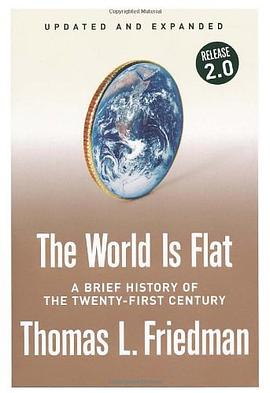

具体描述
这是一本:
对世界经济及商业最富洞察力和预见性的巨作!
被比尔·盖茨、等全球商业领袖顶礼膜拜的里程碑作品
唯一一位3次获得普利策奖的财经作家
连续64周销量位居亚马逊书店十大畅销书之列
全球销售近1000万册
诺贝尔经济学奖得主斯蒂格利茨推荐
IBM大中华区总裁兼首席执行官周伟焜强烈推荐
IBM全体员工人手一册
《金融时报》与高盛2005年度最佳商业图书
When scholars write the history of the world twenty years from now, and they come to the chapter Y2K to March 2004, what will they say was the most crucial development? The attacks on the World Trade Center on 9/11 and the Iraq war? Or the convergence of technology and events that allowed India, China, and so many other countries to become part of the global supply chain for services and manufacturing, creating an explosion of wealth in the middle classes of the world's two biggest nations, giving them a huge new stake in the success of globalization? And with this flattening of the globe, which requires us to run faster in order to stay in place, has the world gotten too small and too fast for human beings and their political systems to adjust in a stable manner?
In this brilliant new book, the award-winning New York Times columnist Thomas Friedman demystifies the brave new world for readers, allowing them to make sense of the often bewildering global scene unfolding before their eyes. With his inimitable ability to translate complex foreign policy and economic issues, Friedman explains how the flattening of the world happened at the dawn of the twenty-first century; what it means to countries, companies, communities, and individuals; and how governments and societies can, and must, adapt. The World Is Flat is the timely and essential update on globalization, its successes and discontents, powerfully illuminated by one of our most respected journalists.
: Thomas L. Friedman is not so much a futurist, which he is sometimes called, as a presentist. His aim in The World Is Flat, as in his earlier, influential Lexus and the Olive Tree, is not to give you a speculative preview of the wonders that are sure to come in your lifetime, but rather to get you caught up on the wonders that are already here. The world isn't going to be flat, it is flat, which gives Friedman's breathless narrative much of its urgency, and which also saves it from the Epcot-style polyester sheen that futurists--the optimistic ones at least--are inevitably prey to.
What Friedman means by "flat" is "connected": the lowering of trade and political barriers and the exponential technical advances of the digital revolution that have made it possible to do business, or almost anything else, instantaneously with billions of other people across the planet. This in itself should not be news to anyone. But the news that Friedman has to deliver is that just when we stopped paying attention to these developments--when the dot-com bust turned interest away from the business and technology pages and when 9/11 and the Iraq War turned all eyes toward the Middle East--is when they actually began to accelerate. Globalization 3.0, as he calls it, is driven not by major corporations or giant trade organizations like the World Bank, but by individuals: desktop freelancers and innovative startups all over the world (but especially in India and China) who can compete--and win--not just for low-wage manufacturing and information labor but, increasingly, for the highest-end research and design work as well. (He doesn't forget the "mutant supply chains" like Al-Qaeda that let the small act big in more destructive ways.)
Friedman has embraced this flat world in his own work, continuing to report on his story after his book's release and releasing an unprecedented hardcover update of the book a year later with 100 pages of revised and expanded material. What's changed in a year? Some of the sections that opened eyes in the first edition--on China and India, for example, and the global supply chain--are largely unaltered. Instead, Friedman has more to say about what he now calls "uploading," the direct-from-the-bottom creation of culture, knowledge, and innovation through blogging, podcasts, and open-source software. And in response to the pleas of many of his readers about how to survive the new flat world, he makes specific recommendations about the technical and creative training he thinks will be required to compete in the "New Middle" class. As before, Friedman tells his story with the catchy slogans and globe-hopping anecdotes that readers of his earlier books and his New York Times columns know well, and he holds to a stern sort of optimism. He wants to tell you how exciting this new world is, but he also wants you to know you're going to be trampled if you don't keep up with it. A year later, one can sense his rising impatience that our popular culture, and our political leaders, are not helping us keep pace.
--Tom Nissley
Before 9/11, New York Times columnist Friedman was best known as the author of The Lexus and the Olive Tree, one of the major popular accounts of globalization and its discontents. Having devoted most of the last four years of his column to the latter as embodied by the Middle East, Friedman picks up where he left off, saving al-Qaeda et al. for the close. For Friedman, cheap, ubiquitous telecommunications have finally obliterated all impediments to international competition, and the dawning "flat world" is a jungle pitting "lions" and "gazelles," where "economic stability is not going to be a feature" and "the weak will fall farther behind." Rugged, adaptable entrepreneurs, by contrast, will be empowered. The service sector (telemarketing, accounting, computer programming, engineering and scientific research, etc.), will be further outsourced to the English-spoken abroad; manufacturing, meanwhile, will continue to be off-shored to China. As anyone who reads his column knows, Friedman agrees with the transnational business executives who are his main sources that these developments are desirable and unstoppable, and that American workers should be preparing to "create value through leadership" and "sell personality." This is all familiar stuff by now, but the last 100 pages on the economic and political roots of global Islamism are filled with the kind of close reporting and intimate yet accessible analysis that have been hard to come by. Add in Friedman's winning first-person interjections and masterful use of strategic wonksterisms, and this book should end up on the front seats of quite a few Lexuses and SUVs of all stripes.
Although it may be catchy, the title of New York Times columnist Friedman's latest book needs explaining. "Flat" here means "level," as in the level playing field on which virtually any nation can now compete, thanks to the explosion of global telecommunications, including the Internet as well as the transfer of information from First World to Third--and back. There's also a leveling of hierarchies within organizations, thanks to the increasing democratization of information from sources such as the Web. Friedman cites 10 forces that have caused this "flattening," including the fall of the Berlin Wall ("We could not think globally about the world when the Berlin Wall was there," said one economist), the emergence of Netscape as an Internet platform, workflow software, open sourcing, outsourcing, the streamlining of the supply chain (witness Wal-Mart), the organization of information on the Internet (Google, Yahoo), and the ubiquity of powerful personal telecommunications devices. Friedman is very thorough at projecting the consequences of these changes, noting the benefits we all share from this hyper-globalization, while realistically addressing, for example, the challenges American workers will face in the coming decades from talented, highly motivated workforces in such countries as India and China. A little more humor might have offset the author's trademark earnestness; still, as he has with other global issues, Friedman brings coherence and a workable plan of action to the fundamental changes our world is experiencing.
Alan Moores
Adult/High School–This brilliantly paced, articulate, and accessible explanation of today's world is an ideal title for tech-savvy teens. Friedman's thesis is that connectedness by computer is leveling the playing field, giving individuals the ability to collaborate and compete in real time on a global scale. While the author is optimistic about the future, seeing progress in every field from architecture to zoology, he is aware that terrorists are also using computers to attack the very trends that make progress plausible and reasonable. This is a smart and essential read for those who will be expected to live and work in this new global environment
–Alan Gropman, National Defense University, Washington, DC
Distance has been annihilated. Your X rays are sent to India, your job to China. In a flat world the U.S. must seize every technological advantage and put the "oomph" we gave the moon shot into breaking our oil habit. (Although the writer suspects that he will be sent to the moon before "W." gets the message.) Narrator Oliver Wyman does a superb job. First he's the irrepressible American, then the Indian gentleman, and finally the Chinese whose English is formal but broken. The audiobook technology that enables us to take in so much information while caught in traffic or scrubbing a pan is precisely the sort of handhold Friedman would urge us all to grasp, and with both hands. B.H.C. Winner of AudioFile Earphones Award
Friedman, nominally a liberal, has historically taken the middle path and supported laissez-faire capitalism, globalization, and the power of institutions like the International Monetary Fund. Ever optimistic about globalization, he pleases its proponents and disappoints its detractors in The World Is Flat. There’s no doubt that Friedman asks timely questions, even if he sometimes shirks definitive answers. Although he acknowledges terrorism’s global weight, he identifies an even more potent force shaping global economics and politics: the "triple convergence—of new players, on a new playing field, developing new processes … for horizontal collaboration," particularly in China and India. Friedman’s story comes alive as we meet the movers and shakers of Globalization 3.0, eavesdrop on Friedman’s interviews, and witness collaborations in progress. Friedman’s personal journey, if slightly padded, makes for entertaining and accessible reading. Yet critics, even those who support globalization, differed on Friedman’s thesis; India, for example, has not yet become the global superpower he describes; many scholars still describe the "flat world" as a nicer name for "cheap labor." Friedman also less effectively analyzes the effects of Globalization 3.0 than its players, and embraces technological determinism at the expense of thoroughly considering major political factors (like terrorist networks, which he’s previously compared to World War III). No matter your stance on the benefits or pitfalls of globalization, The World Is Flat is an important, thought-provoking book—even if Friedman’s answer to unresolved issues is, "Sort that out."
Thomas L. Friedman has won the Pulitzer Prize three times for his work at The New York Times. He is the author of three best-selling books: From Beiruit to Jerusalem (FSG, 1989), winner of the National Book Award for nonfiction and still considered to be the definitive work on the Middle East, The Lexus and the Olive Tree: Understanding Globalization (FSG, 1999), and Longitudes and Attitudes: Exploring the World After September 11 (FSG, 2002). He lives in Bethesda, Maryland, with his family.
《世界是平的》中文版 精装版
《世界是平的》中文版 《世界是平的》中文版 平装版
作者简介
托马斯·弗里德曼是《纽约时报》的专栏作家,曾三次赢得普利策奖。在其1999年出版的经典著作《了解全球化:凌志汽车与橄榄树》当中,他提出了新科技和全球化与传统文化的联系,引发了西方学界一场关于全球化问题的大争论。他认为现在的社会必定抵挡不了全球化的浪潮,全球化的趋势是不可阻挡的。在《世界是平的:21世纪简史》出版之前,他已经是美国公认最有影响力的新闻工作者。
目录信息
读后感
《圣经.旧约》上说,人类的祖先最初讲的是同一种语言。他们在底格里斯河和幼发拉底河之间的巴比伦定居,日子越过越好,决定修建一座可以通到天上去的高塔——巴比伦塔。上帝今天我们所看到的大怒,决定让人世间的语言发生混乱,是人们互相语言不通,结果才形成了几大语系并存...
评分世界是平的,一本据说很火爆的畅销书。听说过蛮长时间,但总觉得标题蛮怪:难道到今天还有人怀疑地球不是圆的么? 于是很居心叵测的怀疑是标题党作祟,无视之。 直到前段一好友决定再次起航北漂,留下一堆杂物与我,其中便有此书中文版。他说不错值得一看,友人推荐又是免费之...
评分[随手一记] 世界是平的&湖南科学技术出版社&东方出版社 我要写书评,而且要评《世界是平的》,你信吗?熟悉我的,或熟悉我的blog的朋友,都肯定不信。但这次,各位非信不可。呃,先声明一句,这本书,我现在只看到第9页。 我要评的这个版本,是很新的2006年9月版,译者是何帆...
评分 评分题记:我渴望成为你思想上的伙伴,平坦世界中的朋友! —— 不戒 一本书洗了我的脑,书的名字叫《世界是平的》。 读完了《纽约时报》专栏作家托马斯•弗里德曼的这本书,我忍不住问自己:天哪,这家伙是怎样做到的呢?然后,我像那只想吃天鹅肉的赖蛤...
用户评价
翻开这本新近出版的《全球变局下的商业智慧》,我内心是既期待又带着一丝审慎的。作者的叙事风格极其流畅,仿佛一位经验老到的行业导师,娓娓道来那些令人咋舌的商业案例。他并没有像某些畅销书那样,陷入空泛的口号和鼓舞人心的陈词滥调。相反,书中对过去十年间,技术迭代如何真实地重塑了传统行业的底层逻辑,进行了细致入微的剖析。我特别欣赏作者对供应链韧性那一章的阐述,他没有停留在“数字化转型”这种宏大叙事层面,而是深入到具体的B2B交易环节中,探讨了区块链技术在提升跨国贸易透明度和效率方面的潜力与实际落地中的困境。例如,他对比了两种不同企业文化在接纳新兴技术时的阻力,前者是固守既得利益的巨头,后者则是机制灵活的中小型创新企业,这种对比分析提供了极具操作性的视角。读到企业如何在高歌猛进的全球化浪潮中,不得不面对地缘政治风险带来的“去中心化”压力时,我深有感触。这本书的价值在于,它提供了一套观察世界复杂性的工具箱,而非简单的答案。它教会我们识别那些正在被加速或减速的结构性力量,并预判它们下一步的行动轨迹。读完后,感觉对未来商业环境的迷雾消散了不少,剩下的,是需要自己去执行的精细化战略部署。
评分我最近翻阅的这本《海洋深处的文明密码》完全是出于一种对未知世界的好奇心。这是一本结合了海洋生物学、古代航海史以及深海地质学的跨学科著作,作者的笔触充满了一种对地球原始力量的敬畏。全书最引人入胜的部分,莫过于对深海热液喷口生态系统的描绘。作者用极其生动的语言,描述了那些完全依赖化学能而非光合作用生存的奇异生物群落,它们的存在挑战了我们对生命基本条件的传统认知。阅读这些描述时,我仿佛能感受到那种极端环境下的幽闭与压力,以及生命在逆境中爆发出惊人适应力的韧性。书中还穿插了对古代波利尼西亚航海者如何仅凭星辰和洋流进行洲际迁徙的考证,这种对人类早期智慧的赞颂,与现代高科技探索形成了有趣的对话。这本书的叙事节奏张弛有度,从微观的微生物世界跳跃到宏观的板块构造运动,始终保持着一种探索的激情。它给予我的感觉是,我们对地表的了解远不如我们想象的那么深入,地球上仍有广阔、充满未知和奇迹的领域等待被发现和理解。
评分我花了整整一个周末才啃完这本《数字游牧民族的生存法则》,坦白说,它更像是一本充满实战技巧的“野外生存手册”,而非一本理论专著。作者显然是一位身体力行者,她的文字充满了烟火气和对细节的偏执关注。全书不谈虚的愿景,只聚焦于“如何通过远程工作实现财务自由和地域自由”这一核心目标。书中关于税务筹划、跨国数字身份管理、以及如何在一个完全虚拟的团队中建立高效信任机制的章节,简直是黄金段落。我尤其欣赏她分享的那些“踩坑”经历——比如如何识别那些承诺高薪但实则为传销陷阱的远程项目,以及在南美和东南亚不同地区生活成本和安全风险的实时对比数据。这种基于亲身体验的详尽指南,在充斥着“成功学”的互联网上是极其珍贵的。对于那些厌倦了朝九晚五、渴望掌控自己时间表的人来说,这本书提供了一条清晰、尽管布满荆棘的路径图。阅读过程中,我甚至忍不住打开了地图软件,开始规划自己下一个远程办公的目的地,那种强烈的行动驱动力,是很多商业书籍难以激发出来的。
评分《艺术的终结与新审美秩序》这本书,以其晦涩而又极具挑衅性的语言风格,将我带入了一场关于“何为美”的哲学思辨。作者似乎对当代艺术界的商业化趋势抱有深深的不屑,他将许多被市场追捧的作品视为“符号的堆砌”,缺乏真正的精神内核。书中对后现代主义美学范式的解构尤为犀利,他指出,在媒介无限复制的时代,原作的光环正在迅速消退,取而代之的是“语境”的统治地位。阅读体验是高强度的脑力体操,作者大量引用了福柯和德勒兹的理论,要求读者具备一定的哲学基础才能跟上其思路。然而,一旦跨越了初期的理解障碍,那种豁然开朗的感觉是极其美妙的。他探讨了人工智能生成艺术(AIGC)对人类创造力的最终挑战,并提出了一个大胆的假设:真正的艺术价值将回归到“不可重复的生命体验”本身,而非最终的物质呈现。这本书并非一本轻松的读物,它更像是一次对我们文化品味的“审判”,迫使我们审视自己对“价值”的定义是否已经被资本裹挟。
评分这本《无声的革命:21世纪的权力转移》无疑是一次对现有认知体系的强力冲击。作者的文字带着一种近乎冷峻的批判色彩,他没有试图美化任何一方,而是将聚光灯打在了权力分配中那些被主流叙事有意无意忽略的角落。全书的结构安排颇为精妙,从宏观的全球治理失衡,逐步深入到微观的个体信息茧房构建,逻辑链条层层递进,让人无法逃避。最让我感到震撼的是其关于“注意力经济”本质的剖析。作者用大量数据佐证,现代社会的信息过载并非偶然,而是被精心设计的商业模式的必然产物。他描述了算法如何利用人类最原始的认知偏差,将我们的专注力榨取至极限,并以此为基础建立起新的经济壁垒。这种论述,让我不得不反思自己日常接触信息的习惯,那种看似自由的选择,实则被隐藏的机制所引导的无力感油然而生。书中对新兴强权国家内部社会矛盾的描写,也极其克制且有力,没有采用西方媒体惯用的简单标签化处理,而是试图去理解其复杂的历史脉络和社会心理基础。这本书的阅读体验是沉重的,它剥去了许多光鲜亮丽的口号,将我们置于一个需要更深刻反思的现实之中。
评分觉得理科生就是天下的美国人。
评分inspired
评分就这样吧
评分我的世界格局启蒙书。
评分飞天猪捐赠,更多精彩书籍请至朋歌书房:http://dou.bz/3OAy4y