具体描述
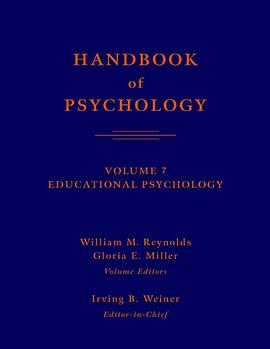
Handbook of Psychology: Preface (I. Weiner).
Volume Preface (W. Reynolds and G. Miller).
Contributors.
PART ONE: INTRODUCTION.
1. Current Perspectives in Educational Psychology (W. M. Reynolds and G. E. Miller).
PART TWO: COGNITIVE CONTRIBUTIONS TO LEARNING, DEVELOPMENT AND INSTRUCTION.
2. Contemporary Theories of Intelligence (R. J. Sternberg).
3. Memory and Information Processes (R. E. Mayer).
4. Self-Regulation and Learning (D. H. Schunk and B. J. Zimmerman).
5. Metacognition and Learning (C. B. McCormick).
6. Motivation and Classroom Learning (P. R. Pintrich).
PART THREE: SOCIOCULTURAL, INSTRUCTION AND RELATIONAL PROCESSES.
7. Sociocultural Contexts for Teaching and Learning (V. John-Steiner and H. Mahn).
8. Teaching Processes in Elementary and Secondary Education (M. Pressley, et al.).
9. Cooperative Learning and Achievement Theory and Research (R. E. Slavin, et al.).
10. Relationships Between Teachers and Children (R. C. Pianta, et al.).
11. School Adjustment (K. R. Wentzel).
12. Gender Issues in the Classroom (J. Koch).
PART FOUR: CURRICULUM APPLICATIONS.
13. Early Childhood Education (H. Goelman, et al.).
14. Psychology of Literacy and Literacy Instruction (M. Pressley).
15. Mathematical Leaning (R. Lehrer and R. Lesh).
16. Computers, the Internet, and New Media for Learning (R. Goldman and J. W. Waxman).
PART FIVE: EXCEPTIONAL LEARNER PROGRAMS AND STUDENTS.
17. School Psychology (D. Reschly).
18. Learning Disabilities (L. S. Siegel).
19. Gifted Education Programs and Procedures (P. Olszewski-Kubilius).
20. School-Related Behavior Disorders (H. M. Walker and F. M. Gresham).
PART SIX: EDUCATIONAL PROGRAM, RESEARCH AND POLICY.
21. Learning and Pedagogy in Initial Teacher Preparation (J. A. Whitcomb).
22. Educational/Psychological Intervention (J. R. Levin, et al.).
23. Research to Policy for Guiding Educational Reform (B. L. McCombs).
24. Future Perspectives in Educational Psychology (G. E. Miller and W. M. Reynolds).
Author Index.
Subject Index.
Handbook of Psychology, Volume 1: Intellectual Assessment and Intellectual Disabilities A Comprehensive Survey of Theory, Measurement, and Practice in Intelligence and Cognitive Functioning This volume of the Handbook of Psychology series delves into the complex and multifaceted domains of intellectual assessment and intellectual disabilities. It serves as an authoritative compendium, synthesizing decades of research, clinical practice, and theoretical advancement across psychology, neuropsychology, education, and cognitive science. Designed for researchers, clinicians, administrators, and advanced students, this handbook provides an in-depth, critical examination of the constructs, methodologies, and implications surrounding human cognitive capacity and impairment. Part I: Foundations of Intelligence and Intellectual Assessment The initial section establishes the theoretical bedrock upon which all subsequent assessment practices are built. It begins with a historical overview, tracing the evolution of intelligence conceptualizations from early psychometric endeavors to contemporary, multi-faceted models. Chapter 1: Historical and Conceptual Frameworks of Intelligence This chapter meticulously details the major historical milestones, from Binet’s initial scaling efforts to Spearman’s $g$ factor, Thurstone’s primary mental abilities, and the subsequent emergence of Cattell-Horn-Carroll (CHC) theory. It critically analyzes the strengths and limitations of unitary versus multifaceted models of intelligence, exploring the ongoing debate regarding the nature of general intelligence versus specific cognitive abilities. Furthermore, it addresses the philosophical underpinnings of intelligence measurement, examining the interplay between biology, environment, and cultural context in shaping cognitive performance. Chapter 2: Theories of Cognitive Abilities and Information Processing Moving beyond traditional psychometrics, this chapter explores contemporary cognitive and information-processing theories. It thoroughly reviews models emphasizing working memory, executive functions (including planning, inhibition, and cognitive flexibility), and attentional mechanisms as core components underlying measured intelligence. Specific attention is paid to how these processing speeds and efficiencies contribute to crystallized and fluid intelligence, offering a mechanistic understanding often absent in purely psychometric descriptions. Chapter 3: Principles of Intellectual Assessment Methodology This section provides a rigorous examination of the psychometric standards required for valid and reliable assessment. Topics covered include test construction, item response theory (IRT), classical test theory (CTT), sampling methodologies, standardization procedures, and cross-cultural validation studies. Emphasis is placed on understanding measurement error, reliability coefficients (e.g., internal consistency, test-retest stability), and the complex interpretation of validity evidence (construct, content, criterion-related). Chapter 4: Major Instruments for Intellectual Assessment This critical chapter reviews the leading standardized instruments used globally for assessing general intellectual functioning and cognitive profiles. Detailed comparisons are drawn between instruments such as the Wechsler scales (WAIS, WISC, WPPSI), the Stanford-Binet Intelligence Scales (SB5), and comprehensive batteries like the Woodcock-Johnson Tests of Cognitive Abilities (WJ IV Cog). The chapter focuses not merely on administration but on the specific theoretical constructs tapped by each subtest and index score, aiding practitioners in selecting the most appropriate tool based on the referral question and the examinee’s profile. It also discusses the practical considerations of computer adaptive testing (CAT) in cognitive assessment. Part II: Assessment of Special Populations and Applied Contexts This part shifts the focus to the practical application of intellectual assessment in diverse and challenging populations, emphasizing specialized techniques required beyond standard normative procedures. Chapter 5: Assessment in Infancy and Early Childhood Evaluating cognitive potential in very young children presents unique methodological challenges. This chapter reviews developmental scales designed for infancy (e.g., Bayley Scales of Infant and Toddler Development) and preschool periods, focusing on interpreting developmental indices, recognizing early indicators of risk, and understanding the limitations imposed by motor skills, attention span, and non-verbal response capabilities in this age group. Chapter 6: Neuropsychological Correlates of Intellectual Functioning Bridging psychology and neuroscience, this chapter explores the biological substrates of intelligence. It synthesizes findings from structural and functional neuroimaging studies (MRI, fMRI, EEG) that correlate specific brain regions and connectivity patterns with various cognitive abilities. It also covers assessing intelligence in the context of known neurological conditions, such as traumatic brain injury (TBI), epilepsy, and neurodevelopmental disorders. Chapter 7: Cross-Cultural and Linguistic Considerations in Assessment A vital section addressing the inherent biases and complexities of testing individuals from diverse linguistic and cultural backgrounds. It examines test translation, adaptation, and the development of culturally sensitive instruments. The chapter analyzes the impact of acculturation, linguistic fluency, and test-taking motivation on performance scores, offering guidelines for making clinically meaningful interpretations when normative data may not perfectly align with the examinee’s background. Chapter 8: Dynamic Assessment and Intervention Planning Moving beyond static measurement, this chapter introduces dynamic assessment paradigms, emphasizing the learning potential (modifiability) of the individual rather than just their current performance level. It details methods where examiner interaction and mediation are integrated into the assessment process, providing prescriptive data crucial for developing targeted cognitive intervention strategies. Part III: Intellectual Disabilities: Definition, Diagnosis, and Support The final section provides a definitive, contemporary framework for understanding intellectual disabilities (ID), aligning with the latest diagnostic manuals and emphasizing functional competence over purely IQ-based thresholds. Chapter 9: Diagnostic Criteria and Differential Diagnosis of Intellectual Disability This chapter offers a comprehensive review of the current diagnostic criteria for Intellectual Disability (ID), focusing on the DSM-5 and ICD-11 definitions that mandate deficits in both intellectual functioning AND adaptive behavior. It details the standardized instruments used to measure adaptive functioning (e.g., Vineland Adaptive Behavior Scales), emphasizing the multidimensional nature of adaptation across conceptual, social, and practical domains. Crucially, it distinguishes ID from other overlapping conditions such as specific learning disorders, language impairment, and attentional disorders. Chapter 10: Etiology and Co-occurring Conditions in Intellectual Disability Exploring the vast spectrum of causes underlying ID, this chapter categorizes etiology into genetic syndromes (e.g., Down Syndrome, Fragile X Syndrome), prenatal/perinatal insults, and environmental factors. It provides essential clinical guidance on identifying common co-occurring physical and mental health conditions, such as autism spectrum disorder, ADHD, and affective disorders, which significantly complicate diagnosis and service delivery. Chapter 11: Intervention Strategies and Supports for Individuals with ID This concluding chapter focuses squarely on evidence-based practice in supporting individuals across the lifespan. It reviews interventions targeting cognitive remediation, skill acquisition, and behavioral supports. Discussions include community integration models, supported employment strategies, functional curriculum design in educational settings, and the critical role of person-centered planning (PCP) in ensuring quality of life outcomes. Emphasis is placed on promoting autonomy and self-determination within existing support structures. Conclusion Handbook of Psychology, Volume 1: Intellectual Assessment and Intellectual Disabilities stands as the essential reference for understanding the complexities of human cognitive measurement and the clinical science dedicated to supporting those with cognitive impairments. It bridges foundational theory with cutting-edge application, ensuring practitioners are equipped with the most rigorous, ethically informed knowledge base available.