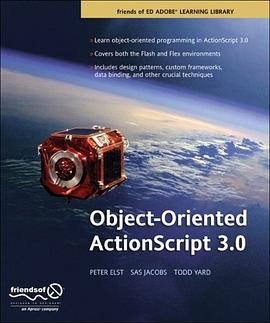

具体描述
http://www.friendsofed.com/book.html?isbn=1590598458
* Learn object-oriented programming in actionscript 3.0
* Covers both the Flash and Flex environments
* Includes design patterns, custom frameworks, data binding, and other crucial techniques
Object-oriented programming (OOP) is something that is usually considered a black art for hardcore programmers, not a topic of conversation for Flash developers. However, when adobe introduced actionscript 3.0 to the mix, it changed everything. actionscript 3.0 is much more powerful than previous versions, allowing Flash developers to produce robust object-oriented applications. but with that power comes great responsibility—OOP is now a requirement, rather than optional, and there are new things to learn.
But never fear—this book, based on the ever-popular Object-Oriented ActionScript for Flash 8, provides you all you need to delve into the world of OOP with confidence, whether you are using the Flash IDE, Flex builder, or even command-line tools for your development work.
First, you are taken gently through all the principles of OOP that you need to know, and then given a guide to designing and implementing applications in actionscript 3.0. Next, we step up a gear, showing you the Flex builder development environment and teaching about creating reusable, extensible component frameworks—manager classes, animation and effects classes, UI widgets, and more. lastly, we look at some more advanced topics such as communication between Flash and the browser and Web services. case studies are included that apply the knowledge presented, giving you real-world projects to learn from and adapt for use in your own work.
Mastering object-oriented programming is essential for modern Flash development, and Object-Oriented ActionScript 3.0 is the only guide you'll need.
In this book you'll learn:
* the essential principles of object-oriented programming, including inheritance, encapsulation, polymorphism, and more
* Valuable lessons on actionscript 3.0 project planning and programming, including design patterns and source control
* How to create your own extensible, reusable application framework using OOP best practices
* Advanced data integration techniques such as Web services and communication between Flash and the browser Object-Oriented ActionScript 3.0
Summary of Contents
* PART ONE: OOP AND ACTIONSCRIPT
o Chapter 1: Introduction to OOP
o Chapter 2: Programming Concepts
o Chapter 3: ActionScript 3.0 Programming
* PART TWO: FLASH OOP GUIDELINES
o Chapter 4: Planning
o Chapter 5: Project Workflow
o Chapter 6: Best Practices
o Chapter 7: Working with Flex 2
* PART THREE: CORE OOP CONCEPTS
o Chapter 8: Encapsulation
o Chapter 9: Classes
o Chapter 10: Inheritance
o Chapter 11: Polymorphism
o Chapter 12: Interfaces
o Chapter 13: Design Patterns
o Chapter 14: Case Study: An OOP Media Player
* PART FOUR: BUILDING AND EXTENDING DYNAMIC FRAMEWORKS
o Chapter 15: Manager Classes
o Chapter 16: UI Widgets
o Chapter 17: OOP Animation and Effects
* PART FIVE: DATA INTEGRATION
o Chapter 18: Exchanging Data Between Components
o Chapter 19: Communication Between Flash and the Browser
o Chapter 20: Server Communication (XML and Web Services)
o Chapter 21: Case Study: Slideshow Engine
作者简介
About the Author
After studying theatre in London, then working for several years as an actor in the US, Todd was introduced to Flash in 2000 and was quickly taken by how it allowed for both stunning creativity and programmatic logic application--a truly left-brain, right brain approach to production--and has not looked back. He now freelances as a Flash developer in New York City, creating both silly animations and utilitarian applications. His personal work and experimentation can be found at his website, www.27Bobs.com. Peter is a certified Flash MX 2004 developer, Team Macromedia volunteer for Flash and runs his own business named MindStudio, which mainly does multimedia development and consultancy.
Introduced to Macromedia Flash in late 1996, he started of doing interactive advertisement campaigns for one of Europe's largest online advertisement agencies. When Macromedia released its Generator software his interest moved more towards the backend side of things, fascinated by Flash and database integration -- what many considered some very innovative technology at that time.
After attending the FlashForward 2001 conference in Amsterdam, Peter was so inspired that he decided to make the switch from HTML to full-fledged multimedia development, a decision he hasn't regretted since.
Sas is a Web developer who loves working with Flash. She set up her business Anything Is Possible in 1994, working in the areas of web development, IT training and technical writing. The business works with large and small clients building web applications with ASP.NET, Flash, XML and databases.
Sas has also spoken at conferences such as Flash Forward, MXDU and FlashKit on topics relating to XML and dynamic content in Flash. In her spare time, Sas is passionate about travelling, photography and enjoying life. One of her most fervent wishes is that Flash will take over the Web!
目录信息
读后感
用户评价
拿到书后,我做的第一件事就是快速浏览那些带有“陷阱”或“常见错误”标记的段落。坦白说,很多技术书籍在讲最佳实践时,往往只展示了“对的”做法,却忽略了“错的”方向是如何一步步产生的。而这本书似乎在这方面做了大量的铺垫工作。我注意到它似乎花了大量的篇幅去剖析AS3虚拟机的一些底层运行机制,尤其是在内存管理和垃圾回收方面,这通常是影响Flash/AIR应用性能的关键瓶颈。如果这本书真的能将这些“幕后”的细节用易于理解的方式呈现出来,那么它就不仅仅是一本“如何写代码”的书,更是一本“如何写出高效代码”的性能调优圣经。对于我这样需要在移动端和桌面端保持高性能输出的开发者来说,这种对底层机制的洞察是无价的。我非常期待它在处理跨平台兼容性,特别是涉及到原生API调用和数据序列化时的解决方案,希望能一举攻克我目前项目中的几个顽固难题。
评分这本书的封面设计得非常抓人眼球,色彩搭配既专业又不失活力,一看就知道是面向有一定基础的开发者的。我拿到手的时候,首先被它厚实的装帧吸引了,显然内容量是相当可观的。翻开第一页,目录结构清晰明了,章节划分逻辑性极强,从基础的数据结构到高级的设计模式,循序渐进,让人感到信心十足。虽然我还没有深入阅读每一个代码示例,但从章节标题来看,作者对ActionScript 3.0的各个方面都有着深入的理解和独到的见解,特别是涉及到性能优化和大型项目架构的部分,似乎有着非常详尽的论述。这本书的排版也非常考究,代码块与文字说明之间的留白恰到好处,阅读起来一点也不觉得拥挤或吃力,这对于长时间面对屏幕的程序员来说,是一个巨大的加分项。我期待着通过这本书,能将我对AS3的理解提升到一个新的层次,尤其是那些在官方文档中难以找到的“最佳实践”和“陷阱规避”的经验之谈,希望能在书中得到印证和学习。整体而言,这本书在视觉和结构上都给人一种专业、权威的感觉,仿佛一位经验丰富的大师正在为你系统地梳理知识体系,迫不及待想开始我的深度学习之旅。
评分我最近在整理旧项目时,发现很多早期用AS3写的代码简直是“意大利面条式”的灾难,急需一次彻底的重构和知识更新。正是带着这种迫切的心情,我淘来了这本被圈内人推荐了很久的工具书。这本书的真正价值,我认为不在于它罗列了多少语法特性——那些我通过日常查阅API就能掌握——而在于它如何将抽象的“面向对象思维”与ActionScript这个特定的平台环境进行深度融合。我尤其关注其中关于如何利用AS3的特性来构建可维护、高内聚、低耦合的类库的讨论。从试读的章节来看,作者似乎非常强调“契约先行”的设计理念,这一点对于我这种过去习惯于“先写功能,再考虑结构”的开发者来说,无疑是一剂强心针。这本书的论述风格非常严谨,没有过多花哨的形容词,每一个概念的提出都伴随着清晰的逻辑推导和务实的解决方案,这对于追求效率的开发者来说是最好的“营养品”,能够帮助我彻底摒弃那些半吊子的编程习惯,建立起一套更健壮的开发哲学。
评分这本书的体量本身就让我感受到了作者倾注的心血,它绝对不是市面上那种浅尝辄止的“速成指南”。我发现它似乎有着非常强的“实战驱动”色彩,很多设计模式的讲解并非纯粹的理论灌输,而是直接与AS3中特定的应用场景(比如游戏循环管理、复杂UI组件的事件分发机制等)紧密挂钩。这种接地气的讲解方式,让原本可能显得枯燥的设计模式变得生动起来,让人能够立刻理解“我为什么需要它”以及“我该如何用它”。我个人对面向对象编程中“继承与组合的选择”这一永恒的难题特别感兴趣,希望这本书能提供一个明确的决策框架,帮助我在面对复杂的业务逻辑时,能做出更优雅、更具扩展性的架构选择,而不是陷入无休止的继承链深渊。这本书的价值,就在于它能帮你把从“知道”到“做到”之间的那道鸿沟,通过详实的案例和清晰的原理分析给填平。
评分说实话,市面上关于ActionScript 3.0的书籍,要么过于基础,要么就是针对特定框架(如Flex或Starling)的深入应用。很少有书籍能像这本书这样,专注于将“纯粹的AS3面向对象思想”进行系统化的梳理和提炼。我最欣赏的是它对SOLID原则的讲解,据说作者是结合AS3的动态特性来阐述这些静态语言哲学如何有效落地,这本身就是一种高难度的知识转化。这种高屋建瓴的视角,对于想要从“编码匠”蜕变为“架构师”的读者至关重要。它不仅仅教你如何写出能跑的代码,更是教你如何设计出能够应对未来需求变化的代码。我期待它能提供一套成熟的“重构清单”或“设计自检流程”,这样我就可以在开发过程中随时拿出来对照检查,确保我的代码质量始终保持在一个高标准之上。这本书看起来更像是一本可以放在手边,时常翻阅的“设计词典”,而不是一本读完就可以束之高阁的教材。
评分 评分 评分 评分 评分