
具体描述
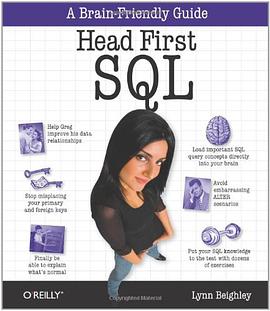
Head First SQL is about RDBMS (databases) specifically mySQL (version 5.0 or newer) and includes features of other databases. The book defines a database, demonstrates how to navigate an existing database, and teaches how to create simple and complex databases, as well as how to let a database grow from simple to complex.
Foundational understanding of database construction and navigation is the focus. The target audience is those brand-new to the topic as well as those with an acquaintance with the subject and the need for a greater conceptual understanding of databases.
It focuses on the basics of databases, so the main information should remain pertinent until RMDBS get re-conceived. I think revisions, such as the reprint due out in December, will add to the strength of the book as typos and coding errors will be addressed.
The title accurately describes the contents and the subtitle "A Brain-Friendly Guide" describes the goal of the approach. The only requirements for working with the material are: a computer or access to one, the ability to identify your operating system, familiarity with downloading from the internet (links and instructions are provided in the book and the program mySQL community release is free (download instructions are given for Mac and Windows users, I believe that instructions for Linux are not included with the assumption Linux users can access the mySQL community release page and download the program without a play-by-play)), and the courage to learn a command line window user interface if you don't already know this.
Head First SQL is most useful to those who, like myself, have heard passing references to databases and other than knowing they are important have no grasp of what it is, means, or can do. Also, this will be a helpful tool for those who have some of the verbiage, enough to pass at a cocktail party, but who would feel the cold chill of horror if expected to design, construct, and implement a database in conjunction with any of their paid responsibilities.
This is the first book that I have read on the subject of databases and the first computer book that I have been able to finish. So much of the educational information about program x, language y, or application z, depends on a working knowledge of the other two variables. This is a great book for beginners. It talks about data types, it explains null, and then has null explain himself. It tells me the importance of the semicolon at the end. All basic stuff. All stuff that other books take for granted. Many times when I believed I wasn't absorbing anything, along came questions I could answer, a crossword I could complete and match-column-A-with-column-B exercises that demonstrated that I was actually learning much more than than I was giving myself credit for.
It includes illustrations, photos, clean layout, and bite sized pieces of information. All this comes from the goal of allowing both sides of the brain access to the information. It's exactly the kind of approach that I need to reinforce the terms and concepts as well as provide encouraging feedback to keep me progressing through the material. I'm also grateful that it entertains me and keeps me going back to finish the whole thing long after the first blush of excitement has worn away.
Links, to the mySQL program necessary to work with the material, are included in the book as well as a few other links in the appendices. The Head First website is a must in order to link to the forums, newsletter, blog and downloadable files to create various tables used in the book. Head First came out with a web app called Hands On SQL which I would encourage you to try. It won't work with all of the book's material but it is a good-looking tool.
作者简介
Lynn Beighley is a fiction writer stuck in a technical book writers body. Upon discovering that technical book writing actually paid real money, she learned to accept and enjoy it.
After going back to school to get a Masters in Computer Science, she worked for the acronyms NRL and LANL. Then she discovered Flash, and wrote her first bestseller.
A victim of bad timing, she moved to Silicon Valley just before the great crash. She spent several years working for Yahoo! and writing other books and training courses. Finally giving in to her creative writing bent, she moved to the New York area to get an MFA in Creative Writing.
Her Head First-style thesis was delivered to a packed room of professors and fellow students. It was extremely well received, and she finished her degree, finished Head First SQL, and cant wait to begin her next book.
Lynn loves traveling, cooking, and making up elaborate background stories about complete strangers. Shes a little scared of clowns.
目录信息
读后感
这本对所有没SQL基础的人来说都是本好书,生动的图画,幽默的语言,紧凑的内容,让你爱不释手,绝对是入门SQL的好!
评分这本对所有没SQL基础的人来说都是本好书,生动的图画,幽默的语言,紧凑的内容,让你爱不释手,绝对是入门SQL的好!
评分将近600页的书,内容并不多。本书着重基本语法的理解和基本概念的阐释,配合大量的插图,所有的东西都是立体的。穿插在各个章节中的练习题恰到好处地让我巩固了刚刚学到的概念和语法,书中“没有蠢问题”一节解答了好多疑惑并提醒好多细节,确实有画龙点睛之妙。总的感觉...
评分花了快三周看完这本书。 其实刚翻开时,它能立刻勾起了你童年时翻连环画时的感觉,这本98元的书每页纸所包含的信息量比你想象的要少很多。 不过读完后,发现这本书还是有很多亮点的: 1.清晰的逻辑线 2.O‘Reilly TAIWAN近乎完美的翻译,尤其是中英文Keyword在书中表述拿捏的...
评分将近600页的书,内容并不多。本书着重基本语法的理解和基本概念的阐释,配合大量的插图,所有的东西都是立体的。穿插在各个章节中的练习题恰到好处地让我巩固了刚刚学到的概念和语法,书中“没有蠢问题”一节解答了好多疑惑并提醒好多细节,确实有画龙点睛之妙。总的感觉...
用户评价
这本书最大的亮点在于它的“非线性”学习方式,这对于我这种容易走神的人来说简直是福音!我以前看的书,都是从头到尾,一本正经地按章节顺序来,但往往看到一半就失去了耐心。而《Head First SQL》就好像一个精心设计的游戏关卡,每个知识点都以一种有趣、直观的方式呈现。我喜欢它时不时抛出的“思考题”,迫使我去主动思考,而不是被动接受。书中的角色对话也很有意思,他们会提出我可能会遇到的问题,然后给出解答,这种“代入感”很强,让我觉得自己不是一个人在战斗。我特别喜欢它在讲解索引的时候,用了一个“图书馆查找书籍”的比喻,瞬间就明白了索引的原理和重要性。这本书的语言风格也很轻松幽默,完全没有那种技术书籍的严肃感,读起来感觉就像在和一位知识渊博的朋友聊天。我已经能够自信地写出一些基本的查询语句了,而且对于数据库的整体架构也有了更清晰的认识,感觉自己离“数据库达人”又近了一步!
评分在读《Head First SQL》之前,我对数据库的印象就是一堆表格和冰冷的代码。我总觉得要学好SQL,需要有很强的逻辑思维和数学背景,所以我一直有点畏难情绪。然而,这本书完全打破了我的这种刻板印象。它用了大量生动形象的比喻和故事,把原本抽象的概念变得鲜活起来。比如,它把数据库表比作一个包含各种信息的“收纳盒”,把SQL查询比作“查找特定物品”的过程。这种方式让我一下子就感觉亲近了许多。书中的“大脑体操”和“实际演练”环节,更是把我牢牢地吸引住了。我不是那种喜欢死记硬背的人,而这本书的设计恰恰满足了我的学习习惯,通过动手操作,我能更深刻地理解每个SQL命令的作用和背后的逻辑。我发现,原来写SQL语句也可以是一件很有创意的事情,就像在“编织”数据一样。这本书的排版也很有特色,大量的图片和非线性的阅读方式,让我在翻阅过程中不会感到疲劳,反而会产生一种“探索未知”的兴奋感。
评分我一直对数据分析和数据库管理很感兴趣,但苦于找不到合适的入门书籍。市面上很多SQL教材要么太理论化,要么太枯燥。《Head First SQL》的出现,简直是为我量身打造的!它用一种非常“反传统”的方式来教授SQL,不拘泥于传统的学习模式。我尤其欣赏它将学习内容与实际应用场景紧密结合的方式。比如,在讲解数据插入和更新的时候,它会模拟一个“管理餐厅菜单”的场景,让我亲手去操作,而不是死记硬背INSERT和UPDATE的语法。书中的“小测验”和“挑战”环节,也让我能够及时检验自己的学习成果,并且知道哪些地方还需要加强。我觉得这本书最成功的地方在于,它不仅教了我“怎么做”,更让我明白了“为什么这么做”。通过大量的图示和形象的比喻,我能够深入理解SQL语句的执行原理,而不是仅仅停留在表面。这本书让我对SQL产生了浓厚的兴趣,也给了我继续深入学习的信心。
评分这本《Head First SQL》简直颠覆了我对学习数据库的认知!我之前尝试过看一些传统的SQL教材,总是感觉枯燥乏味,枯燥的概念和晦涩的术语让我望而却步。但《Head First SQL》完全不一样,它就像一个热情的导游,带着你一步步探索SQL的奇妙世界。书中的插图、对话和各种有趣的练习,让学习过程充满了惊喜和乐趣。我记得有一次,为了理解JOIN的操作,书中设计了一个“寻宝游戏”的场景,我竟然能一边玩一边把JOIN的逻辑理解得透透彻彻!最让我惊喜的是,它并没有像其他书一样上来就灌输理论,而是通过实际应用场景,让你在解决问题的过程中自然而然地掌握SQL语句。我以前觉得SQL是个高高在上的技术,现在觉得它其实非常实用,而且《Head First SQL》让我看到了它解决现实世界问题的巨大潜力。这本书不仅仅是教我SQL语法,更重要的是,它教会我如何思考,如何用数据库的思维去分析和解决问题。我已经迫不及待地想用我学到的知识去构建一些有趣的项目了!
评分作为一名非技术背景的读者,我曾经对SQL这类技术性内容感到非常头疼。在接触《Head First SQL》之前,我以为学习数据库必须要有很强的计算机基础。但是,这本书彻底改变了我的看法!它用一种非常平易近人的方式,将SQL的各个概念娓娓道来。我最喜欢的是它对复杂概念的拆解和可视化。例如,在讲解数据库设计时,它会用生活中的例子来比喻,比如“为你的收藏品整理出一个清单”,然后再引出表、字段、主键等概念。这种由浅入深、循序渐进的学习方法,让我感觉一点也不吃力。书中的案例设计非常贴近生活,让我能够很快地理解SQL的实用性,比如如何查询顾客订单、如何统计销售数据等等。我发现,原来SQL并没有想象中的那么难,只要用对了方法,任何人都可以学会。这本书不仅让我掌握了SQL的基础知识,更重要的是,它激发了我探索数据世界的兴趣,让我看到了数据分析的巨大可能性。
评分忙,没时间看完了。
评分为什么其他人打分这么高。这么一本书简直不适合给程序员看,代码不清晰杂乱无章不能忍受
评分大二寒假时候读的,也是我读的第一本HeadFirst系列的书,当时就被这系列的书吸引了,里面很多概念讲述的非常印象深刻
评分SQL
评分Headfirst 系列作者为读者动用了心智的力量啊。。。