
具体描述
The first fifteen years of the 21st century have thrown into sharp relief the challenges of growth, equity, stability, and sustainability facing the world economy. In addition, they have exposed the inadequacies of mainstream economics in providing answers to these challenges.
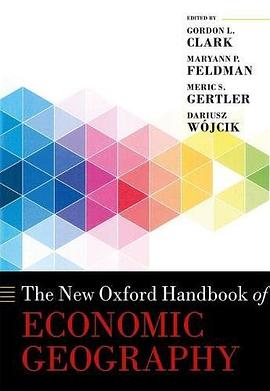
This volume gathers over 50 leading scholars from around the world to offer a forward-looking perspective of economic geography to understanding the various building blocks, relationships, and trajectories in the world economy. The perspective is at the same time grounded in theory and in the experiences of particular places. Reviewing state-of-the-art of economic geography, setting agendas, and with illustrations and empirical evidence from all over the world, the book should be an essential reference for students, researchers, as well as strategists and policy makers.
Building on the success of the first edition, this volume offers a radically revised, updated, and broader approach to economic geography. With the backdrop of the global financial crisis, finance is investigated in chapters on financial stability, financial innovation, global financial networks, the global map of savings and investments, and financialization. Environmental challenges are addressed in chapters on resource economies, vulnerability of regions to climate change, carbon markets, and energy transitions. Distribution and consumption feature alongside more established topics on the firm, innovation, and work. The handbook also captures the theoretical and conceptual innovations of the last fifteen years, including evolutionary economic geography and the global production networks approach. Addressing the dangers of inequality, instability, and environmental crisis head-on, the volume concludes with strategies for growth and new ways of envisioning the spatiality of economy for the future.
作者简介
Gordon L. Clark is the Director of the Smith School of Enterprise and the Environment with cross-appointments in the Said Business School and the School of Geography and the Environment at Oxford University. He holds a Professorial Fellowship at St Edmund Hall, Oxford. His publications include Sovereign Wealth Funds (with Ashby Monk and Adam Dixon, Princeton University Press, 2013), Saving for Retirement (with Kendra Strauss and Janelle Knox-Hayes, OUP, 2012), and Managing Financial Risks (with Ashby Monky and Adam Dixon, OUP, 2009).
Maryann P Feldman is the Heninger Distinguished Professor in the Department of Public Policy at the University of North Carolina. In 2013, she was awarded with the prestigious Global Entrepreneurship Research Award from the Swedish Entrepreneurship Forum and Research Institute of Industrial Economics. Her publications include Dynamic Geographies of Knowledge Creation and Innovation (co-edited with H. Bathelt and D.F. Kogler, Routledge, 2010) and Cluster Genesis (co-edited with P. Braunerhjelm, OUP, 2007).
Meric S Gertler is the President of University of Toronto, and Professor of Geography and Planning. He was also the founding co-director of the Program on Globalization and Regional Innovation Systems (PROGRIS) at the Munk School of Global Affairs. His publications include Manufacturing Culture (OUP, 2004) and Innovation and Social Learning (co-edited with David A. Wolfe, Palgrave, 2002).
Dariusz Wojcik is a Professor of Economic Geography at the School of Geography and the Environment, Oxford University, and Fellow of St Peters College Oxford. His publications include The Global Stock Market (OUP, 2011) and Geography of Finance (with Gordon L. Clark, OUP, 2007).
目录信息
读后感
用户评价
这本书的厚度就足以说明其内容的丰富程度,封面上“新”和“牛津”的字样,更是传递出一种权威性和时效性。我购买这本书的初衷,是希望能够对经济地理学这个学科有一个系统而全面的认识。我设想它会是一本集理论、方法和前沿研究于一体的综合性著作,能够涵盖经济地理学的核心概念,例如空间分析、区位论、区域发展、全球化与地方化等。我特别希望书中能够包含一些对当前全球经济格局进行深度剖析的内容,比如,新兴经济体的崛起对传统发达国家经济地理的影响,以及数字经济时代下,空间因素在新经济发展中所扮演的角色。我期待它能提供一些严谨的研究方法,比如如何运用GIS技术进行空间数据分析,如何构建经济地理模型来预测区域发展趋势。总而言之,我希望这本书能成为我深入理解经济地理学,并将其应用于分析现实经济问题的有力工具。
评分我被这本书的书名所吸引,因为“经济地理学”这个词本身就充满了探索的意味。它暗示着经济活动并非是抽象的、无地域限制的,而是与我们脚下的土地、我们所处的空间紧密相连。这本书,我预想它会像一位经验丰富的向导,带领我穿梭于全球的经济脉络之中。我期待它能描绘出不同区域经济发展模式的独特之处,例如,海洋的通达性是如何催生了港口城市和贸易枢纽,而内陆的地理障碍又会如何影响当地产业的形成与发展。更让我感兴趣的是,书中是否会探讨“地理决定论”是否依然适用,或者说,在当今科技高度发达的时代,人类是否已经能够突破地理条件的限制?我希望它能提供一些关于创新集群、产业生态系统在空间上的分布和演变规律的深刻见解。毕竟,了解经济活动的空间维度,对于理解贫富差距、区域发展不平衡等全球性挑战,至关重要。我期待它能解答我心中关于“为什么经济活动会如此不均匀地分布”的疑问,并能给我带来一些启发。
评分这本书的封面设计就透着一股沉甸甸的学术气息,纸张的触感也相当不错,摸起来是那种有质感的哑光纸,装帧也十分考究,拿在手里感觉很踏实,这对于一本要常翻常查的手册来说,无疑是加分项。我之所以对它感兴趣,是因为我一直觉得经济活动并不是孤立存在的,它深深地根植于地理环境之中,地域差异、空间关系、交通网络等等,都在潜移默化地影响着经济的走向。这本书的名字——“经济地理学新牛津手册”,听起来就像是把这些错综复杂的联系给梳理清楚的利器。我设想它里面会对不同地区在产业发展、资源配置、贸易往来等方面是如何受到地理条件的制约或驱动进行深入的探讨。比如,那些依山傍水的城市,它们的经济发展模式会和广阔平原上的城市有何不同?气候、地形、自然资源的分布,这些看似最基础的地理要素,究竟是如何塑造出千姿百态的经济格局的?我希望能在这本书里找到答案,并且能看到一些最新的研究成果,因为经济地理学这个领域,随着全球化进程的加速和科技的飞速发展,想必也在不断地演进和深化。我期待它能提供一些全新的视角,帮助我理解当前错综复杂的全球经济版图。
评分翻开这本书,我立刻被其严谨的学术风格所吸引。排版非常清晰,目录条理分明,让我能迅速找到自己感兴趣的主题。从书名来看,它似乎是一本专注于经济地理学领域前沿研究的汇编,涵盖了诸如全球化对区域经济的影响、城市化进程中的经济动力、跨国公司的空间策略,以及新兴经济体在世界经济格局中的地位等诸多议题。我尤其对书中关于“空间互动”和“经济集聚”的理论阐释抱有极大的期望。究竟是什么样的地理力量促使产业在某些地区高度集中,形成所谓的“经济引擎”?而这种集聚又会产生哪些积极和消极的效应?书中是否会通过大量的案例分析来印证这些理论?我希望它能提供一些量化的数据和扎实的实证研究,而不仅仅是泛泛而谈的理论推演。同时,作为一个读者,我更希望它能引导我思考,如何在理解这些宏观经济地理现象的同时,也能洞察个体企业或地区在其中扮演的角色,以及如何通过有效的空间规划和政策制定,来优化经济发展。
评分我对《The New Oxford Handbook of Economic Geography》这本书充满了好奇,它传递出一种现代、前沿的气息。我联想到,经济地理学不仅仅是关于地图上的国家和城市,更是关于这些地方是如何在经济活动中相互联系、相互影响,并塑造出我们今天所看到的全球经济格局的。我希望能在这本书中看到一些关于“空间经济学”的最新理论和实证研究,比如,全球价值链的地理分布是如何随着技术和贸易政策的变化而演变的?数字技术(如互联网、大数据)在多大程度上正在改变传统的经济地理模式?书中是否会探讨一些关于“软”地理因素,例如制度、文化、创新网络等,是如何与“硬”地理因素(如资源、交通)共同作用,影响经济发展的?我期待这本书能够提供一些富有洞察力的分析,帮助我理解那些肉眼看不见的、但却真实存在的空间力量,如何塑造着我们生活的经济世界,并或许能为我们应对未来的经济挑战提供一些新的思路。
评分 评分 评分 评分 评分