
具体描述
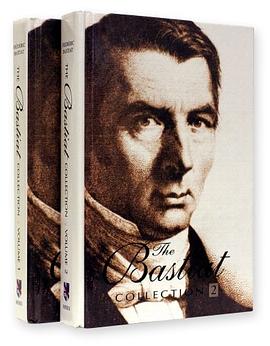
In two volumes, here is The Bastiat Collection, the main corpus of his writings in English in a restored and elegant translation that includes some of the most powerful defenses of free markets ever written. This restoration project has yielded a collection to treasure. After years of hard work and preparation, we can only report that it is an emotionally thrilling moment to finally offer to the general public.
Claude Frédéric Bastiat was an economist and publicist of breathtaking intellectual energy and massive historical influence. He was born in Bayonne, France on June 29th, 1801. After the middle-class Revolution of 1830, Bastiat became politically active and was elected Justice of the Peace in 1831 and to the Council General (county-level assembly) in 1832. He was elected to the national legislative assembly after the French Revolution of 1848.
Bastiat was inspired by and routinely corresponded with Richard Cobden and the English Anti-Corn Law League and worked with free-trade associations in France. Bastiat wrote sporadically starting in the 1830s, but in 1844 he launched his amazing publishing career when an article on the effects of protectionism on the French and English people was published in the Journal des Economistes which was held to critical acclaim.
The bulk of his remarkable writing career that so inspired the early generation of English translators—and so many more—is contained in this collection.
If we were to take the greatest economists from all ages and judge them on the basis of their theoretical rigor, their influence on economic education, and their impact in support of the free-market economy, then Frédéric Bastiat would be at the top of the list.
As Murray N. Rothbard noted: "Bastiat was indeed a lucid and superb writer, whose brilliant and witty essays and fables to this day are remarkable and devastating demolitions of protectionism and of all forms of government subsidy and control. He was a truly scintillating advocate of an untrammeled free market."
These volumes bring together his greatest works and represents the early generation of English translations. These translators were like Bastiat himself, people from the private sector who had a love of knowledge and truth and who altered their careers to vigorously pursue intellectual ventures, scholarly publishing, and advocacy of free trade.
Thus does this collection, totally 1,000 pages plus extensive indexes, represent some of the best economics ever written. He was the first, and one of the very few, to be able to convincingly communicate the basic propositions of economics.
The vast majority of people who have learned anything about economics have relied on Bastiat or publications that were influenced by his work. This collection—possibly more than anything ever written about economics—is the antidote for economic illiteracy regarding such things as the inadvisability of tariffs and price controls, and everyone from the novice to the Ph.D. economist will benefit from reading it.
The collection consists of three sections, the first of which contains his best-known essays. In “That Which is Seen, and That Which is Not Seen,” Bastiat equips the reader to become an economist in the first paragraph and then presents the story of the broken window where a hoodlum is thought to create jobs and prosperity by breaking windows. Bastiat solves the quandary of prosperity via destruction by noting that while the apparent prosperity is seen, what is unseen is that which would have been produced had the windows not been broken.
Professor Jörg Guido Hülsmann credits Bastiat for discovering the counterfactual method, which allowed Bastiat to show that destruction (and a variety of government policies) is actually the path to poverty, not prosperity. This lesson is then applied to a variety of more complex cases and readers will never be able to deny that scarcity exists and will always—hopefully—remember that every policy has an opportunity cost. If nothing else, they will not believe—as is often claimed—that earthquakes, hurricanes, and wars lead to prosperity.
The remaining essays cover the important institutions of society—law, government, money, and capital—where Bastiat explains the nature of these institutions and disabuses the reader of all the common misconceptions regarding them.
The second section is Bastiat’s Economic Sophisms, a collection of 35 articles on the errors of protectionism broadly conceived. Here Bastiat shows his mastery of the methods of argumentation— using basic logic and taking arguments to their logical extreme—to demonstrate and ridicule them as obvious fallacies. In his “Negative Railroad” Bastiat argues that if an artificial break in a railroad causes prosperity by creating jobs for boatmen, porters, and hotel owners, then there should be not one break, but many, and indeed the railroad should be just a series of breaks—a negative railroad.
In his article “An Immense Discovery!” he asks, would it not be easier and faster simply to lower the tariff between points A and B rather than building a new railroad to transport products at a lower cost? His “Petition of the Candlemakers” argues in jest that a law should be passed to require that all doors and windows be closed and covered during the day to prevent the sun from unfairly competing with the makers of candles and that if such a law were passed it would create high-paying jobs in candle and candlestick making, oil lamps, whale oil, etc. and that practically everyone would profit as a result.
The third section is Bastiat’s Economic Harmonies which was hastily written before his death in 1850 and is considered incomplete. Here he demonstrates that the interests of everyone in society are in harmony to the extent that property rights are respected. Because there are no inherent conflicts in the market, government intervention is unnecessary. Here we find a powerful but sadly neglected defense of the main thesis of old-style liberalism: that society and economy are capable of self-managing. Unless this insight is understood and absorbed, a person can never really come to grips with the main meaning of liberty.
VOLUME I
Introduction by Mark Thornton
I. That Which Is Seen, and That Which Is Not Seen
1. The Broken Window
2. The Disbanding of Troops
3. Taxes
4. Theaters and Fine Arts
5. Public Works
6. The Intermediaries
7. Protectionism
8. Machinery
9. Credit
10. Algeria
11. Frugality and Luxury
12. He Who Has a Right to Work Has a Right to Profit
II. The Law
III. Government .
IV. What Is Money?
V. Capital and Interest
1. Introduction
2. Ought Capital to Produce Interest?
3. What Is Capital?
4. The Sack of Corn
5. The House
6. The Plane
7. What Regulates Interest?
VI. Economic Sophisms—First Series
Introduction
1. Abundance—Scarcity
2. Obstacle—Cause
3. Effort—Result
4. To Equalize the Conditions of Production
5. Our Products Are Burdened with Taxes
6. Balance of Trade
7. Petition of the Manufacturers of Candles
8. Differential Duties—Tariffs
9. Immense Discovery
10. Reciprocity
11. Nominal Prices
12. Does Protection Raise Wages?
13. Theory—Practice
14. Conflict of Principles
15. Reciprocity Again
16. Obstruction—The Plea of the Protectionist
17. A Negative Railway
18. There Are No Absolute Principles
19. National Independence
20. Human Labor—National Labor
21. Raw Materials
22. Metaphors
23. Conclusion
VII. Economic Sophisms—Second Series
1. Natural History of Spoliation
2. Two Systems of Morals
3. The Two Hatchets
4. Lower Council of Labor
5. Dearness—Cheapness
6. To Artisans and Workmen
7. A Chinese Story
8. Post Hoc, Ergo Propter Hoc
9. The Premium Theft—Robbery by Subsidy
10. The Tax Gatherer
11. Protection; or, The Three City Aldermen
12. Something Else
13. The Little Arsenal of the Free-Trader
14. The Right Hand and the Left
15. Domination by Labor
Index
VOLUME II
VIII. Harmonies of Political Economy (Book One)
To the Youth of France
1. Natural and Artificial Organization
2. Wants, Efforts, Satisfactions
3. Wants of Man
4. Exchange
5. Of Value
6. Wealth
7. Capital
8. Property—Community
9. Landed Property
10. Competition
Concluding Observations
IX. Harmonies of Political Economy (Book Two)
11. Producer—Consumer
12. The Two Aphorisms
13. Rent
14. Wages
15. Saving
16. Population
17. Private and Public Services
18. Disturbing Causes
19. War
20. Responsibility
21. Solidarity
22. Social Motive Force
23. Existence of Evil
24. Perfectibility
25. Relationship of Political Economy and Religion
Index
作者简介
目录信息
读后感
用户评价
这本书的书架上的名字是《思想的殿堂》,我带着一种对古典自由主义的敬畏和好奇心翻开了它。首先映入眼帘的是对人类精神自由的赞美,作者仿佛是一位手持火把的哲人,在启蒙的迷雾中为我们指引方向。他深入浅出地探讨了个人权利的神圣性,那种对政府过度干预的警惕,以及对自发秩序的坚定信仰,读来让人精神为之一振。特别是书中对于“看不见的手”更深层次的阐释,不再是那种流于表面的经济学口号,而是将其提升到了一种社会伦理的高度。那种强调个体决策累积起来的智慧,远超任何中央计划者的想象,这种论述方式极其细腻,充满了对人类本性的深刻洞察。我尤其欣赏作者在论证过程中所展现出的逻辑严密性,他不像许多当代经济学家那样沉湎于复杂的模型,而是用日常生活中最朴素的例子,构建起坚不可摧的思想高塔。阅读过程中,我时常停下来,细细回味那些精妙的譬喻,它们如同照亮夜空的星辰,让我对自由市场的运作机制有了更加清晰和深刻的理解。这本书不仅仅是经济学的著作,更像是一部关于如何构建一个理性、繁荣和公正社会的行动指南,其文字的力量,足以撼动那些根深蒂固的集体主义偏见。
评分这本书,暂且称之为《理性之光》,给我带来的阅读体验是颠覆性的,它就像一位经验丰富的园丁,耐心地修剪着我脑海中那些杂乱无章的社会观念的枝桠。它的叙事节奏非常舒缓而富有韵律感,不像某些学术著作那样咄咄逼人,反而像是一位智者在壁炉边娓娓道来,带着一种历经沧桑后的平和与确定性。作者对于“干预主义”的批判,简直是入木三分,他并没有简单地指责政策制定者缺乏善意,而是精妙地揭示了在信息不对称和短期激励驱动下,任何看似美好的初衷如何一步步滑向非预期的负面后果。书中关于公共选择理论的早期萌芽思想,虽然没有被明确地贴上标签,但那种对权力集中腐蚀性的警觉,贯穿始终。我特别喜欢其中几章对“租金寻求”行为的描绘,它用生动的场景还原了资源如何被从创造价值的领域转移到分配价值的领域,这种转换过程的隐蔽性和危害性,被作者描摹得淋漓尽致,让人读后感到一种强烈的紧迫感,仿佛置身于一个正在被无形之手蚕食的社会边缘。
评分初翻《真理之鉴》,我差点被它略显古旧的文风劝退,但一旦沉浸其中,便发现其思想的穿透力竟能轻易跨越时代。这本书的风格是那种典型的十九世纪的宏大叙事,充满了对历史经验的总结和对人类文明走向的深沉思考。它探讨的重点似乎更偏向于社会结构和道德基础对经济繁荣的支撑作用,而非纯粹的供需关系。书中对于“财产神圣不可侵犯”的论证,并非简单地停留于法律条文,而是将其上升到了一种维护社会契约、激励长期投资的道德制高点。作者对积累资本和延迟满足的推崇,在如今这个“即时满足”的时代听来,简直像是一剂清醒剂。我注意到,书中对于“价值”的定义非常具有匠心,它超越了市场价格的波动性,回归到劳动投入和风险承担的本源。这种对经济现象背后伦理逻辑的挖掘,使得全书的立意高远,读完后,我感觉自己对财富的产生和分配有了更具重量感的理解,不再是轻易得来的小数目,而是凝聚着时间和智慧的凝固成果。
评分这本厚重的读物,我把它看作是一次思想上的“深度潜水”,它带我进入了一个对人类社会运作机制有着近乎偏执的精确理解的内心世界。作者展现出一种罕见的“结构性思维”,他总是在探究事物表象之下隐藏的因果链条,尤其是那种关于“成本转移”的分析,令人拍案叫绝。例如,当讨论到某种公共福利项目时,作者不会停留在赞美其意图,而是立刻追问:这个福利的资金从哪里来?最终的承担者是谁?这种追问的深度和广度,迫使读者跳出单一视角的限制,从整个社会的资源配置角度去审视问题。全书的论证语言,充满了清晰的界限感和不容置疑的确定性,仿佛作者已经提前预见了未来一百年中可能出现的各种辩论陷阱,并一一布下了破解的密码。它教会我的最重要一课是:任何试图强行改变价格信号的行为,最终都会扭曲人类的行为模式,带来意想不到的社会摩擦。读完之后,我对那些习惯于在统计数据中寻找简单答案的论调产生了本能的怀疑,转而更加相信人类在自由选择中所展现出的复杂而迷人的适应性。
评分这本书给我的感觉是,它是一位经验丰富的航海家,在波涛汹涌的社会思潮海洋中,为我们指明了避开暗礁的航线。它的结构是层层递进的,从对基本经济学原理的坚守开始,逐渐扩展到对政府职能边界的审慎界定。其中有一部分关于“跨国贸易”的论述尤为精彩,作者以极富同情心和逻辑性的笔触,剖析了重商主义的谬误,强调了国际分工带来的互惠互利,这在当时的环境下,需要极大的勇气和远见。我所欣赏的是其始终如一的实用主义倾向,它不追求空中楼阁般的乌托邦设想,而是聚焦于如何在一个充满缺陷的现实世界中,通过最小化的强制力,实现最大化的和谐共存。文字中流淌着一种对普通劳动者的深深的尊重,认为每一个诚实的交易都是对社会贡献的一种体现,这种朴素的立场,在充斥着精英主义论调的当代,显得尤为珍贵和接地气。它鼓励读者以审慎的态度对待任何声称能“一劳永逸”解决所有社会问题的宏大方案。
评分巴斯夏的逻辑与幽默无与伦比。他把一切政治经济谬论驳斥得体无完肤。劲~!
评分说那么多激进的话,就是叫人别管太多。中间utopia喷的还是蛮得人心的。
评分巴斯夏的逻辑与幽默无与伦比。他把一切政治经济谬论驳斥得体无完肤。劲~!
评分说那么多激进的话,就是叫人别管太多。中间utopia喷的还是蛮得人心的。
评分巴斯夏的逻辑与幽默无与伦比。他把一切政治经济谬论驳斥得体无完肤。劲~!