
具体描述
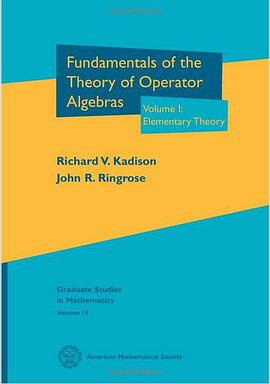
This work and Fundamentals of the Theory of Operator Algebras. Volume II, Advanced Theory present an introduction to functional analysis and the initial fundamentals of $C^*$- and von Neumann algebra theory in a form suitable for both intermediate graduate courses and self-study. The authors provide a clear account of the introductory portions of this important and technically difficult subject. Major concepts are sometimes presented from several points of view; the account is leisurely when brevity would compromise clarity. An unusual feature in a text at this level is the extent to which it is self-contained; for example, it introduces all the elementary functional analysis needed. The emphasis is on teaching. Well supplied with exercises, the text assumes only basic measure theory and topology. The book presents the possibility for the design of numerous courses aimed at different audiences.
Operator Algebras: An Introduction to Algebraic Structures in Functional Analysis This text offers a comprehensive exploration of operator algebras, a cornerstone of modern functional analysis with profound implications across various branches of mathematics and physics. It delves into the foundational concepts and key structures that define this vibrant field, providing readers with a rigorous and intuitive understanding of these powerful mathematical objects. The journey begins with a thorough introduction to $C^$-algebras, the most extensively studied class of operator algebras. We meticulously develop the fundamental properties, including the $C^$-norm, the Gelfand-Naimark-Segal (GNS) construction, and the crucial concept of irreducible representations. The text illuminates the rich representation theory of $C^$-algebras, demonstrating how abstract algebraic properties are intimately linked to concrete geometric and topological structures. The spectral theorem for self-adjoint operators, a central result in functional analysis, is presented in its algebraic setting, showcasing its power and elegance within the framework of operator algebras. We then pivot to explore von Neumann algebras, also known as $W^$-algebras. These algebras, arising naturally from the study of bounded operators on Hilbert spaces, possess a distinct algebraic character and are equipped with a distinguished trace. The book provides a detailed account of their classification into type I, II, and III algebras, introducing the concepts of projections, factors, and the center of a von Neumann algebra. The Tomita-Takesaki theory, a profound development in the structure theory of von Neumann algebras, is presented with careful explanations of modular theory, modular automorphisms, and the central role of the modular conjugation operator. This theory reveals deep connections between algebraic structure and a notion of time evolution, impacting areas like quantum statistical mechanics. The text also dedicates significant attention to the interplay between operator algebras and geometry. It explores how operator algebras can be used to study geometric properties of spaces, particularly through the lens of $K$-theory. Concepts such as the $C^$-algebra of a topological space and its relationship to its continuous functions are explored, laying the groundwork for understanding how algebraic invariants can capture topological and geometric information. The development of $K$-theory for $C^$-algebras provides powerful tools for classifying and distinguishing these algebras, with applications ranging from index theorems to the study of foliations. Furthermore, the book ventures into the study of crossed products, a fundamental construction that allows for the creation of new operator algebras from existing ones and group actions. This construction is instrumental in understanding the structure of many important operator algebras, particularly those arising from symmetries in physical systems or from topological dynamics. We investigate the properties of crossed products in both the $C^$-algebraic and von Neumann algebra settings, highlighting their role in relating the algebraic structure of the crossed product to the properties of the base algebra and the acting group. Throughout the text, emphasis is placed on motivating the abstract concepts with concrete examples drawn from functional analysis, quantum mechanics, and differential geometry. The reader will encounter essential examples such as the algebra of all bounded operators on a Hilbert space, matrix algebras, irrational rotation algebras, and the algebras associated with compact groups and discrete groups. These examples serve not only to illustrate the theoretical constructions but also to showcase the broad applicability and interpretability of operator algebra theory. The text is designed to be accessible to graduate students and researchers with a solid background in functional analysis and a working knowledge of Hilbert spaces and bounded operators. It progresses from foundational principles to more advanced topics, gradually building the reader's expertise. Exercises are interspersed throughout, designed to reinforce understanding and encourage independent exploration of the material. The objective is to equip readers with the necessary theoretical framework and technical skills to engage with contemporary research in operator algebras and its related fields.