
具体描述
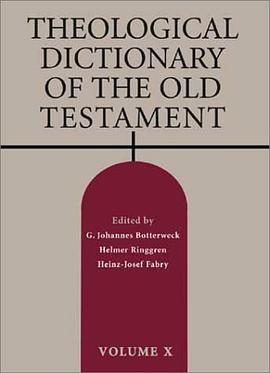
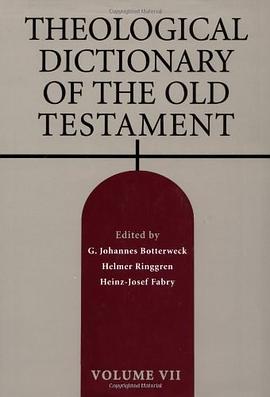
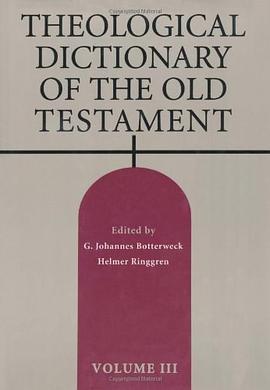
This multivolume work is still proving to be as fundamental to Old Testament studies as its companion set, the Kittel-Friedrich "Theological Dictionary of the New Testament," has been to New Testament studies.
Beginning with "'ābh ('āb)," father, and continuing through the alphabet, the "TDOT" volumes present in-depth discussions of the key Hebrew and Aramaic words in the Old Testament. Leading scholars of various religious traditions (including Roman Catholic, Lutheran, Reformed, Anglican, Greek Orthodox, and Jewish) and from many parts of the world (Denmark, France, Germany, Great Britain, Greece, Israel, Italy, the Netherlands, Norway, Sweden, Switzerland, and the United States) have been carefully selected for each article by editors Botterweck, Ringgren, and Fabry and their consultants, George W. Anderson, Henri Cazelles, David Noel Freedman, Shemaryahu Talmon, and Gerhard Wallis.
The intention of the writers is to concentrate on "meaning," starting from the more general, everyday senses and building to an understanding of theologically significant concepts. To avoid artificially restricting the focus of the articles, "TDOT" considers under each keyword the larger groups of words that are related linguistically or semantically. The lexical work includes detailed surveys of a word?'s occurrences, not only in biblical material but also in other ancient Near Eastern writings. Sumerian, Akkadian, Egyptian, Ethiopic, Ugaritic, and Northwest Semitic sources are surveyed, among others, as well as the Qumran texts and the Septuagint; and in cultures where no cognate word exists, the authors often consider cognate ideas.
"TDOT "s emphasis, though, is on Hebrew terminology and on biblical usage. The contributors employ philology as well as form-critical and traditio-historical methods, with the aim of understanding the religious statements in the Old Testament. Extensive bibliographical information adds to the value of this reference work.
This English edition attempts to serve the needs of Old Testament students without the linguistic background of more advanced scholars; it does so, however, without sacrificing the needs of the latter. Ancient scripts (Hebrew, Greek, etc.) are regularly transliterated in a readable way, and meanings of foreign words are given in many cases where the meanings might be obvious to advanced scholars. Where the Hebrew text versification differs from that of English Bibles, the English verse appears in parentheses. Such features will help all earnest students of the Bible to avail themselves of the manifold theological insights contained in this monumental work.
作者简介
目录信息
读后感
用户评价
作为一名非母语为希伯来语的研究者,我经常发现自己在面对那些复杂的词形变化和罕见的词根时感到吃力。这部工具书在这方面的帮助简直是无价的。它提供的系统性的词汇分析,包括了词根、构词法、以及在不同文体中出现的异形,为语言学习者搭建了一座坚实的桥梁。它不会放过任何一个细微的语言学挑战,比如一些在《七十士译本》中被赋予特殊含义的词汇,作者也会及时地引出希腊文的对照,这对于理解早期基督教对旧约的解释路径同样提供了宝贵的线索。这种跨语言、跨文本的参照系统,极大地提升了研究的效率和广度。我发现,仅仅是跟随着书中对几个关键动词的深入分析,就足以重塑我对特定情境下以色列人行为动机的理解。
评分这部浩瀚的学术巨著,即便是只翻阅其中任何一卷,都足以让人感受到其宏大的视野和深邃的探究精神。我尤其欣赏作者群在处理那些晦涩难懂的旧约希伯来语词汇时所展现出的那种近乎考古学家的细致与耐心。例如,书中对“אֱלֹהִים”(Elohim)的词源学演变、不同文本传统中的用法差异,以及其在古代近东宗教背景下的复杂语境,进行了极为细致的梳理和比较分析。这种处理方式,绝非简单的词典释义,而更像是一场围绕特定概念展开的微型历史与神学研讨会。读者在阅读时,可以清晰地看到一个词汇如何穿越数个世纪的信仰变迁,如何在不同的先知、诗人和律法制定者的笔下被赋予新的层次和重量。这种深度,使得即便是对圣经背景有所了解的研究者,也能从中发掘出全新的洞见。书中的索引和交叉引用系统也设计得极为精妙,极大地便利了那些需要进行深入文本比较的学者,真正体现了“工具书”的最高标准,即在提供坚实基础知识的同时,还能引导使用者进行更广阔的学术探索。
评分阅读这套书的体验,更像是与一群最顶尖的旧约学者进行了一场持续多年的对话。它的论述风格虽然严谨,但字里行间透露出的那种对古代文献的深刻热爱和敬畏感,是极具感染力的。它不是一本轻飘飘的导读手册,而是要求读者付出相应的智力投入,但所获得的回报是知识结构的根本性重塑。每一次查阅,都像是在挖掘一个深埋的宝藏。无论是对于理解古代以色列的社会结构,还是对于厘清犹太教与早期基督教之间的神学分歧,这本书都提供了无可替代的基础性材料和最前沿的学术视角。它存在的意义,不在于提供简单的答案,而在于引导读者提出更深刻、更有穿透力的问题,从而真正进入旧约文本的灵魂深处。
评分老实说,我最初接触这套书时,内心是抱持着一丝敬畏和些许畏惧的。它庞大的篇幅和密集的脚注,初看起来确实有些令人望而却步。然而,一旦沉下心来,逐字逐句地跟随作者的论证脉络,那种“拨云见日”的体验是其他任何辅助读物难以比拟的。我记得我曾为了搞清楚某个与“公义”(צֶדֶק, Tzedek)相关的特定语境下的微妙含义,查阅了数个相关的词条。作者不仅穷尽了该词在《摩西五经》中的主要用法,还细致地对比了它与“正直”(יֹשֶׁר, Yosher)以及“怜悯”(חֶסֶד, Hesed)在语义场上的重叠与分野。这种对概念细微差别的把握,对于准确理解先知文学中那些激昂的道德呼吁至关重要。它强迫你跳出框架化的现代神学理解,真正进入到古代以色列人构建其世界观和伦理体系的思维方式中去。这本书的价值在于,它不仅仅是告知你“这个词是什么意思”,更是告诉你“这个词在那个特定的历史与信仰结构中是如何起作用的”。
评分这本书的排版和装帧,虽然是典型的严肃学术出版物风格,但其内在逻辑的清晰度却令人称赞。对于一个需要频繁在不同词条间跳转进行研究的人来说,这一点尤其重要。我尤其欣赏那些长篇的综述性条目,它们往往不仅仅是对词语的词源考证,更像是对一个核心神学主题在旧约文本中完整叙事线的梳理。举个例子,关于“约”(בְּרִית, Berit)的探讨,作者并未将它视为一个孤立的法律或宗教契约概念,而是将其置于创世、民族身份的建立乃至末世论的期盼之中,展示了它在以色列信仰史上的核心枢纽地位。这种宏观的叙事能力,使得即便是最枯燥的词汇分析,也充满了历史的厚重感和神学上的张力。它避免了将旧约圣经视为一堆零散文本的倾向,而是将其视为一个有机统一的、持续演进的信仰见证。
评分 评分 评分 评分 评分