
具体描述
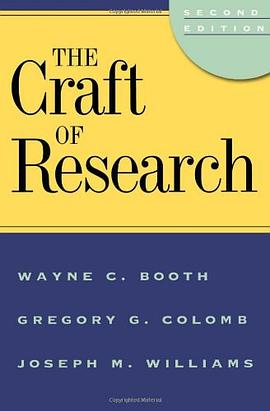
With more than 400,000 copies now in print, The Craft of Research is the unrivaled resource for researchers at every level, from first-year undergraduates to research reporters at corporations and government offices.
Seasoned researchers and educators Gregory G. Colomb and Joseph M. Williams present an updated third edition of their classic handbook, whose first and second editions were written in collaboration with the late Wayne C. Booth. The Craft of Research explains how to build an argument that motivates readers to accept a claim; how to anticipate the reservations of readers and to respond to them appropriately; and how to create introductions and conclusions that answer that most demanding question, “So what?”
The third edition includes an expanded discussion of the essential early stages of a research task: planning and drafting a paper. The authors have revised and fully updated their section on electronic research, emphasizing the need to distinguish between trustworthy sources (such as those found in libraries) and less reliable sources found with a quick Web search. A chapter on warrants has also been thoroughly reviewed to make this difficult subject easier for researchers
Throughout, the authors have preserved the amiable tone, the reliable voice, and the sense of directness that have made this book indispensable for anyone undertaking a research project.
作者简介
Wayne Clayson Booth (1921–2005) was the George M. Pullman Distinguished Service Professor Emeritus in English Language and Literature at the University of Chicago. His many books include The Rhetoric of Fiction and For the Love of It: Amateuring and Its Rivals, both published by the University of Chicago Press. Gregory G. Colomb is professor of English language and literature at the University of Virginia. He is the author of Designs on Truth: The Poetics of the Augustan Mock-Epic. Joseph M. Williams (1933–2008) was professor emeritus in the Department of English Language and Literature at the University of Chicago and the author of Style: Toward Clarity and Grace. Together Colomb and Williams wrote The Craft of Argument. Booth, Colomb, and Williams coedited the seventh edition of Kate L. Turabian’s A Manual for Writers of Research Papers, Theses, and Dissertations.
目录信息
读后感
用户评价
这本书的语言风格是一种成熟学者的沉稳与幽默感的完美结合,读起来非常舒服,丝毫没有那种“说教”的味道。它大量引用了历史上杰出学者的“失败经验”和“转折点”,而不是仅仅展示他们成功的“光环”,这让整个阅读体验充满了人情味和真实感。例如,书中有一段关于如何处理“研究者完美主义倾向”的论述,指出过度追求完美往往是拖延的温床,并鼓励读者要接受“足够好”(Good Enough)的初稿。这种对人性弱点的洞察,让这本书超越了一般的工具书范畴,更像是一部关于学术生涯心理建设的指南。它鼓励我们拥抱迭代和修改的过程,把每一次修改都看作是提升,而不是对既有成果的否定。对我而言,它提供的最大价值是帮助我建立起一个健康、可持续的研究心态,让我能够更从容、更自信地投入到下一个研究项目中去。
评分我得说,这本书的结构设计简直是艺术品级别的精妙。它不是那种按照时间顺序或学科领域的传统方式来组织内容的,而是完全以研究者的“心路历程”为蓝图展开。从最开始的“灵感乍现”,到后来的“文献海洋中的导航”,再到最终“成果的打磨与传播”,每一步都对应着研究过程中最关键的挑战。我特别欣赏它对“论点构建”的细致剖析。许多初学者常常混淆“研究主题”和“核心论点”,这本书用非常清晰的图表和例子解释了,一个好的论点必须具备可辩论性(debatable)、有足够支撑(substantiated)和指向性(focused)。我记得书里有一章专门讲“如何与你的导师或同事有效沟通你的研究”,这在学术圈里简直是无价的技能,它教会你如何用最少的语言,将最复杂的研究意图准确无误地传达出去。这本书的叙事节奏掌握得非常好,从不拖泥带水,每翻过一页,都能感觉到自己的研究能力又被提升了一个档次。
评分这本书的真正价值在于其极强的“操作性”和“工具箱”属性。它没有停留在高屋建瓴的理论阐述上,而是提供了大量实用的技巧和模板。例如,在谈到数据收集和分析时,它并没有局限于某个特定的定量或定性方法,而是提供了一个通用的框架,让你无论采用何种方法,都能确保过程的严谨性。我尤其喜欢它关于“有效笔记”的那一节,它推荐了一种结合了主题标记和交叉引用的笔记系统,极大地提高了我的文献管理效率。在写初稿时,我们常常会遇到“写不下去”的瓶颈,这本书坦诚地指出了这种挫败感是普遍存在的,并提供了一系列突破僵局的策略,比如“先写最熟悉的部分”、“用口头语言描述你的论证链条”等等。这使得研究过程不再是孤军奋战的苦役,而更像是一场有章可循的冒险。它的建议是如此接地气,让我感觉作者真的理解一个正在摸索中的研究者会遇到的所有痛点。
评分我用了好几年时间才意识到,研究的失败往往不在于智力不足,而在于对“不确定性”的处理不当。这本书对“风险管理”在研究中的应用进行了深入探讨,这一点是我在其他任何学术写作指导书中都没有见过的。它讨论了如何预见研究中可能出现的各种“黑天鹅事件”,比如关键数据缺失、理论模型失效,并提前准备好B计划或C计划。这种前瞻性的思维训练,极大地增强了我的学术韧性。此外,关于研究伦理和学术诚信的部分也写得非常到位,它没有用空洞的口号,而是通过具体的情境分析,引导读者思考在道德灰色地带如何做出负责任的判断。阅读这本书的过程,与其说是在学习研究技巧,不如说是在完成一次深刻的“自我学术规范化”的洗礼。它让你明白,一个优秀的研究成果,其背后必须有坚实、无可指摘的道德基础作为支撑。
评分这本书简直是研究者必备的宝典,我花了整整两个周末才啃完,简直是受益匪浅。它不像那些枯燥的教科书,而是像一个经验丰富的老教授在跟你娓娓道来,手把手教你如何构建一个扎实、有意义的研究项目。最让我印象深刻的是它对“问题意识”的强调。很多人在开始研究时,往往急于收集数据或者搜集文献,却忘了最核心的一步:提出一个真正值得回答的问题。这本书用大量生动的案例展示了如何从日常观察中提炼出深刻的研究问题,并且如何不断打磨、聚焦,直到你的问题清晰、具体且具有可行性。它教你的不仅仅是研究方法,更是一种思维方式,一种面对未知世界保持好奇心和批判性思维的态度。读完后,我感觉自己看待文献和信息的方式都有了质的飞跃,不再是浅尝辄止地浏览,而是带着目的性地去解构和吸收。特别是关于文献综述的部分,它清晰地指出了如何避免陷入文献的泥潭,而是要让文献成为你论证的强大支撑,而不是简单的堆砌。
评分"A Manual for Writers" is a combination of "the Craft of Research" and "Style".
评分Very Good
评分recommended by advisor
评分对于真正想进入研究领域的人来说, 或者对做过多年研究想整理思路的人来说, 都是很好的学习材料
评分1. Writing is not the last stage of a project, which should start from the beginning. It is a way to facilitate thinking. 2. Writer is not alone. Writing is an interaction between writers and readers.