
具体描述
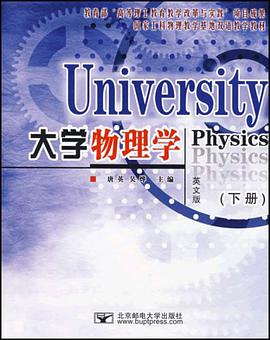
大学物理学(上册 英文版),ISBN:9787563513642,作者:唐英、吴烨
作者简介
目录信息
Part 2 Thermal Physics
Chapter 7 The Kinetic Theory of Gases
Chapter 8 The First Law of Thermodynamics
Chapter 9 the Second Law of
Thermodynamics Part 3 Waves and Optics
Chapter 10 Oscillations
Chapter 11 Waves
Chapter 12 Interference
Chapter 13 Diffraction
Chapter 14 Polarization
Volume 2 Part 4 Electromagnetism
Chapter 15 Electric Charge
Chapter 16 Electric Field
Chapter 17 Gauss Law
Chapter 18 Electric Potential
Chapter 19 Capacitors and Dielectrics
Chapter 20 Magnetic Fields
Chapter 21 Magnetic Fields Due to Currents
Chapter 22 Magnetism of Matter
Chapter 23 Electromagnetic Induction
Chapter 24 Maxwells Equations and Electromagnetic Waves
Part 5 Quantum Physics
Chapter 25 Wave-Particle Duality
Chapter 26 Matter Waves
Chapter 27 Electrons in Atoms
Chapter 28 Electrons in Solids
Chapter 29 Nuclear Physics
Chapter 30 Elementary ParticlesUniversity PhysicsCONTENTS CONTENTSAn Introduction to Physics10-1What Is Physics?1
0-2Applications of Physics 1
0-3Models,Theories,and Laws 2
0-4Vectors3
Chapter
Kinematics61-1Reference Frames and Coordinate Systems
1-2Position and Displacement
1-3Average Velocity and Instantaneous
Velocity
1-4Average Acceleration and Instantane-
ous Acceleration
1-5Straight-Line Motion
1-6Projectile Motion
1-7Circular Motion
1-8Relative Motion
Review & Summary20
Discussion Questions
Problems
Chapter 2
Force and Montion232-1Newtons First Law
2-2Newtons Second Law
2-3Newtons Third Law
2-4Some Particular Forces
2-5Fundamental Forces
2-6Applying Newtons Laws
Review & Summary
Discussion Questions
Problems
Chapter 3
Work and Energy373-1Work and Power
3-2 Work-Kinetic Energy Theorem
3-3Conservative Force
3-4Potential Energy
3-5Calculating the Conservative Force from
the Potential
3-6Conservation of Mechanical Energy
3-7Conservation of Energy
Review & Summary
Discussion Questions
Problems
Chapter 4
Linear Momentum and Collisions554-1The Center of Mass
4-2Newtons Second Law for a System of
Particles
4-3Linear Momentum
4-4Conservation of Linear Momentum
4-5Systems with Varying Mass:A Rocket
4-6Impulse and Linear Momentum
4-7Collisions
Review & Summary
Discussion Questions
Problems
Chapter 5
Rotations of Rigid Bodies725-1The Kinematics of Rotations about
a Fixed Axis73
5-2Kinetic Energy of Rotation
5-3Calculating the Rotational Inertia
5-4Torque
5-5Newtons Second Law for Rotation
5-6Work and Rotational Kinetic Energy
5-7Angular Momentum
5-8Newtons Second Law in Angular Form
5-9Conservation of Angular Momentum
5-10The Spinning Top
Review & Summary
Discussion Questions
Problems
Chapter 6
Special Relativity102 6-1The Einsteins Postulates of Special
Relativity
6-2Space and Time
6-3The Relativity of Simultaneity
6-4The Relativity of Time
6-5The Relativity of Length
6-6The Lorentz Transformation
6-7Some Consequences of the Lorentz
Transformation
6-8The Relativity of Velocities
6-9Spacetime and Causality
6-10Momentum in Special Relativity
6-11Energy in Special Relativity
Review & Summary
Discussion Questions
Problems
Chapter 7
The Kinetic Theory of Gases1277-1Temperature and Thermal Equilibrium
7-2Thermodynamic Variables and the
Equation of State
7-3Pressure and Molecular Motion
7-4The Microscopic Interpretation of
Temperature
7-5The Equipartition of Energy
7-6Mean Free Path
7-7The Distribution of Molecular Speeds
7-8The Boltzmann Distribution
7-9Van der Waals Equation of State
Review & Summary
Discussion Questions
Problems
Chapter 8
The First Law of Thermodynamics1478-1Changes in Thermodynamic Systems
8-2Heat and Work
8-3The First Law of Thermodynamics
8-4Some Special Cases of the First Law of
Thermodynamics
8-5The Molar Specific Heats of an Ideal Gas
8-6The Adiabatic Expansion of an Ideal Gas
8-7Heat Transfer Mechanisms
Review & Summary
Discussion Questions
Problems
Chapter 9
The Second Law of Thermodynamics1669-1The Directionality of Spontaneous
Processes
9-2Change in Entropy
9-3The Second Law of Thermodynamics
9-4Engines
9-5Refrigerators
9-6A Statistical View of Entropy
Review & Summary
Discussion Questions
Problems
Chapter 10
Oscillations18410-1Simple Harmonic Motion
10-2Simple Harmonic Motion and Uniform Circular
Motion
10-3Force Law for Simple Harmonic Motion
10-4Energy in Simple Harmonic Motion
10-5An Angular Simple Harmonic
Oscillator
10-6Pendulums
10-7Combinations of Two Simple Harmonic
Motions
10-8Damped Simple Harmonic Motion
10-9Forced Oscillations and Resonance
Review & Summary
Discussion Questions
Problems
Chapter 11
Waves20511-1Types of Waves
11-2Traveling Waves
11-3Simple Harmonic Wave
11-4Speed of a Traveling Wave
11-5Energy Transported by Waves
11-6Superposition of Waves and Standing
Waves
11-7Sound Waves
11-8Beats
11-9The Doppler Effect
11-10Supersonic Speeds and ShockWaves
Review & Summary
Discussion Questions
Problems
Chapter 12
Interference23212-1Light as a Wave
12-2Youngs Double-Slit Interference
12-3Coherence
12-4Thin-Film Interference
12-5Newtons Rings
12-6The Michelson Interferometer
Review & Summary
Discussion Questions
Problems
Chapter 13
Diffraction25113-1The Diffraction of Light
13-2Single-Slit Diffraction
13-3Diffraction by a Circular Aperture
13-4The Diffraction Grating
13-5X-Ray Diffraction
13-6Holography
Review & Summary
Discussion Questions
Problems
Chapter 14
Polarization
14-1The Polarization States of Light
14-2Polarization by Polarizing Sheets
14-3Polarization by Reflection
14-4Polarization by Scattering
14-5Birefringence
Review & Summary
Discussion Questions
Problems
Appendix A
Some Fundamental Constants of Physics*288Appendix B
Some Astronomical Data289Appendix C
常用数学符号及一些数学式的英语读法290Appendix D
SI Prefixes292ANSWERS to Checkpoints and Problems
Chapter 15Electric Charge
15.1 Electromagnetism
15.2 Electric Charge
15.3 Charge Conservation and Quantization
15.4 Coulomb’s Law
15.5 The Significance of the Electric Force
Review & Summary
Discussion Questions
Problems
Chapter 16Electric Field
16.1 The Electric Field
16.2 Electric Field Lines
16.3 The Electric Field Due to a ContinuousCharge Distribution
16.4 A Point Charge in an Electric Field
16.5 A Dipole in an External Electric Field
Review & Summary
Discussion Questions
Problems
Chapter 17Gauss’ Law
17.1 Electric Flux
17.2 Gauss’ Law
17.3 Applications of Gauss’ Law
17.4 Conductors and Electric Fields
Review & Summary
Discussion Questions
Problems
Chapter 18Electric Potential
18.1 Electric Potential Energy
18.2 Electric Potential
18.3 Equipotential Surfaces
18.4 Calculating the Field from the Potential
18.5 Potentials and Fields around Conductors
Review & Summary
Discussion Questions
Problems
Chapter 19 Capacitors and Dielectrics
19.1 Capacitance
19.2 Capacitors in Parallel and in Series
19.3 Energy in Capacitors and in Electric Fields
19.4 Dielectrics
19.5 Microscopic Description of Dielectrics
19.6 Gauss’ Law with a Dielectric
Review & Summary
Discussion Questions
Problems
Chapter 20 Magnetic Fields
20.1 Magnets and Magnetic Fields
20.2 Magnetic Force on a Moving Charge
20.3 Magnetic Force on a Moving Charge: Applications
20.4 Magnetic Force on a Current.Carrying Wire
20.5 Torque on a Current Loop
20.6 The Hall Effect
Review & Summary
Discussion Questions
Problems
Chapter 21Magnetic Fields Due to Currents
21.1 The Biot-Savart Law
21.2 Ampere’s Law
21.3 Solenoids and Toroids
21.4 The Maxwell Displacement Current
21.5 Magnetic Flux and Gauss’ Law forMagnetism
21.6 Force between Two Parallel Currents
Review & Summary
Discussion Questions
Problems
Chapter 22Magnetism of Matter
22.1 The Effect on Magnetic Fields Due to Magnetic Matters
22.2 Atomic Magnetic Moments
22.3 The Magnetization of Magnetic Materials
22.4 Ferromagnetism
22.5 Magnetism and Superconductivity
Review & Summary
Discussion Questions
Problems
Chapter 23Electromagnetic Induction
23.1 Faraday’s Law of Induction
23.2 Motional Emf
23.3 Induced Emf and Induced Electric Field
23.4 Self.Induction
23.5 Energy in a Magnetic Field
23.6 Mutual Induction
Review & Summary
Discussion Questions
Problems
Chapter 24Maxwell’s Equations and ElectromagneticWaves
24.1 Maxwell’s Equations
24.2 Production of Electromagnetic Waves
24.3 Properties of Electromagnetic Waves
24.4 〖ZK(〗Energy Transport and the Poynting Vector
24.5 Radiation Pressure
24.6 The Spectrum of Electromagnetic Waves
Review & Summary
Discussion Questions
Problems
Chapter 25Wave-Particle Duality
25.1 Planck’s Quantum Hypothesis
25.2 Photon Theory and the Photoelectric Effect
25.3 Photons and the Compton Effect
25.4 Photon Interactions and Pair Production
25.5 Wave Nature of Matter
25.6 The Probability Wave and the Probability Amplitude
25.7 Schrdinger’s Equation
25.8 Heisenberg’s Uncertainty Principle
25.9 Barrier Tunneling
Review & Summary
Discussion Questions
Problems
Chapter 26More About Matter Waves
26.1 Waves on Strings and Matter Waves
26.2 An Electron in an Infinite Potential Well
26.3 An Electron in a Finite Well
26.4 More Electron Traps
26.5 Two. and Three.Dimensional Traps
26.6 The Quantum Oscillator
26.7 Expectation Values
26.8 Observable and Operators
Review & Summary
Discussion Questions
Problems
Chapter 27Electrons in Atoms
27.1 The Hydrogen Atom
27.2 The Exclusion Principle and the Periodic Table
27.3 X.Rays and the Numbering of the Elements
27.4 Magnetic Resonance
27.5 The Laser
Review & Summary
Discussion Questions
Problems
Chapter 28Electrons in Solids
28.1 Free.Electron Theory of Metals
28.2 Band Theory of Solids
28.3 Semiconductors
28.4 The p.n Junction
28.5 The Light.Emitting Diode (LED)
28.6 The Transistor
Review & Summary
Discussion Questions
Problems
Chapter 29Nuclear Physics
29.1 Some Properties of Nuclei
29.2 Binding Energy
29.3 Radioactive Decay
29.4 The Decay Processes
29.5 Nuclear Reactions
29.6 Nuclear Fission
29.7 Nuclear Fusion
Review & Summary
Discussion Questions
Problems
Chapter 30Elementary Particles
30.1 The Fundamental Forces in Nature
30.2 Positrons and other Antiparticles
30.3 Mesons and the Beginning of Particle Physics
30.4 Classification of Elementary Particles
30.5 Conservation Laws
30.6 Strange Particles and Strangeness
30.7 The Quark Model of Matter
30.8 Problems and Perspectives
Review & Summary
Discussion Questions
Appendix A
Some Fundamental Constants of Physics
Appendix B
Some Astronomical Data
Appendix C
常用数学符号及一些数学式的英语读法
Appendix D
SI Prefixes
ANSWERS to Checkpoints and Problems
· · · · · · (收起)
读后感
用户评价
这本书的语言风格非常值得称赞,它成功地在“严谨的学术性”和“平易近人的可读性”之间找到了一个令人赞叹的平衡点。很多物理教材,尤其是翻译版本,读起来常常像是在啃一本晦涩的哲学论著,句子冗长、从句复杂,让人望而却步。然而,这部《大学物理学》的行文却非常清晰、节奏明快。作者擅长使用简洁有力的陈述来界定概念,比如对熵的定义,它没有纠结于复杂的统计推导,而是先给出一个直观的、关于“无序程度”的清晰定义,然后再逐步完善其数学描述。这种先建立直觉理解,再进行精确量化的方法,极大地降低了初学者的心理门槛。读这本书的感觉,就像是有一位经验丰富、耐心十足的导师在你身边,他总是知道你什么时候需要一个形象的比喻来放松一下紧绷的思维,什么时候又必须停下来,仔细推敲一个符号背后的物理意义。这种叙事上的流畅感,使得我阅读的效率大大提高,也让我对物理这门学科本身产生了更深层次的热爱和亲近感。
评分我花了整整一个周末的时间来研读这本书的力学部分,最大的感受是其逻辑构建的严谨性。这本书的处理方式不是那种堆砌公式的“公式大全”型教材,而是非常注重物理思想的传承和逻辑推导的完整性。例如,在介绍能量守恒定律时,作者并没有急于抛出最终的数学表达式,而是从伽利略的落体实验、惠更斯对碰撞的研究开始,一步步引导读者体会“不可变”量的重要性,然后才引入势能和动能的概念,最终推导出系统的总能量守恒。这种历史的、思想的引入,让每一个公式都像是自然而然、水到渠成的结论,而不是凭空出现的“真理”。我在其他一些教材中,常常会因为某个关键的数学跳跃而卡壳,但在这本书里,作者总是会细心地标注出“我们在这里使用了微积分中的链式法则”或者“请回顾第X章中关于矢量场的讨论”,这种前后呼应的写作手法,让知识点之间的联系异常紧密,读起来有一种步步为营、胸有成竹的感觉。这对于那些希望深入理解物理学“为什么是这样”的深度学习者来说,无疑是一大福音。
评分这本书在习题部分的编排上,展现出了一种非常高明的“分层教学”策略。我注意到,每一章节末尾的习题并不是一个扁平的列表,而是清晰地分成了三个等级:基础巩固、概念应用和挑战拓展。基础巩固类的题目大多是公式的直接套用和基本概念的检验,数量适中,能帮助读者迅速建立信心和肌肉记忆。概念应用类的题目则开始引入实际情境,比如计算一个复杂机构的转动惯量,或者分析一个非线性振动系统的稳定性,这些题目迫使你必须将书本知识与现实场景进行有效联接。最让我受益的是“挑战拓展”部分,这些题目往往需要跨章节的知识整合,甚至有些涉及到一些前沿研究领域的简化模型。例如,有一个关于磁流体力学的小挑战,虽然难度陡增,但解答过程极大地激发了我对后续专业课程的期待。更贴心的是,本书的答案解析部分(我借阅的是带有详细解答的版本)对于那些难题的解析,不是简单地写出答案,而是详细阐述了解题的思路和可能遇到的陷阱,这使得习题不再是检验的工具,而是学习和自我纠错的强大平台。
评分这本《大学物理学》的排版真是让人眼前一亮。初拿到书时,就被它那种沉稳而又充满现代感的封面设计吸引住了。内页的纸张质量也相当不错,没有廉价的油墨味,阅读起来非常舒适。更让我惊喜的是,书中的图示和插图简直是教科书级别的典范。那些复杂的物理概念,比如电磁场中的矢量分析,或者量子力学中的波函数图解,以往总是在脑海中盘旋不清,但这本书里的插图清晰、标注精确,配上合理的空间布局,一下子就把抽象的概念具象化了。举个例子,讲解牛顿第二定律时,它不仅给出了公式,还配上了不同受力情况下物体运动轨迹的示意图,甚至还有动态的模拟效果(如果是在电子版中,这种交互性会更强)。这种对视觉体验的重视,极大地减轻了阅读物理教材的枯燥感,让我在学习过程中能保持更高的专注度。作者在图文结合上下足了功夫,这绝不是简单地将文字和图片堆砌在一起,而是经过深思熟虑的教学设计,真正体现了“一图胜千言”的精髓。对于初次接触物理或者希望加深对基础概念理解的读者来说,这种视觉上的友好度,是决定他们能否坚持读下去的关键因素。
评分如果说有什么地方让我觉得可以更加完美,那就是关于实验物理与现代物理交叉部分的深度可以再挖掘一些。虽然本书涵盖了经典力学、电磁学、热力学和基础量子力学,体系庞大且稳固,但对于一些处于学科前沿的“热点”话题的介绍略显保守。例如,在讲到固体物理和半导体时,虽然提到了能带理论,但对于最近十年内微电子学领域的飞速发展,比如石墨烯的电子特性或者拓扑绝缘体的概念,只是点到为止,没有提供深入的阅读引导或者案例分析。我理解大学基础教材需要保持稳定性和普适性,但对于未来科研方向的展望,如果能增加哪怕一到两个专门的小节来介绍这些新兴领域是如何建立在经典物理基础之上的,我想会更具吸引力。这就像是登上了山顶,虽然风景壮阔,但如果能看到通往更高山峰的路径指示牌,读者的探索欲望会更加强烈。不过,瑕不掩瑜,作为一本奠定坚实基础的著作,它无疑是出色的。
评分 评分 评分 评分 评分