
具体描述
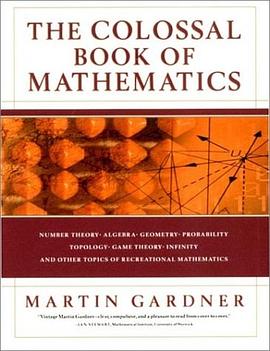
Whether discussing hexaflexagons or number theory, Klein bottles or the essence of "nothing," Martin Gardner has single-handedly created the field of "recreational mathematics." The Colossal Book of Mathematics collects together Gardner's most popular pieces from his legendary "Mathematical Games" column, which ran in Scientific American for twenty-five years. Gardner's array of absorbing puzzles and mind-twisting paradoxes opens mathematics up to the world at large, inspiring people to see past numbers and formulas and experience the application of mathematical principles to the mysterious world around them. With articles on topics ranging from simple algebra to the twisting surfaces of Mobius strips, from an endless game of Bulgarian solitaire to the unreachable dream of time travel, this volume comprises a substantial and definitive monument to Gardner's influence on mathematics, science, and culture. In its twelve sections, The Colossal Book of Math explores a wide range of areas, each startlingly illuminated by Gardner's incisive expertise. Beginning with seemingly simple topics, Gardner expertly guides us through complicated and wondrous worlds: by way of basic algebra we contemplate the mesmerizing, often hilarious, linguistic and numerical possibilities of palindromes; using simple geometry, he dissects the principles of symmetry upon which the renowned mathematical artist M. C. Escher constructs his unique, dizzying universe. Gardner, like few thinkers today, melds a rigorous scientific skepticism with a profound artistic and imaginative impulse. His stunning exploration of "The Church of the Fourth Dimension," for example, bridges the disparate worlds of religion and science by brilliantly imagining the spatial possibility of God's presence in the world as a fourth dimension, at once "everywhere and nowhere." With boundless wisdom and his trademark wit, Gardner allows the reader to further engage challenging topics like probability and game theory which have plagued clever gamblers, and famous mathematicians, for centuries. Whether debunking Pascal's wager with basic probability, making visual music with fractals, or uncoiling a "knotted doughnut" with introductory topology, Gardner continuously displays his fierce intelligence and gentle humor. His articles confront both the comfortingly mundane "Generalized Ticktacktoe" and "Sprouts and Brussel Sprouts" and the quakingly abstract "Hexaflexagons," "Nothing," and "Everything." He navigates these staggeringly obscure topics with a deft intelligence and, with addendums and suggested reading lists, he informs these classic articles with new insight. Admired by scientists and mathematicians, writers and readers alike, Gardner's vast knowledge and burning curiosity reveal themselves on every page. The culmination of a lifelong devotion to the wonders of mathematics, The Colossal Book of Mathematics is the largest and most comprehensive math book ever assembled by Gardner and remains an indispensable volume for the amateur and expert alike.
作者简介
目录信息
读后感
用户评价
这本书的逻辑组织方式,简直就像是工程师在设计一座功能至上的结构体,每一个章节都像是一个坚固的承重柱,彼此之间联系紧密,但连接处的过渡却显得有些生硬。我特别欣赏它在处理某些特定领域时展现出的那种近乎苛刻的严谨性,比如它对集合论基础的阐述,几乎达到了吹毛求疵的地步,每一步推导都无懈可击,让人不得不佩服作者对逻辑纯粹性的追求。但问题在于,这种极致的严谨性,似乎是以牺牲叙事流畅度为代价的。我阅读的时候,常常有一种“飞跃感”,上一页还在讨论几何的直观性,下一页就直接进入了抽象代数的范畴,中间缺少了那种温柔的引导,仿佛作者不耐烦地推了你一把,让你自己去寻找连接点。我理想中的数学著作,应该像音乐的演奏,即使是复杂的对位,也能听出和谐的旋律;而这本书更像是一系列完美的、但排列得过于机械的乐章片段,需要读者自己去努力拼凑出完整的交响乐图景。
评分这本书的装帧真是让人眼前一亮,封面那种深沉的墨绿色调配上烫金的字体,一看就知道是本分量十足的“硬菜”。我最初是冲着它名字里那个“Colossal”去的,心想,能把数学做成“巨著”,里面一定藏着什么不为人知的秘密,或者至少是那种能让人一口气读完、酣畅淋漓的叙事结构。拿到手里的时候,那种厚重感简直了,感觉自己像捧着一块通往知识宝库的砖头。我期待的是那种能把复杂的概念用极其精妙的比喻串联起来的写作手法,最好是那种能让一个对微积分还心存芥蒂的人,读完后能笑着跟邻居炫耀自己弄懂了洛必达法则的故事。我希望它能像一部史诗,不仅仅是罗列公式和定理,而是讲述数学家们在黑暗中摸索、在逻辑的迷宫中穿行,最终找到那束真理之光的过程。如果能有那种引人入胜的轶事穿插其中,那就更妙了,比如某个天才少年如何在一个慵懒的午后,用一支铅笔和一个咖啡渍,推导出了一个影响后世的猜想。总而言之,这本书的“外观”已经成功地勾起了我最原始的好奇心和对深度探索的渴望,它在我的书架上,就像一个沉默的巨人,散发着一种不容置疑的权威感。
评分说实话,当我真正开始翻阅这本书时,那种感觉就像是被突然扔进了一个结构严谨但异常宏大的图书馆,里面摆满了各种语言的古代卷轴和最新的研究报告,但却没有清晰的索引。我原以为它会像一本精心策划的旅行指南,带我领略数学世界的风光,从代数的平原到拓扑的山脉,每一步都有清晰的标记和友善的解说。然而,我发现它更像是一部详尽的原始档案汇编。它似乎默认读者已经具备了相当的数学素养,那些对初学者来说至关重要的“为什么”和“如何开始”的铺垫非常精简,很多时候,它直接就跳跃到了“于是,我们得出”的结论。这种写作风格对那些有一定基础,想要填补知识体系中空白的读者来说,或许是高效的,但对于我这种希望通过阅读来巩固基础,甚至想从根本上理解数学思维的人来说,偶尔会感到一阵强烈的“知识鸿沟”的冲击。我不得不频繁地停下来,掏出手机搜索背景资料,仿佛在阅读一部古老的外星语文献,虽然内容深邃,但解读的门槛实在太高,需要极大的耐心和毅力才能在这片知识的海洋中稳定前行。
评分从阅读的整体体验来看,这本书像是一次需要专业登山装备才能完成的攀登。它提供的工具和地图是顶级的,绝对能带你到达常人难以企及的高度,但攀登的过程本身充满了挑战,需要持续的体力和精神投入。我尤其喜欢其中穿插的一些历史注脚,它们如同在高山上偶尔出现的绿洲,提醒着读者,在这些冰冷的符号和逻辑背后,是人类智慧不屈的奋斗史。然而,这些绿洲出现的频率并不高,大部分时间里,我都在努力解读那些冗长而复杂的定理证明,这些证明往往需要读者具备极高的符号操作能力和抽象思维的敏锐度。读完一章,我获得的成就感是巨大的,但这种成就感往往伴随着心力交瘁的疲惫。这本书的价值毋庸置疑,它是一个知识的宝库,但它不会主动向你敞开大门,你需要用自己的汗水和智慧去撬开它厚重的锁扣。它不是一本可以让你在周末下午轻松翻阅的读物,它更像是需要你签订一份严肃学习契约的伙伴。
评分我注意到这本书的一个非常独特的方面,那就是它对某些数学分支的侧重程度,明显超出了我原先的预期。我本以为会看到一个全面均衡的数学全景图,涵盖从古典数论到现代概率论的广阔天地,但我发现,某些领域(比如某个偏重于纯粹代数结构的章节)占据了大量的篇幅,其深度和广度令人咋舌,仿佛作者对这个领域有着近乎宗教般的虔诚。相反,一些在我看来同样重要的应用数学领域,比如流体力学背后的数学模型,或者统计学中的贝叶斯推断的哲学基础,则只是被轻描淡写地提及,或者被处理得非常简略。这让我不禁思考,这本书的真正受众究竟是谁?它更像是一本为专业学者准备的工具书,用以查阅某一特定领域的深层理论,而不是一本旨在为广大学生提供全面数学教育的教科书。这种选择性的深度挖掘,虽然保证了特定内容的无可替代性,但也使得它在成为一本“包罗万象”的参考书时,显得有些偏科了。
评分 评分 评分 评分 评分