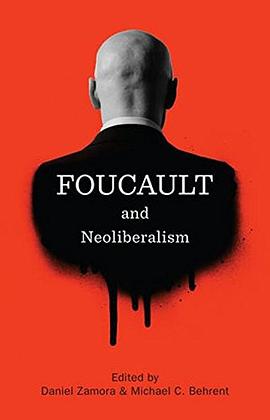

具体描述
Michel Foucault's death in 1984 coincided with the fading away of the hopes for social transformation that characterized the postwar period. In the decades following his death, neoliberalism has triumphed and attacks on social rights have become increasingly bold. If Foucault was not a direct witness of these years, his work on neoliberalism is nonetheless prescient: the question of liberalism occupies an important place in his last works. Since his death, Foucault's conceptual apparatus has acquired a central, even dominant position for a substantial segment of the world's intellectual left.
However, as the contributions to this volume demonstrate, Foucault's attitude towards neoliberalism was at least equivocal. Far from leading an intellectual struggle against free market orthodoxy, Foucault seems in many ways to endorse it. How is one to understand his radical critique of the welfare state, understood as an instrument of biopower? Or his support for the pandering anti-Marxism of the so-called new philosophers ? Is it possible that Foucault was seduced by neoliberalism?
This question is not merely of biographical interest: it forces us to confront more generally the mutations of the left since May 1968, the disillusionment of the years that followed and the profound transformations in the French intellectual field over the past thirty years. To understand the 1980s and the neoliberal triumph is to explore the most ambiguous corners of the intellectual left through one of its most important figures.
作者简介
DANIEL ZAMORA is a PhD candidate at the Free University of Brussels and his work on Foucault has been widely published.
MICHAEL C. BEHRENT is Associate Professor at Appalachian State University.
目录信息
Acknowledgements ix
Introduction: Foucault, the Left, and the 1980s Daniel Zamora 1
1 Foucault and New Philosophy: Why Foucault Endorsed André Glucksmann's The Master Thinkers Michael Scott Christofferson 6
2 Liberalism without Humanism: Michel Foucault and the Free-Market Creed, 1976-1979 Michael C. Behrent 24
3 Foucault, the Excluded, and the Neoliberal Erosion of the State Daniel Zamora 63
4 Foucault, Ewald, Neoliberalism, and the Left Mitchell Dean 85
5 Bourdieu, Foucault, and the Penal State in the Neoliberal Era Loïc Wacquant 114
6 The Unfulfilled Promises of the Late Foucault and Foucauldian "Governmentality Studies" Jan Rehmann 134
7 Michel Foucault and the Spiritualization of Philosophy Jean-Loup Amselle 159
8 The Great Rage of Facts Michel Foucault Michael Scott Christofferson 170
Conclusion: The Strange Failure (and Peculiar Success) of Foucault's Project Michael C. Behrent 176
Index 187
· · · · · · (收起)
读后感
用户评价
The pairing of "Foucault" and "Neoliberalism" in this book's title is, for me, an irresistible invitation to explore the intricate ways in which profound philosophical critique can illuminate contemporary socio-economic structures. Foucault's work, with its deep dives into the history of power and knowledge, has provided a vital vocabulary for understanding how societies are shaped and individuals are constituted. Neoliberalism, as a pervasive and often unquestioned ideology, has become the bedrock of much contemporary policy and thinking. I am deeply curious about the specific analytical threads the author will weave to connect these two domains. I envision a significant portion of the book dedicated to exploring Foucault's notion of "technologies of the self," and how neoliberalism encourages individuals to see themselves as entrepreneurial agents constantly optimizing their human capital. This self-optimization, driven by market imperatives, could be seen as a subtle but powerful form of control, where individuals internalize the logic of competition and efficiency. Furthermore, I am eager to learn how the book will address Foucault's critique of institutions and how this critique is applied to understanding the transformative impact of neoliberal policies on areas like education, healthcare, and the justice system. The prospect of detailed analyses of how market principles are introduced into these sectors, and the subsequent effects on social relations and individual experiences, is particularly appealing.
评分初读《Foucault and Neoliberalism》这本书的标题,我的脑海中立刻浮现出一系列关于“自由”与“控制”、“个体”与“社会结构”的哲学辩论。福柯,这个名字本身就象征着一种对既定权力叙事的解构和对历史系谱学的探究。而“新自由主义”,则是近年来席卷全球的一股强大的经济与政治思潮,它承诺解放市场,削减国家干预,但其背后却孕育着深刻的社会不平等和异化。因此,我无比期待这本书能够像一把锋利的解剖刀,深入剖析福柯的理论工具,如何被用来审视和理解新自由主义的核心逻辑。我设想,书中或许会详细阐述福柯关于“主体化”的观念,解释新自由主义如何塑造出一种“企业家式”的主体,个体被鼓励将自身视为一个投资项目,不断进行自我优化和风险管理,从而在这种看似个体化的追求中,悄然融入了集体的市场规则。我同样好奇,作者会如何连接福柯的“生命政治”理论与新自由主义对人口健康、社会福利的干预。新自由主义的政策,例如私有化医疗、削减社会保障,是否可以被看作是对个体生命及其风险的一种计算和管理,从而实现对人口整体的控制?我希望这本书能够提供具体的历史和现实证据,来支撑这些理论上的推演,而不是停留在抽象的哲学探讨。
评分The very title, "Foucault and Neoliberalism," conjures an image of a intellectual excavation, unearthing the subterranean connections between a radical philosopher's critiques of power and the pervasive ideology shaping our contemporary world. Foucault's work, characterized by its historical depth and its focus on the micro-physics of power, offers a lens through which to examine almost every facet of modern life. Neoliberalism, with its unwavering faith in free markets and individual responsibility, has become the dominant paradigm, influencing everything from economic policy to personal aspirations. I am particularly keen to discover how the author will deploy Foucault's analytical apparatus to dissect the core tenets of neoliberalism. I anticipate a thorough exploration of Foucault's concept of "discipline," and how it manifests in the neoliberal era. For example, are performance evaluations in educational systems, employee assessments within corporations, or even the curated self-presentation on social media all instances of self-discipline under neoliberalism, aimed at more effectively integrating into and adapting to market competition? I am also intrigued by the potential discussion of Foucault's ideas on "surveillance," and whether neoliberalism's embrace of surveillance technologies, data collection, and the prediction and intervention in individual behavior constitutes a new, more sophisticated form of life regulation. I hope this book will provide abundant historical documentation and empirical analysis to support the author's arguments, helping us to more clearly recognize the underlying logic of power at play behind seemingly "free" market mechanisms, and how they shape our lives today.
评分《Foucault and Neoliberalism》这个书名,对我来说,就像是两个看似独立却又彼此纠缠的强大概念的碰撞。福柯的著作,无论是《规训与惩罚》还是《性史》,都以其独特的洞察力揭示了权力如何在微观层面渗透于我们的生活,如何塑造我们的身体、我们的思想,以及我们的欲望。而新自由主义,作为一种经济和政治理念,它宣扬自由市场,强调个人责任,并促成了全球化浪潮下新的社会不平等。我迫切地想知道,作者是如何在这两者之间建立起一座桥梁的。我预设,书中很可能聚焦于福柯的“治理术”(governmentality)这一概念,探讨新自由主义是如何将治理的重心从传统的国家权力转移到一种更为分散、更为内化的、以市场为中介的治理模式。新自由主义的“竞争力”、“效率”等话语,是否就是通过规训和塑造个体行为,使其符合市场逻辑的一种新形式?我同样好奇,作者是否会探讨新自由主义如何利用福柯式的权力分析来巩固自身的合法性,例如,通过强调个体的“选择自由”来掩盖结构性的限制,或者将失败归咎于个体的不努力,而非社会制度的缺陷。这本书的潜力在于,它能够为我们理解当下社会中的各种现象提供一个强有力的理论框架,从教育的商业化到劳动市场的弹性化,从隐私的边界模糊到公共空间的私人化,都可能在新自由主义的视角下,与福柯的思想产生深刻的共鸣。
评分这本《Foucault and Neoliberalism》的书名,首先在我脑海中勾勒出一幅画面:宏大的哲学思想与当下的社会经济现实交织在一起,形成一种既有张力又充满启发的对话。福柯,这位以解构权力、审视历史系谱而闻名的大师,他的思想锋芒毕露,总是能直指现代社会中那些被忽略的角落。而新自由主义,则是近几十年塑造全球格局的重要力量,它对经济、政治、文化都产生了深远影响。我十分好奇,作者将如何运用福柯的工具箱来拆解新自由主义的构成要素。我期待书中能够深入分析福柯的“话语”理论,探讨新自由主义是如何通过建构特定的语言和叙事,来合法化其政策,并影响人们的认知和行为模式的。例如,关于“效率”、“创新”、“个体责任”的强调,是否就是新自由主义话语霸权的体现?我同样对书中可能涉及的福柯的“生命政治”概念感到兴奋,新自由主义下的医疗改革、环境政策、甚至是对人口增长的干预,是否都带有生命政治的印记,即通过对生命本身的调控来达到政治和经济的目的?我希望这本书能够提供足够详实的案例研究,来证明这些理论的联系,从公共服务部门的私有化到劳动力市场的灵活就业,从信息技术的监控到对社会福利的削减,这些现实的变迁,都可能在福柯的理论框架下得到全新的解读。
评分My initial reaction to the title "Foucault and Neoliberalism" was one of intellectual anticipation, imagining a rigorous engagement between two profoundly influential intellectual forces. Foucault, renowned for his deconstruction of power and his genealogical method, offers a critical framework for understanding societal control. Neoliberalism, as a dominant economic and political doctrine, has profoundly shaped global developments in recent decades. I am eager to explore how this book might illuminate the ways in which Foucault's theoretical insights can be applied to understanding the rise and operationalization of neoliberalism. My hypothesis is that the book will likely focus on Foucault's concept of "biopolitics," examining how neoliberal policies, such as healthcare reforms, environmental regulations, and even interventions in population growth, all bear the imprint of biopolitics—that is, the regulation of life itself for political and economic ends. I am also curious about the author's approach to analyzing the specific mechanisms through which neoliberalism constructs and reinforces its hegemonic position. This might involve an examination of how neoliberal discourse, with its emphasis on "individual responsibility" and "market efficiency," subtly normalizes certain forms of social organization and marginalizes others. I would be particularly interested in concrete examples and case studies that illustrate these theoretical connections, demonstrating how Foucault's critical apparatus can offer new perspectives on phenomena ranging from the privatization of public services to the erosion of social safety nets.
评分这本书的封面设计就透着一股子厚重感,深邃的蓝色背景配上烫金的字体,仿佛在预示着内容绝非等闲之辈。我一直对福柯的思想在当代社会中的演变轨迹充满好奇,特别是他那些关于权力、知识、话语的概念,在理解我们当下所处的这个世界时,总能提供一种别样的视角。而“新自由主义”这个词,更是近几十年来频繁出现在我们视野中的经济和社会形态的代名词。将这两者放在一起,自然勾起了我极大的兴趣。我设想着,这本书大概会深入探讨福柯的某些核心理论,比如规训、生命政治,是如何被新自由主义的逻辑所吸收、转化,甚至被用来合理化和推行其政策的。或许作者会剖析新自由主义如何构建一种新的主体性,让个体在看似自由的选择中,实际上却被市场逻辑和社会达尔文主义的幽灵所驱动。我期待着书中能有对具体案例的细致分析,例如医疗、教育、司法体系在新自由主义语境下的变化,以及这些变化背后,福柯式权力运作的痕迹。这本书的名字本身就给我一种强烈的预告:它不仅仅是对某个哲学家的某个时期的理论回顾,更是一次跨越时代的思想对话,一次对现代社会深层结构的一次诊断。我甚至猜测,作者可能会对福柯的思想进行一些批判性的解读,指出其在分析新自由主义时可能存在的局限性,或者提出更具前瞻性的理论框架。
评分这本书的标题《Foucault and Neoliberalism》immediately struck me as a profoundly relevant and timely intellectual undertaking. Foucault's intricate analyses of power, knowledge, and discourse have long provided us with potent tools to scrutinize the structures of modern society. Neoliberalism, on the other hand, represents a dominant economic and political ideology that has shaped our world for decades, promising liberation but often delivering increasing inequality. I am eager to see how this book bridges these two powerful currents. My expectation is that the author will delve deeply into Foucault's concept of "governmentality," exploring how neoliberalism has shifted the focus of governance from the state to more diffuse, internalized, and market-mediated forms. Could the neoliberal emphasis on "competitiveness" and "efficiency" be a new manifestation of discipline and the shaping of individual behavior to align with market logic? I am also curious about whether the book will examine how neoliberalism employs Foucaultian power analysis to solidify its own legitimacy. For instance, by emphasizing individual "freedom of choice" to obscure structural constraints, or by attributing failure to individual lack of effort rather than systemic flaws. The potential of this book lies in its ability to offer a robust theoretical framework for understanding a wide range of contemporary phenomena, from the commodification of education and the flexibilization of labor markets to the blurring of privacy boundaries and the privatization of public spaces, all of which may resonate deeply with Foucault's ideas when viewed through the lens of neoliberalism.
评分From the moment I saw the title "Foucault and Neoliberalism," I recognized the potential for a deeply insightful and critical examination of our contemporary world. Foucault's groundbreaking work on power, knowledge, and the formation of subjectivity has always offered a powerful means to deconstruct dominant narratives. Neoliberalism, as a pervasive ideology shaping global economic and social policies, presents a rich field for such analysis. I am particularly interested in how the book might explore Foucault's concept of "dispositif" (apparatus), and how neoliberalism functions as a complex web of discourses, institutions, and practices that produce specific forms of subjectivity and social relations. I anticipate that the author will explore how neoliberalism, by promoting the idea of the self-regulating market, has effectively privatized many areas of social life, from education and healthcare to even personal well-being, and how Foucault's insights into the history of sexuality and madness might offer critical perspectives on these developments. My hope is that the book will provide a detailed exploration of concrete examples, demonstrating how the principles of neoliberalism are implemented in practice and how they intersect with the power dynamics that Foucault so brilliantly analyzed. The prospect of understanding how individuals are encouraged to embrace risk, manage their own social welfare, and participate in competitive arenas, all under the guise of freedom, is a central reason for my interest.
评分《Foucault and Neoliberalism》——仅仅是书名,就足以让一个对社会理论充满热情的人心潮澎湃。福柯,那个以其颠覆性的思想挑战了我们对权力、知识和主体性的传统理解的哲学家,他的洞见至今仍熠熠生辉。而新自由主义,这个在过去几十年里深刻重塑了全球政治经济格局的意识形态,其影响无处不在。我强烈地预感,这本书将是一次深入的、具有批判性的思想探索,它会把福柯的分析工具应用于理解新自由主义的崛起和运作。我期待作者能够详细阐述福柯的“规训”理论,以及它如何在新自由主义的社会中得以体现。例如,教育体系的绩效评估、企业内部的员工考核、甚至社交媒体上的自我展现,是否都是新自由主义下个体自我规训的表现,目的是为了更有效地融入和适应市场竞争?我同样对书中可能涉及的福柯关于“监管”的思想感到好奇,新自由主义下的监控技术、数据收集、以及对个体行为的预测和干预,是否构成了对生命的一种新型的、更精密的监管?我希望这本书能提供丰富的历史文献和现实分析,来支撑作者的论点,帮助我们更清晰地认识到,在看似“自由”的市场机制背后,潜藏着怎样的权力运作逻辑,以及它们是如何塑造了我们当下的生活。
评分 评分 评分 评分 评分