
具体描述
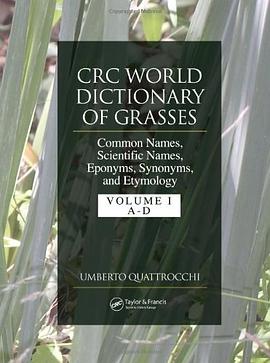
2008 NOMINEE The Council on Botanical and Horticultural Libraries Annual Award for a Significant Work in Botanical or Horticultural Literature "...now we have easier and better access to grass data than ever before in human history. That is a marked step forward. Congratulazioni Professor Quattrocchi!" -Daniel F. Austin, writing in Economic Botany The remarkable work of a brilliant botanist and linguist, this critically acclaimed unparalleled lexicon offers an indispensable guide for all those involved with plants and gardens, whether they are growing, studying, or writing about them. Detailing approximately 800 generic names and thousands of species of grasses, including cereals and forages, this three volume set lists all relevant properties related to the main and secondary uses of the grasses, as well as detailed descriptions and geographical distribution. Entries include genus, synonyms, and etymology, as well as vernacular names, rejected names, and orthographic variants. It provides a huge amount of obscure sources of nearly impossible to find information. Destined to become a seminal resource for those directly involved with botany, plant science, horticulture, and agriculture, this masterly referenced work will also enrich the understanding of any individual in the physical or social sciences who is fascinated with history, the birth of ideas, culture, the art of bibliography, and the evolution of linguistics. Utilizes a Myriad of Resources Cites Tens of Thousands of References The material found in the volumes has been painstakingly gathered from a wide variety of typical and atypical sources that includes both electronic and print media, as well as personal investigation. These sources include papers of general interest, reports and records, taxonomic revisions, field studies, herbaria and herbarium collections, notes, monographs, pamphlets, botanical literature and literature tout court, sources available at various natural history libraries, floras and standard flora works, local floras and local histories, nomenclatural histories, and the International Code of Botanical Nomenclature. Leaving no stone unturned, the author also culled information from reference collections, botanical gardens, museums, and nurseries, dictionaries, drawings, poetry, journal articles, personal communications, and biographies. Much More than a Nomenclature Reference While these volumes serve as the most authoritative and sophisticated nomenclature lexicon ever compiled in this area, it is much more than a dictionary. It offers unique insight across a range of subjects that include the history of botany and botanists, travels and botanical discoveries, the histories of medicine, science, and mankind, the history of genera and species, linguistics, geography, and ethnography. While this information may not be typically found in such references, it's the author's belief that all these details belong to any complete history of botany. Umberto Quattrocchi earned his first degree in political science from the University of Palermo. He followed this achievement with an M.D., specializing in obstetrics and gynecology. In 1992, he retired from the practice of medicine to pursue his studies in botany across the world while teaching as a professor of political science. Highly prolific, Quattrocchi has numerous political and botanical books and articles to his credit, including those on plants and gardening that have been published in Hortus and The Garden. In 1997, he received the prestigious Hanbury Botanical Garden Award promoted by the Premio Grinzane Cavour for his book Piante Rustiche Tropicali. He received a second Hanbury Award for the bestselling CRC World Dictionary of Plant Names. He is a member of the International Dendrology Society, the Royal Horticultural Society, and the Botanical Society of America. He is also an elected Fellow of the world-renowned Linnean Society.
作者简介
目录信息
读后感
用户评价
作为一名对农业史略感兴趣的业余研究者,我总是在寻找那些能提供更深层次背景信息的参考资料,而这本书的深度和广度超出了我的预期。它不仅仅是罗列了各种草类的名称,更像是构建了一个宏大的生态系统图谱。我发现自己不自觉地开始思考这些不同种类的草在全球气候带的分布规律,以及它们在不同文明发展过程中扮演的关键角色。那种将生物学分类与地理学、历史学联系起来的叙事方式,极大地丰富了我对这些常见植物的认知。我甚至开始留意起自家后院里那些不起眼的野草,试图从那些复杂的分类体系中找到它们的一席之地。这种由点及面的探索过程,让人体会到知识的链条是如何环环相扣的,每一个看似微小的生命体背后,都蕴含着深厚的演化历史和环境适应策略。
评分当我合上这本书时,脑海中浮现出的不是枯燥的拉丁词汇,而是广袤草原上风吹麦浪的景象,是热带雨林边缘那些奇特草本植物的生命力。这本书成功地将冷峻的科学分类,与生动的自然体验连接了起来。它有一种魔力,能让你从一个文字符号的集合,过渡到对真实世界中那些韧性十足的生命体的深刻理解。它让人意识到,我们习以为常的“草地”并非单调的背景板,而是一个由无数独特生命交织而成的复杂剧场。这本书的编纂者显然是怀揣着对自然界无尽的热爱和敬畏之心来完成这项浩大工程的,这种情感的渗透,是任何冰冷的数据堆砌都无法比拟的,这也是我推荐它的核心原因。
评分坦白说,我最初对这类专业工具书是持怀疑态度的,觉得它们可能过于学术化,难以消化。然而,这本书的编排逻辑却出奇地清晰流畅。它的索引系统设计得极其人性化,即便是初次接触植物分类学的读者,也能通过多种路径快速定位到所需信息。我试着去查找一种我在野外偶然拍到的不认识的草,通过形态特征描述和地理分布,我很快就锁定了几个疑似目标,然后通过对比细微的结构差异,最终得到了确认。这种“侦探式”的求证过程,让学习过程充满了乐趣和成就感。它没有采用那种晦涩难懂的行话堆砌,而是用非常规范但易于理解的术语构建了一套完整的识别框架,让人感觉自己仿佛拥有了一把解锁自然奥秘的万能钥匙。
评分这本书的价值,绝不仅仅体现在它提供了海量的物种数据上。更令人赞叹的是它对地方性(Endemic)草种的关注力度。很多大型的通用图鉴往往会忽略那些仅在特定微气候或地理区域存在的物种,但这本书却细致地收录了这些“边缘”的成员。这对于生态保护工作者和区域性生物多样性研究来说,是无价的资源。我曾听说,对于一些环境敏感区域的监测来说,对特定优势草种的准确识别是至关重要的第一步,而这本书恰恰提供了最可靠的基准。它传达出一种信息:每一个物种,无论大小,都值得被认真对待和精确记录,这种科学精神令人敬佩。这种对“全面性”的追求,使得这本书超越了普通参考书的范畴,升华为一种区域生态学的深度档案。
评分这本书的装帧和印刷质量着实令人印象深刻,那种厚重的纸张和清晰的排版,拿在手里就有一种知识的沉甸甸的分量感。我本来只是抱着随便翻阅的心态,没想到这一翻,竟然完全沉浸在了那些精妙的插图和详尽的拉丁文学名之中。它不像那种干巴巴的教科书,更像是一本精心制作的植物志,每一页都充满了研究者对细节的执着。光是看着那些草本植物的形态结构图,就已经让人对自然界的精妙设计感到惊叹不已。无论是叶片的脉络,还是花序的排列方式,都描绘得栩栩如生,即便是没有深厚的植物学背景,也能从中感受到那种科学的严谨和艺术的美感。我尤其喜欢它在物种描述中那种精确到毫米的尺寸标注,体现了编纂者一丝不苟的工作态度。这本书的阅读体验,很大程度上来自于它对视觉呈现的重视,让人在学习知识的同时,也是一种视觉上的享受。
评分 评分 评分 评分 评分