
具体描述
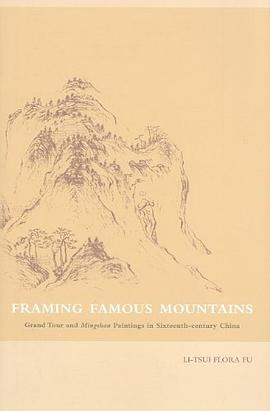
Mingsha, which literally means "famous mountains", refers to a group of mountains in China that have been set apart for special veneration since ancient times. Over the centuries, the "famous mountains" as a conceptual term has been continually (re)invented, (re)framed and (re)appropriated by different ideological systems. Treating landscape painting as yet another framing system, in both the symbolic and material sense, this book examines sixteenth-century paintings of famous mountains by three major artists in the light of a diachronic account of the evolution of famous mountains over time and a synchronic account of the vogue for the grand tour in late Ming society. The author adopts a cultural approach in describing the significance of paintings of famous mountains in late Ming and delves into the cultural imagery of famous mountains and their pictorial representation and artistic presentation. This book helps the reader understand Chinese landscape painting from a new and refreshing perspective.
作者简介
Flora Li-tsui FU (傅立萃) PhD, University of California, Berkeley, 1995
Associate Professor
Tel:2358-8024
Email:hmltfu
学术经历
Professor Fu graduated from National Taiwan University and received her MA and PhD in Art History from University of California at Berkeley. Her dissertation was on the sixteenth and seventeenth century Chinese paintings representing famous mountains and beautiful sights. She taught nineteenth and twentieth-century Chinese painting at the Institute of Art Studies, National Central University, Taiwan, before she came to join HKUST in 1998.
研究旨趣
Research Interests
Twentieth-century Chinese painting; Ming and Qing painting; topographical painting.
发表成果
Representative Publications
Framing Famous Mountains: Grand Tour and Mingshan Paintings in Sixteenth-Century China. Hong Kong: Chinese University Press. (forthcoming)
〈葉澄及其《雁蕩山圖》〉[Ye Cheng and His Picture of Mount Yandang]. In《書畫為寄--趙孟頫國際學術研討會論文集》[Essays for the International Symposium on Zhao Mengfu], ed. by Xu Jiang and Ma Yi. 237-248. Hangzhou: The China Academy of Art Press, 2007.
〈《南國詩人》與高劍父的人物畫〉[‘Poet of the South’ and the Figure Paintings by Gao Jianfu]. In《嶺南畫派創始三家百年大展論文集》[Essays for the Centennial Exhibition on the Three Masters of the Lingnan School], ed. by Li Wanhui. 77-98. Taipei: Au Ho-Nien Culture Foundation, 2007.
〈網絡與認同--嶺南畫派的延續與傳播〉[Network and Identity: The Spread and Perpetuation of the Lingnan School]. In《區域與網絡--近千年來中國美術史研究國際學術研討會論文集》 [Area and Network: Proceedings for the International Conference on a Millennium of Chinese Art Historical Studies]. 701-726. Taipei: National Taiwan University, 2001.
〈吳彬 “仿唐寅萬山松色圖”〉[Landscape after Tang Yin’s Myriad Pines and Mountains by Wu Bin],〈李流芳 “仿元山水冊頁”〉[Landscape in the Style of Yuan Dynasty Masters by Li Liufang],〈馮可賓 “竹石圖”〉[Bamboo and Rocks by Feng Kebin],〈王鐸 “墨蘭圖”〉[Ink Orchids by Wang Duo],〈梅翀 “山水冊頁”〉[Landscape Album by Mei Chong],〈王翬 “山水冊頁”〉 [Landscape Album by Wang Hui],〈石濤 “東坡詩意圖冊”〉[Painting in the Spirit Su Dongpo’s Poems by Shitao]. In《悅目:石頭書屋藏中國晚期書畫》[Enchanting Images: Late Chinese Painting and Calligraphy from the Shih-t’ou Shu-wu Collection]. 28-29, 33-34, 57-59, 76, 92-94, 97-98, 110-112. Taipei: Rock Publishing, 2001.
〈實景山水與疆土論述--七○年代以前中國大陸與台灣的山水畫與政治意識〉[Landscape Discourse and National Identity: Political Meanings in Representations of Specific Places in China and Taiwan 1911-1970s]. In《中華文化百年》[Chinese Culture Centenary]. 93-133. Taipei: National Museum of History, 1999.
〈有關中國繪畫贊助的研究〉[Studies of Patronage in Chinese Painting].《人文學報》[Journal of Humanities East/West] (College of Liberal Arts, National Central University) 15 (December 1997): 55-80.
〈謝時臣的名勝古蹟四景圖--兼談明代中期的壯遊〉[Paintings of Four Famous Views by Xie Shichen: The Vogue of Travel in the Second Half of the Ming Dynasty]. 《國立台灣大學美術史研究集刊》[Taida Journal of Art History] 4 (March 1997): 185-222.
目录信息
Acknowledgements xv
Illustrations xxv
Ideological and Literary Framings of Famous Mountains 3
Pictorial Framings of Famous Mountains before 25
The Vogue for the Grand Tour in Late Ming Society 51
Commemoration of Travel and Travel Painting 83
Xie Shichen and the Four Great Views 109
Paintings of Famous Mountains for a Scholars 147
Conclusion 177
Notes 185
Bibliography 243
IndexGlossary 267
版权
· · · · · · (收起)
读后感
用户评价
这本书的语言风格简直是一场华丽的文字盛宴,充满了古典的韵味和现代的张力。我常常需要放慢语速,细细咀嚼那些句式复杂却又无比流畅的表达。作者似乎对词汇的运用有着近乎偏执的追求,每一个形容词和动词的选择都恰到好处,为整个故事披上了一层精致的、略带忧郁的滤镜。它不像那些追求直白叙事的作品,而是更倾向于用一种诗意盎然的方式来构建世界观。其中对于一些抽象概念的具象化描写,更是达到了出神入化的地步,让那些原本难以捉摸的情感和哲学思辨,变得触手可及。这种对语言美学的极致追求,使得即便是最简单的对话场景,也充满了值得玩味的层次感。老实说,初读时可能需要适应这种略显晦涩的美感,但一旦进入状态,便会发现自己被卷入了一个由优美文字编织而成的梦境之中,难以自拔。
评分从技术层面来看,作者在处理复杂群体场景时的掌控力令人叹服。书中描绘的那些大型集会、历史转折点,其细节之丰富、场面之宏大,仿佛有一部史诗般的交响乐在耳边奏响。每一个小人物的命运都在历史洪流中被清晰地勾勒出来,他们既是个体,也是时代的缩影。这种对群像描写的细腻处理,需要作者具备极强的空间感和对历史的敬畏之心。即便是瞬间出现的配角,其寥寥数语的刻画也栩栩如生,绝不脸谱化。这种对“众生相”的捕捉能力,让整个故事的背景拥有了无与伦比的厚重感和真实感。读完之后,我感觉自己仿佛真的置身于那个特定的时代背景之下,感受到了历史的重量和那些普通人在巨大变迁面前的无力和坚韧。
评分我必须承认,这本书的结构布局非常大胆,挑战了传统小说的线性叙事模式。它采用了多重时间线并行推进的方式,不同的视角和片段如同散落的宝石,需要读者自己去串联起完整的图景。起初,这种跳跃感可能会让人感到一丝迷惘,仿佛手中拿着一幅被打乱的拼图。然而,正是这种主动的参与感,极大地增强了阅读的乐趣。每当我找到一个关键的线索,将两个看似无关的章节联系起来时,那种恍然大悟的喜悦是无与伦比的。作者的这种处理方式,极大地丰富了故事的解读空间,使得每一次重读都能发现新的联系和隐藏的意义。它不仅仅是一个故事,更像是一个复杂的谜题,考验着读者的专注力和逻辑推理能力。最终拼凑出的画面是如此宏大而精妙,足以让人对作者的布局能力感到由衷的敬佩。
评分这本书所探讨的主题深度远远超出了我最初的预期。它没有满足于讲述一个引人入胜的故事,而是深入挖掘了关于记忆、身份认同以及时间流逝的本质性问题。作者非常擅长运用象征和隐喻,将宏大的哲学思考巧妙地融入到角色的日常挣扎之中。我特别喜欢那种淡淡的疏离感,它使得读者在共情角色的同时,又能保持一份审视的距离,从而更清晰地审视那些关于“存在”的疑问。它不是那种会直接给出答案的书,它更像是一个发人深省的引子,在你读完很久之后,依然会在不经意间跳出来,让你思考自己的人生轨迹和选择。这本书需要的不是快速翻阅,而是深夜里,一杯清茶或烈酒相伴,去与之进行一场深刻的内心对话。它对人类精神世界的探索是勇敢且坦诚的。
评分这本书的叙事节奏把握得极佳,仿佛一位经验丰富的老船长,精准地引导着读者的心绪在波澜壮阔的情节中起伏。作者对于人物心理的刻画细腻入微,即便是最微小的犹豫和最深沉的渴望,都能通过精准的文字精准地捕捉到。我尤其欣赏他对于环境描写的笔触,那些山脉、河流和古老的建筑,不仅仅是背景板,它们本身就拥有了鲜活的生命力,与故事中的角色们产生了复杂而深刻的共鸣。阅读过程中,我常常被那种扑面而来的真实感所震撼,仿佛我就是故事中的一员,亲身经历了那些爱恨交织、生离死别的瞬间。这种沉浸式的体验,是很多当代作品所欠缺的,它要求读者慢下来,去品味每一个词语背后的深意,去感受角色们内心的挣扎与蜕变。特别是书中后半段,情节的转折设计得极其巧妙,既在意料之外,又在情理之中,让人在掩卷长思时,仍能感受到那份经久不散的震撼。
评分 评分 评分 评分 评分