
具体描述
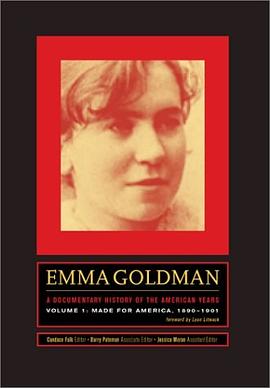
"Emma Goldman: A Documentary History of the American Years" redefines the historical memory of Emma Goldman and illuminates a forgotten yet influential facet of the history of American and European radicalism. This definitive multivolume work, which differs significantly from Goldman's autobiography, presents original texts - a significant group of which are published in or translated into English for the first time - anchored by rigorous contextual annotations. The distillation of years of scholarly research, these volumes include personal correspondence, newspaper articles, government surveillance reports from America and Europe, dramatic court transcripts, unpublished lecture notes, and an array of other rare items and documentation. Biographical, newspaper, and organizational appendixes are complemented by in-depth chronologies that underscore the complexity of Goldman's political and social milieu. The first volume, "Made for America, 1890-1901", tracks the young Emma Goldman's introduction into the anarchist movement, features her earliest known writings in the German anarchist press, and charts her gradual emergence from the radical immigrant circles of New York City's Lower East Side into a political and intellectual culture of both national and international importance. Goldman's remarkable public ascendance is framed within a volatile period of political violence: within the first few pages, Henry Clay Frick, the anti-union industrialist, is shot by Alexander Berkman, Goldman's lover; the book ends with the assassination of President William McKinley, an act in which Goldman was falsely implicated. The documents surrounding these events shed light on difficult issues - and spark an important though chilling debate about Goldman's strategy for reconciling her 'beautiful vision' of anarchism and the harsh realities of her times. The documents articulate the force of Goldman's rage, tracing the development of her political and social critique as well as her originality and her remarkable ability to synthesize and popularize cutting-edge political and cultural ideas. Goldman appears as a rising luminary in the mainstream press - a voice against hypocrisy and a lightning rod of curiosity, intrigue, and sometimes fear. The volumes include newspaper accounts of the speaking tours across America that eventually established her reputation as one of the most challenging and passionate orators of the twentieth century. Themes that came to dominate Goldman's life - anarchism and its possibilities, free speech, education, the transformative power and social significance of literature, the position of labor within the capitalist economic system, the vital importance of women's freedom, the dynamics of personal relationships, and strategies for a social revolution - are among the many introduced in Made for America.
作者简介
目录信息
读后感
用户评价
这本书给我的印象,是一种强烈的、近乎眩晕的“陌生感”。我原以为自己对那个历史阶段有所了解,但作者的叙述方式,完全打破了我既有的认知框架。他大量引用了第一手文献和民间书信,使得文本充满了烟火气和未经修饰的粗粝感。尤其是关于艺术审查制度的那部分内容,描述得极其辛辣,那种在僵化体制下,艺术家们如何用各种隐晦的、甚至是双关的方式来表达不满,简直是高超的文字游戏。我仿佛能听到那些压抑的笑声和无声的抗议。作者似乎对“异见者”有着一种近乎迷恋的关注,他笔下的那些不被主流社会接纳的人物,都不是脸谱化的英雄或罪人,而是充满矛盾、犯着错误但又无比真实的个体。阅读过程中,我常常感到一种强烈的共情,不是因为我认同他们的所有观点,而是因为作者成功地将他们从历史的尘埃中拉了出来,让我们看到了他们作为“人”的脆弱和坚韧。这本书读完后,我感觉我的世界观被轻轻地推了一下,原本以为平坦的地面,其实布满了看不见的断层。
评分这本书的结构非常大胆,它不像传统传记或历史著作那样线性推进,反而采取了一种碎片化、拼贴画式的叙事策略。作者似乎在有意地打乱时间线,将不同时期、不同地域的事件并置,以此来强调某种跨越时空的普遍困境。这种手法极大地考验了读者的理解力,因为你需要自己去建立事件之间的逻辑关联。其中有一部分内容,是关于不同社群对“进步”概念的不同理解的对比分析,这种对比极其犀利,揭示了许多看似一致的口号背后,实际隐藏的利益冲突和文化隔阂。作者没有给我们提供一个清晰的路线图,反而把我们扔进了一个充满回声的巨大空间,所有的声音都在互相反射和扭曲。这使得阅读体验更像是一次主动的考古挖掘,你需要不断地从散落的文物中重构出完整的历史场景。这种阅读的挑战性,正是这本书的魅力所在——它要求读者放弃被动接受的姿态,转而成为一个积极的意义建构者。它让我意识到,理解历史,远比记住事实要困难得多。
评分读完这本厚厚的书稿,我最大的感受是它的“重量感”。这不仅仅指物理上的重量,更是指它所承载的历史信息密度和思辨深度。作者似乎是一位深谙社会学和心理学的老练观察家,他用一种近乎冷峻的笔调解剖了当时社会结构中那些最细微的裂痕。比如,书中对工人阶级教育运动的描述,不是简单的口号式赞美,而是深入到具体的教材内容、师资力量的匮乏以及实际受教者心态变化的复杂过程。我特别留意了作者对“激进”一词的多次重新定义,他似乎在不断地追问:何为真正的激进?是街头口号的呐喊,还是对既有思维范式的彻底颠覆?这本书的语言风格极其精准,充满了精确的术语和严密的逻辑推导,读起来像是在啃一块极富营养的硬骨头,需要不断地查阅背景资料来辅助理解。但正是这种不妥协的学术态度,让这本书在众多同类题材的作品中脱颖而出,它不是提供一个简单的答案,而是强迫读者去面对问题的复杂性本身。它像一把精密的解剖刀,剖开了那个时代的诸多“政治正确”表象之下的真实肌理。
评分坦率地说,这本书的文学性远超我的预期。我原本以为这会是一本枯燥的政治史或思想史的综述,但作者的叙事功力极其高超。他擅长使用象征性的意象和重复的主题来构建起整部作品的内在张力。比如,书中反复出现的“玻璃穹顶”和“看不见的墙”,它们象征着社会阶层和思想禁锢的无形壁垒,每一次提到,都伴随着角色命运的转折点。作者的句式变化多端,时而如密集的鼓点,时而如悠长的咏叹调,让阅读过程本身成为一种情绪的起伏。更令人称奇的是,书中对人际关系的描写,特别是知识分子群体内部的微妙权力斗争和友谊的脆弱性,刻画得入木三分。那些微妙的眼神、未说出口的试探,比直接的冲突描写更具杀伤力。这本书不是在向你灌输知识,而是在邀请你进入一个复杂的情感迷宫,你需要自己去辨认哪些是真诚,哪些是伪装。我合上书本时,脑海中浮现的不是年份和法令,而是那些在昏暗灯光下,神色各异的面孔。
评分这本书的封面设计,说实话,第一眼看过去,那种古典的字体配上略显斑驳的米黄色背景,立刻就给人一种穿越时空的感觉。我当时在书店里随便翻阅,只是被这种“老派”的美学吸引了。内容上,我发现它对19世纪末到20世纪初欧洲知识分子的精神困境描摹得极其细腻。作者似乎对那些在启蒙思想的余晖下挣扎的个体怀有一种深切的同情,但又不失冷静的批判。尤其有一章专门探讨了咖啡馆文化对个体思想解放的作用,那种对特定历史环境下知识交流场所的细节还原,简直就像是给我打开了一扇活的历史窗口。我尤其欣赏作者在叙事中穿插的那些充满哲理性的独白,它们不像刻意的说教,更像是角色内心深处自然流淌出的对自由与体制的思考。读完后,我脑子里挥之不去的是那种浓郁的、略带霉味的旧纸张气息,以及那些在理性至上时代里,被理性挤压到边缘的,关于人性、欲望和非主流情感的低语。这本书的节奏是缓慢而沉稳的,它不追求情节上的跌宕起伏,而是着力于气氛的营造和内在世界的挖掘,读起来需要耐心,但回报是丰厚的——一种对“旧世界”如何孕育“新思想”的深刻理解。
评分 评分 评分 评分 评分