
具体描述
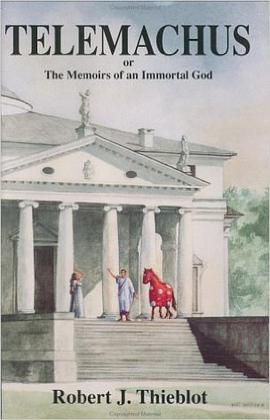
Telemachus comprises the memoirs of Telemachus who was born in Athens about the year 314 B.C. He is of semidivine origin, having the mortal Demetrius of Phaleron for a father and the goddess Xanthippe of Paestum for a mother.
Demetrius of Phaleron was a peripatetic philosopher, author and politician who was made governor of Athens by Cassander of Macedon in 318 B.C. Driven from power ten years later, he sought refuge in Alexandria. Telemachus was thus raised in Alexandria, something he refers to in his memoirs, but only in passing. Xanthippe of Paestum is a goddess of Magna Graecia, the Greek diaspora into southern Italy. She has to a considerable measure overcome her obscure origins by her beauty and intelligence. Zeus finds her fetching and accords her privileges she would not otherwise have. This has caused resentment in Hades, Lord of the Underworld. His antipathy extends to her son as well, whom he accuses of meddling in human (mortal) affairs. The gods know that men create gods, not gods men. They, in fact, differ little from their creators, except that they are incorporeal, and by reason of that, immortal. Their power over men is the power of illusion.
In the heaven of the immortal gods reigns Zeus (Jupiter to the Latins) who is addressed as "Patroisos" (Father). From behind a mask of affability he jealously guards his power and would be ruthless in suppressing dissent.
It was in the early Roman Empire that the gods became alarmed by the proliferation of religious ideas of a largely irrational, fantastic and redemptory nature. They feared this adulteration would extend to themselves, that mortals would imagine them in a different way, and as imagined they would be changed.
When Patroisos learned of the Emperor Commodus (A.D. 161-192) shuffling humbly behind the priests of Isis cradling in his arms the image of a monkey god, he knew the time had come to disengage. The result was the Decree of Separation, which in essence forbids immortals congress with mortals. To the extent the gods maintain a presence among mortals, it is only one of surveillance-absent exceptional circumstances. The decree has much incommoded Telemachus, who finds the heaven of the gods boring and yearns to observe the human condition.
The memoirs commence with an audience with Patroisos and end with one. The period is about a year, January 1794-January 1795. The reason for the first audience is the report of an odd occurrence in a France theretofore deemed safely Christian. Patroisos speaks of Lutetia. Telemachus knows he means Paris. What happened in Paris was the crowning of a Goddess of Reason in what had been the Cathedral of Notre Dame. Telemachus, as he learns to his delight, is to be sent to explore this dangerous phenomenon. In fact, it was just a matter of anti-Christian posturing by the atheist Hebert and his "enrages," the most extreme of French Revolutionary factions.
In this and other audiences, Patroisos and Telemachus are given to dissimulation. Patroisos pretends Telemachus finds association with mortals unpleasant and claims he much regrets the necessity of sending him forth into the real world (the world of mortals) to do this or that. When he orders him home, he thanks him profusely. Telemachus, for his part, plays upon his master's fears, exaggerates the danger to Olympian institutions posed by mortals' thoughts about the gods, and is quite prepared to concoct stories to frighten his master, to the enlargement of his liberty.
Telemachus is very aware that power corrupts. He is unabashedly republican, believing a well ordered republic best for the protection of liberty. That the gods are different from men, the created from their creators, he knows to be false. Yet, nowhere in the memoirs does he suggest that anything other than absolutism (the absolutism of Patroisos) is appropriate for the immortal gods. What constrains him is fear. That he is himself subject to institutions which accord no right to liberty may well explain his strong preference for liberty and its protections in mortal affairs.
Much of the memoirs are retrospective. While they begin and end in the French Revolution, they cover much more. "It was," as Telemachus put it, "the rebirth of learning which, as it liberated mortals, liberated me." The year was 1340 and what frightened Patroisos was garbled intelligence of the doings of Petrarch, a mortal in love with the past, with classical antiquity, possibly then also with the religion of classical antiquity, the religion of the Olympian gods. It was a fear Telemachus was to feed. Given by a frightened master an exemption from the Decree of Separation, he was to spend nearly 250 years in the real world of his delight, free to do there nearly whatever he liked. In that time he served various popes, intervened in the political affairs of Florence, studied and admired the Venetian Republic, and also studied its opposite, as it were, the tyranny of the Ottoman Turks. As a Knight Hospitaler, he would resist them on Malta and be present at Lepanto, witness to the victory there. Sent to France in the spring of 1794, he actually arrived after the death of Hebert (guillotined at the instigation of Robespierre). Conspiring with the terrorist Fouche, he set about the destruction of Robespierre and Saint-Just. Succeeding in that, he threw himself into post-Thermidorian politics, but was too soon thereafter recalled.
In the audience that ends the memoirs, Patroisos and Telemachus (typically) view the world in different ways. Patroisos is pleased, but not because the Robespierrist tyranny has come to an end. He is pleased because the end of Robespierre ended also his cult of the Supreme Being. Telemachus is very aware that this Supreme Being was but an oddity of the megalomania of Robespierre and no threat to Olympus. Yet, smiling knowingly, he does nothing to dispel the useful delusion of the Father of the Gods.