
具体描述
IEEE DS Online Exclusive Content
Book Reviews
The Tech Hotlist: Grid Computing and P2P
Milan Lathia • Gridalogy and University of Illinois at Urbana-Champaign
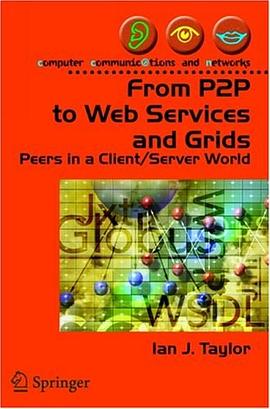
From P2P to Web Services and Grids: Peers in a Client Server World
By Ian J. Taylor
275 pages
US$64.95
Springer, 2004
ISBN: 1-852-33869-5
P2P (peer-to-peer) and grid computing are hot new technologies that have been
touted by the media and are popular in academic and industrial circles. From P2P
to Web Services and Grids: Peers in a Client Server World provides a
comprehensive, updated review of the new and improved distributed computing
technology formed by the union of computing and communications.
As Ian J. Taylor points out, he wrote the book primarily for university students.
It’s written like a textbook, and very well, too. You need a computing foundation
and some familiarity with grid computing to grasp all the concepts. The book does,
however, give a good overview of the technology before delving too deeply into
the details. Each chapter builds the technical know-how needed for the next one.
Taylor is a professor at the University of Cardiff. The book is based largely on his
online notes on P2P and distributed systems, which have been valuable to many
students, including me. In addition, the book explains in detail recent technologies
such as JXTA, Jini, Globus, and Freenet. Taylor also gives security, a rising </P>
concern with grid computing, the attention it deserves. He provides additional
references for each chapter if you need more detail.
The book has four parts: Distributed Environments; Middleware, Applications, and
Supporting Technologies; Middleware Deployment; and From Web Services to
Future Grids. The distributed-environments section works as an orientation and an
introduction to many grid-computing-related concepts. It talks about P2P (peer-topeer),
Web services, and grid-computing technologies. It covers the concept of
distributed computing and P2P, their history, the technology, and academic and
industrial applications. The grid-computing chapter is well written, with good
information on the Globus Toolkit and the grid architecture. This section sets the
tone of the book by introducing and explaining the basic principles of distributed
computing—the backbone of P2P and grid computing.
The second section explores several well-known P2P and distributed computing
technologies such as Jini and JXTA. Taylor uses code snippets to simplify many
complex concepts used in these technologies. He also introduces signatures,
encryption, and other related technologies. The analogical and simplified
explanations of key concepts such as virtual organization, network topology, and
addressing are well done. Additionally, this section details Gnutella and Freenet,
two of the most popular P2P file-sharing mechanisms. Although neither Taylor nor
I support illegal file sharing, I do appreciate the system’s architecture and design.
His explanation does justice to file-sharing software concepts and technology. This
section also looks in depth at concerns such as scalability and security. Not many
authors have written in detail about security for grid computing.
The third section includes chapters on several demo applications and code
examples for using different technologies in grid computing. You can download
and run the sample code from the companion Web site. The section details and
demonstrates the power of Jini, JXTA, and related Web services. </P>
The final section covers various grid technologies. Services based on the Grid
Computing Architecture and OGSA (Open Grid Services Architecture) reintroduce
the notion of "state to a Web service.” P2P and grid computing are becoming
extremely popular and require much effort in terms of standardization. The section
also brings up issues such as the drawbacks of OGSI (Open Grid Services
Infrastructure).
The book is an easy read and makes many complex concepts easy to
understand. Its small size encouraged me to bring it along during business trips.
The book explains and correlates many P2P and grid-related concepts. Being in
the grid-computing business, I own many books on the subject, and From P2P to
Web Services and Grids: Peers in a Client Server World is a valuable addition to
my collection.
The book is a must for all grid-computing professionals and a good read for
enthusiasts and those who are curious about the technologies.
Milan Lathia is the president of Gridalogy, a grid software services and research company, and a
master’s student at the University of Illinois at Urbana-Champaign. Contact him at
milan@gridalogy.com.
Related Links
l DS Online's Peer-to-Peer Community
l DS Online's Grid Computing Community
l "A Loosely Coupled Vision for Computational Grids"
l "A Scalable P2P Platform for the Knowledge Grid" </P>
Cite this article:
Milan Lathia, "The Tech Hotlist: Grid Computing and P2P," review of From P2P to Web Services and
Grids: Peers in a Client Server World by Ian J. Taylor, IEEE Distributed Systems Online, vol. 6, no. 11,
2005. </P>
</P>
作者简介
目录信息
读后感
用户评价
对于那些长期在软件架构领域工作的人士来说,这本书无疑是一份非常及时的回顾与展望。它将跨越二十年的技术演进轨迹清晰地呈现在我们面前,使我们能够更好地定位我们目前所处的位置,并预见可能的下一个技术热点。尤其是在处理大规模数据传输和异构系统互操作性的章节中,作者对当前业界主流解决方案的局限性的剖析,发人深省。它没有给出“万能药”,而是系统地指出了当前架构设计中那些尚未被完全解决的“灰色地带”。我感觉自己仿佛完成了一次系统的“技术体检”,对自身知识体系中的薄弱环节有了清晰的认识。这本书的价值不在于教会你最新的API用法,而在于提升你对计算基础设施本质的理解深度。它是一块坚实的基石,为那些渴望在技术领域走得更远的人们,提供了不可或缺的理论支撑和历史参照系。
评分这本书的语言风格可以说是非常克制和精确,充满了工程师特有的那种不浪费一个多余词汇的习惯。它很少使用夸张的形容词或煽动性的语句,所有的论断都建立在扎实的技术事实和逻辑推演之上。我特别欣赏作者在回顾历史技术时所保持的客观姿态,没有对任何一种架构进行“一言堂”式的褒贬。例如,在讨论到网格计算与后来Web服务的迭代关系时,作者清晰地指出了两者在资源管理哲学上的差异,以及为什么某些特性在特定应用场景下被保留或被抛弃。这种冷静的分析使得读者能够独立思考,形成自己的判断。阅读这本书的过程中,我经常停下来,拿起一张白纸,试图自己画出系统交互的流程图,这种主动参与式的学习方式极大地加深了我的理解。它鼓励的不是被动的知识接收,而是主动的知识重构过程,这对于技术人员的长期发展至关重要。
评分这本书的阅读体验,坦率地说,对我来说是一次智力上的马拉松。它的内容深度远超我最初的预期,尤其是在探讨Web服务标准化的过程中,作者对于SOAP、WSDL以及RESTful架构的对比和批判性分析,展现了极高的专业水准。我花了相当长的时间来消化其中关于面向服务架构(SOA)的哲学基础和实际部署的陷阱。作者并没有回避那些复杂的标准化博弈和商业利益驱动下的技术选择,而是以一种近乎历史学家的口吻,客观地记录了这些技术标准是如何确立其主导地位的。读到关于服务编排和业务流程管理(BPM)如何嵌入到这些服务体系结构中时,我深刻体会到软件工程在构建大规模、高可靠性系统时所面临的复杂性。整本书的结构组织得非常巧妙,从底层网络结构到上层应用协议,再到最终的计算资源池化,逻辑链条紧密相连,没有一丝松懈。这种由点及面、由微观到宏观的叙事风格,使得读者在获得知识的同时,也能建立起一个完整、立体的技术知识体系框架。
评分这本书的封面设计给我留下了非常深刻的印象,那种深邃的蓝色调和简洁的字体排版,立刻让人联想到高精尖的科技前沿。我是在一个偶然的机会接触到这本书的,当时我对网络架构的演进历史非常感兴趣,尤其是从早期的点对点(P2P)技术如何一步步过渡到如今主流的Web服务和网格计算。翻开这本书,我首先感受到的是作者严谨的学术态度和对技术脉络清晰的梳理能力。它并非那种浮于表面的技术综述,而是深入剖析了每一次技术范式转变背后的驱动力、核心协议的创新点以及实现这些架构时所遇到的实际工程挑战。比如,书中对P2P网络中如何解决去中心化环境下的数据一致性和可发现性问题,进行了非常细致的数学模型推导和案例分析,这对于理解分布式系统的基础至关重要。那种层层递进的论述方式,仿佛带着读者亲自走过每一个技术发展的关键路口,让人感到既充实又振奋。我尤其欣赏作者在跨领域技术融合时的洞察力,它不仅仅是简单地罗列技术名词,而是将它们置于一个宏大的计算范式变革的背景下进行考察,使得即便是那些看似已经过时的技术,也能焕发出新的理解光芒。
评分我必须承认,这本书的某些章节具有相当的学术挑战性,特别是涉及分布式事务处理和高可用性设计的部分。我记得有那么一个下午,我反复对照着图示和公式,试图完全理解在异步消息传递环境下如何保证“恰好一次”的语义。作者在处理这些疑难杂症时,展现出一种令人敬佩的细致和耐心,他会先提出一个理想化的模型,然后逐步引入现实世界的约束(如网络延迟、节点故障),最终导出一个在工程上可行的折中方案。这本书不仅仅是一本技术手册,更像是一份关于“如何进行复杂系统设计”的哲学探讨。它让我开始重新审视那些我们现在习以为常的云计算服务,认识到它们背后的理论根基是多么深厚且来之不易。对于那些希望从纯粹的“实现者”转变为“架构师”的工程师来说,这本书提供的思维工具箱是无价的。它教会我的不是如何敲击某一行代码,而是如何从根本上思考计算资源的分配、通信的可靠性以及系统的韧性。
评分 评分 评分 评分 评分