
具体描述
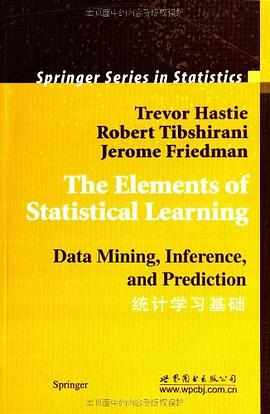
计算和信息技术的飞速发展带来了医学、生物学、财经和营销等诸多领域的海量数据。理解这些数据是一种挑战,这导致了统计学领域新工具的发展,并延伸到诸如数据挖掘、机器学习和生物信息学等新领域。许多工具都具有共同的基础,但常常用不同的术语来表达。《统计学习基础(第2版)(英文)》介绍了这些领域的一些重要概念。尽管应用的是统计学方法,但强调的是概念,而不是数学。许多例子附以彩图。《统计学习基础(第2版)(英文)》内容广泛,从有指导的学习(预测)到无指导的学习,应有尽有。包括神经网络、支持向量机、分类树和提升等主题,是同类书籍中介绍得最全面的。
《统计学习基础(第2版)(英文)》可作为高等院校相关专业本科生和研究生的教材,对于统计学相关人员、科学界和业界关注数据挖掘的人,《统计学习基础(第2版)(英文)》值得一读。
作者简介
作者:(德国)T.黑斯蒂(Trevor Hastie)
目录信息
1 Introduction Overview of Supervised Learning
2.1 Introduction
2.2 Variable Types and Terminology
2.3 Two Simple Approaches to Prediction: Least Squares and Nearest Neighbors
2.3.1 Linear Models and Least Squares
2.3.2 Nearest-Neighbor Methods
2.3.3 From Least Squares to Nearest Neighbors
2.4 Statistical Decision Theory
2.5 Local Methods in High Dimensions
2.6 Statistical Models, Supervised Learning and Function Approximation
2.6.1 A Statistical Model for the Joint Distribution Pr(X,Y)
2.6.2 Supervised Learning
2.6.3 Function Approximation
2.7 Structured Regression Models
2.7.1 Difficulty of the Problem
2.8 Classes of Restricted Estimators
2.8.1 Roughness Penalty and Bayesian Methods
2.8.2 Kernel Methods and Local Regression
2.8.3 Basis Functions and Dictionary Methods
2.9 Model Selection and the Bias-Variance Tradeoff
Bibliographic Notes
Exercises
3 Linear Methods for Regression
3.1 Introduction
3.2 Linear Regression Models and Least Squares
3.2.1 Example:Prostate Cancer
3.2.2 The Ganss-Markov Theorem
3.3 Multiple Regression from Simple Univariate Regression
3.3.1 Multiple Outputs
3.4 Subset Selection and Coefficient Shrinkage
3.4.1 Subset Selection
3.4.2 Prostate Cancer Data Example fContinued)
3.4.3 Shrinkage Methods
3.4.4 Methods Using Derived Input Directions
3.4.5 Discussion:A Comparison of the Selection and Shrinkage Methods
3.4.6 Multiple Outcome Shrinkage and Selection
3.5 Compntational Considerations
Bibliographic Notes
Exercises
4 Linear Methods for Classification
4.1 Introduction
4.2 Linear Regression of an Indicator Matrix
4.3 Linear Discriminant Analysis
4.3.1 Regularized Discriminant Analysis
4.3.2 Computations for LDA
4.3.3 Reduced-Rank Linear Discriminant Analysis
4.4 Logistic Regression
4.4.1 Fitting Logistic Regression Models
4.4.2 Example:South African Heart Disease
4.4.3 Quadratic Approximations and Inference
4.4.4 Logistic Regression or LDA7
4.5 Separating Hyper planes
4.5.1 Rosenblatts Perceptron Learning Algorithm
4.5.2 Optimal Separating Hyper planes
Bibliographic Notes
Exercises
5 Basis Expansions and Regularizatlon
5.1 Introduction
5.2 Piecewise Polynomials and Splines
5.2.1 Natural Cubic Splines
5.2.2 Example: South African Heart Disease (Continued)
5.2.3 Example: Phoneme Recognition
5.3 Filtering and Feature Extraction
5.4 Smoothing Splines
5.4.1 Degrees of Freedom and Smoother Matrices
5.5 Automatic Selection of the Smoothing Parameters
5.5.1 Fixing the Degrees of Freedom
5.5.2 The Bias-Variance Tradeoff
5.6 Nonparametric Logistic Regression
5.7 Multidimensional Splines
5.8 Regularization and Reproducing Kernel Hilbert Spaces . .
5.8.1 Spaces of Phnctions Generated by Kernels
5.8.2 Examples of RKHS
5.9 Wavelet Smoothing
5.9.1 Wavelet Bases and the Wavelet Transform
5.9.2 Adaptive Wavelet Filtering
Bibliographic Notes
Exercises
Appendix: Computational Considerations for Splines
Appendix: B-splines
Appendix: Computations for Smoothing Splines
6 Kernel Methods
6.1 One-Dimensional Kernel Smoothers
6.1.1 Local Linear Regression
6.1.2 Local Polynomial Regression
6.2 Selecting the Width of the Kernel
6.3 Local Regression in Jap
6.4 Structured Local Regression Models in ]ap
6.4.1 Structured Kernels
6.4.2 Structured Regression Functions
6.5 Local Likelihood and Other Models
6.6 Kernel Density Estimation and Classification
6.6.1 Kernel Density Estimation
6.6.2 Kernel Density Classification
6.6.3 The Naive Bayes Classifier
6.7 Radial Basis Functions and Kernels
6.8 Mixture Models for Density Estimation and Classification
6.9 Computational Considerations
Bibliographic Notes
Exercises
7 Model Assessment and Selection
7.1 Introduction
7.2 Bias, Variance and Model Complexity
7.3 The Bias-Variance Decomposition
7.3.1 Example: Bias-Variance Tradeoff
7.4 Optimism of the Training Error Rate
7.5 Estimates of In-Sample Prediction Error
7.6 The Effective Number of Parameters
7.7 The Bayesian Approach and BIC
7.8 Minimum Description Length
7.9 Vapnik Chernovenkis Dimension
7.9.1 Example (Continued)
7.10 Cross-Validation
7.11 Bootstrap Methods
7.11.1 Example (Continued)
Bibliographic Notes
Exercises
8 Model Inference and Averaging
8.1 Introduction
8.2 The Bootstrap and Maximum Likelihood Methods
8.2.1 A Smoothing Example
8.2.2 Maximum Likelihood Inference
8.2.3 Bootstrap versus Maximum Likelihood
8.3 Bayesian Methods
8.4 Relationship Between the Bootstrap and Bayesian Inference
8.5 The EM Algorithm
8.5.1 Two-Component Mixture Model
8.5.2 The EM Algorithm in General
8.5.3 EM as a Maximization-Maximization Procedure
8.6 MCMC for Sampling from the Posterior
8.7 Bagging
8.7.1 Example: Trees with Simulated Data
8.8 Model Averaging and Stacking
8.9 Stochastic Search: Bumping
Bibliographic Notes
Exercises
9 Additive Models, Trees, and Related Methods
9.1 Generalized Additive Models
9.1.1 Fitting Additive Models
9.1.2 Example: Additive Logistic Regression
9.1.3 Summary
9.2 Tree Based Methods
10 Boosting and Additive Trees
11 Neural Networks
12 Support Vector Machines and Flexible Discriminants
13 Prototype Methods and Nearest-Neighbors
14 Unsupervised Learning
References
Author Index
Index
· · · · · · (收起)
读后感
统计学习的经典教材,数学难度适中,英文难度较低,看了其中有监督学习部分,无监督学习部分没怎么看,算法比较经典,但是也比较老。
评分读 ESL 快半年了,也读了差不多1/3,写个短评记录一下,等读完的时候再来改吧。然后简单对比下基本常见的机器学习教材。 我本科是学物理的,对于统计甚至概率论可以说是一无所知。入门的时候读的是周志华老师的《机器学习》,不过并没有读完的。一方面在家看书效率太低;另一...
评分 评分https://esl.hohoweiya.xyz/index.html ==========================================================================================================================================================
评分https://esl.hohoweiya.xyz/index.html ==========================================================================================================================================================
用户评价
这本书给我的最大感受就是“细致”。很多时候,我们在学习算法时,会遇到一些似懂非懂的地方,比如某个参数的含义,某个条件的设置,可能只是稍微带过。但在这本书里,作者会把这些细节都抠得很清楚。举个例子,在讲到正则化的时候,它不仅仅是给出了L1和L2正则化的公式,还会详细解释它们各自有什么优缺点,分别在什么时候更适用,以及它们是如何影响模型的泛化能力的。还有关于模型评估的部分,不仅仅是列出准确率、召回率这些指标,还会深入讲解这些指标的局限性,以及如何根据具体的业务场景选择合适的评估指标,甚至还会提到一些更高级的评估方法,比如交叉验证。读到这里,我才意识到,原来模型评估不仅仅是计算几个数字,里面还有这么多讲究。这些细节的讲解,让我觉得这本书的作者是一位真正用心在教学的人,他站在读者的角度,把那些容易被忽略的关键点都帮我们梳理清楚了。
评分我之前接触过一些机器学习的课程,感觉很多时候都是在讲“怎么做”,而这本书更多地是在讲“为什么这么做”。它不仅仅是介绍算法的步骤,更重要的是解释算法背后的数学原理和统计思想。比如,在讲解决策树的时候,它会详细分析信息增益、基尼系数等概念的由来,以及它们是如何帮助我们选择最优分裂点的。这种对原理的深入挖掘,让我觉得自己在学习过程中,能够建立起一个非常牢固的理解,而不是对算法“知其然,不知其所以然”。当我遇到新的、不熟悉的算法时,我也会尝试用这本书中讲解的思路去分析它,理解它的核心思想和工作原理。这种举一反三的能力,是我在这本书中最大的收获之一。
评分我一直认为,学习任何知识,都需要有“内功”和“外功”。“内功”就是基础理论,“外功”就是实践应用。很多书可能只侧重其中一方面,要么理论枯燥乏味,要么实践脱离理论。但《统计学习基础》在这方面做得相当平衡。它在讲解理论的同时,会不断地引导你思考这些理论在实际问题中的应用。虽然这本书本身不直接提供代码实现,但它对算法的讲解非常透彻,让我自己在动手写代码时,能够做到心中有数。比如,在讲到支持向量机(SVM)的时候,它不仅详细解释了核函数的概念和原理,还分析了不同核函数对模型性能的影响,这让我自己在选择核函数时,有了一个理论上的指导。甚至在尝试不同的参数设置时,我都能根据书中的原理,去预测可能的结果,而不是盲目地尝试。这种理论指导实践的能力,是我在这本书中收获最大的。
评分总的来说,这本书是一本非常值得推荐的统计学习入门和进阶书籍。它不仅在理论上讲得非常透彻,而且在逻辑上也非常清晰,在语言上也非常流畅。它能够帮助读者建立起一个坚实的统计学习理论基础,并为进一步深入学习和实践打下良好的基础。我个人觉得,这本书非常适合那些希望系统学习统计学习,但又苦于找不到一本好书的读者。它不仅仅是一本书,更像是一位循循善诱的良师益友,在我学习的道路上给予我宝贵的指导和启发。即使是已经有一些机器学习基础的读者,也能从中获得不少启发,找到自己知识体系中的薄弱环节,并加以弥补。
评分这本书我早就想买来着,一直犹豫着,看到推荐说讲得特别透彻,就下定决心入手了。拿到手沉甸甸的,很有质感,封面设计也挺别致的,一看就是本正经的书。我一直对数据分析和机器学习很感兴趣,但总觉得理论知识不够扎实,很多算法都是模模糊糊的,遇到实际问题就卡壳。这本《统计学习基础》从名字就能看出它在基础理论上的侧重,所以我特别期待它能帮我建立起一个坚实的知识体系。翻开书的第一章,就被它严谨的逻辑和清晰的讲解吸引住了。作者并没有一开始就抛出复杂的公式和模型,而是从最基本的概念讲起,比如什么是统计学习,它解决的核心问题是什么,有哪些主要的学习范式。即使是初学者,也能很容易地理解。而且,它并不是那种干巴巴的理论堆砌,而是穿插了大量的例子,这些例子都非常有代表性,能够帮助我直观地理解抽象的概念。我尤其喜欢它在讲解过程中引入的一些思考题,虽然没有直接给出答案,但能引导我去主动思考,加深对内容的理解。总的来说,第一遍读下来,感觉它像一位循循善诱的老师,耐心而细致地把我领进了统计学习的大门,让我对这个领域有了全新的认识。
评分这本书的章节安排和内容递进也做得非常出色。它从最基础的统计学习概念开始,然后逐步深入到各种经典的算法和模型。每一章的内容都与前一章紧密相连,层层递进,没有出现那种突然跳跃或者前后矛盾的情况。而且,作者在讲解过程中,还会适当地回顾前面学过的知识,帮助读者巩固记忆。我喜欢它循序渐进的学习方式,不会一开始就给读者太大的压力,而是让读者能够在一个比较舒适的环境下,逐步掌握复杂的概念。读完这本书,你会发现自己对统计学习的整体脉络有了非常清晰的认识,从宏观的模型体系到微观的算法细节,都有了比较全面的理解。
评分我一直很喜欢那些能“启发思考”的书,而不是那种“填鸭式”灌输知识的书。这本书就属于前者。它在讲解过程中,会提出一些开放性的问题,引导我去思考,去探索。比如,在讨论偏差-方差权衡的时候,它会让你思考,什么时候我们应该更关注降低偏差,什么时候又应该更关注降低方差,以及如何通过模型的选择和调整来实现这种平衡。这些问题没有标准答案,但它们能促使我深入地思考问题的本质,而不是仅仅停留在表面的概念上。我还会时不时地停下来,翻回前面的章节,或者去查阅一些相关的资料,试图回答这些问题。这种主动学习的过程,让我感觉自己不仅仅是在被动接受信息,而是在主动构建知识体系。这种体验,是我读很多书时都很难获得的。
评分我一直觉得,要真正掌握一门技术,光看代码是不够的,必须深入理解背后的原理。尤其是机器学习,涉及到大量的数学知识,什么概率论、线性代数、微积分,这些东西我虽然大学学过,但很多都还给老师了。读这本《统计学习基础》之前,我有点担心自己数学基础不够,怕看不懂。但事实证明,我的担心是多余的。作者在讲解算法的时候,并不是直接搬出那些让人头疼的数学推导,而是会先用通俗易懂的语言解释算法的直观思想,然后再逐步引入数学公式,并对每一个符号、每一个步骤都进行详细的解释。而且,它还会介绍这些数学工具是如何帮助我们理解算法的性质、分析算法的优劣的。我特别喜欢它对一些经典算法的讲解,比如线性回归、逻辑回归,不仅仅是给出公式,还会从统计学的角度去分析模型的假设、误差的来源,以及如何进行模型评估和选择。这些内容让我觉得,不仅仅是在学习一个算法,更是在学习一种解决问题的思路和方法。读完关于回归模型的部分,我对如何建立一个有效的预测模型有了更清晰的认识,也明白了为什么有时候模型效果不佳,可能是哪些环节出了问题。
评分我平时阅读技术书籍,最怕的就是那种“翻译腔”特别重,读起来很不通顺的书。但《统计学习基础》的语言非常流畅自然,即使是讨论比较深奥的理论,也不会让人感觉晦涩难懂。作者的遣词造句都非常精准,能够准确地表达出技术含义,同时又保持了很好的可读性。我特别喜欢它在讲解一些复杂概念时,使用的比喻和类比,这些都非常形象生动,能够帮助我快速抓住问题的关键。即使是那些我之前完全不了解的领域,读完相关的章节,我也能大概理解它在讲什么,以及它在这个领域中的地位和作用。
评分我对这本书的另一个印象深刻的点是它的“严谨性”。作者在讲解每一个概念,每一个定理的时候,都会给出严格的数学定义和证明。这对于我这种喜欢刨根问底的人来说,简直是福音。很多时候,我们在学习中会遇到一些“约定俗成”的说法,但在这本书里,作者会告诉你这些说法的来源,以及它们背后的数学依据。比如,在讲解最大似然估计的时候,它会详细推导似然函数的定义,以及如何通过最大化似然函数来估计参数。这种严谨的数学推导,让我对机器学习模型有了更深层次的理解,也让我能够更有信心地去使用这些模型。即使有些推导过程看起来比较复杂,但作者会一步一步地讲解,并且会用图示辅助说明,所以即使是数学基础不是特别扎实的读者,也能理解。
评分Statistical Learning 最经典的入门教材。很多Machine Learning的书,没有关注太多模型背后的原理。但是要做好Machine Learning,这些必不可少。另,Youtube上可以搜到Hastie和小伙伴前些年的授课视频。
评分Will be a classic
评分Statistical Learning 最经典的入门教材。很多Machine Learning的书,没有关注太多模型背后的原理。但是要做好Machine Learning,这些必不可少。另,Youtube上可以搜到Hastie和小伙伴前些年的授课视频。
评分Will be a classic
评分Will be a classic